Impact of Digital Learning Tools on Student Performance in Science: A Comparative Study in Two High Schools in Yaounde
DOI:
https://doi.org/10.65150/EP-jsshrs/V2E3/2026-19Keywords:
Digital learning tools, educational technology, academic performance, biology, secondary education, software tutorialAbstract
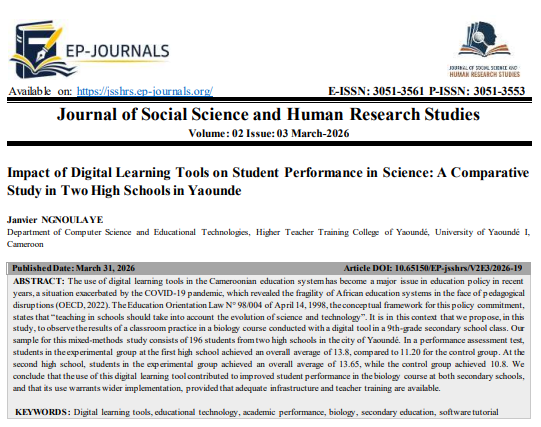
The use of digital learning tools in the Cameroonian education system has become a major issue in education policy in recent years, a situation exacerbated by the COVID-19 pandemic, which revealed the fragility of African education systems in the face of pedagogical disruptions (OECD, 2022). The Education Orientation Law N° 98/004 of April 14, 1998, the conceptual framework for this policy commitment, states that “teaching in schools should take into account the evolution of science and technology”. It is in this context that we propose, in this study, to observe the results of a classroom practice in a biology course conducted with a digital tool in a 9th-grade secondary school class. Our sample for this mixed-methods study consists of 196 students from two high schools in the city of Yaoundé. In a performance assessment test, students in the experimental group at the first high school achieved an overall average of 13.8, compared to 11.20 for the control group. At the second high school, students in the experimental group achieved an overall average of 13.65, while the control group achieved 10.8. We conclude that the use of this digital learning tool contributed to improved student performance in the biology course at both secondary schools, and that its use warrants wider implementation, provided that adequate infrastructure and teacher training are available.
References
1) ADEA (2022). Synthesis Report of the 2022 Triennial: Digital Transformation of Education in Sub-Saharan Africa. Association for the Development of Education in Africa. https://www.adeanet.org
2) Aesaert, K., Vanslambrouck, S., & Van Braak, J. (2022). The influence of ICT use and related attitudes on students' math and science performance: Multilevel analyzes of the last decade's PISA surveys. Large-Scale Assessments in Education, 10(1), 1–28. https://doi.org/10.1186/s40536-022-00128-6
3) Baga, P. (2012). Development of a prototype computerized learning environment and functional validation with a clientele of secondary school students and teachers in Burkina Faso [Doctoral dissertation, University of Sherbrooke]. HDL. http://hdl.handle.net/11143/6379
4) Bakonga, JB (2021). Pedagogical uses of digital tools in the classroom, technological skills and academic motivation in secondary education in Cameroon: A comparative study of institutional and individual characteristics [Doctoral dissertation, CY Cergy Paris University]. HAL. https://theses.hal.science/tel-03633583
5) Béché, S. (2014). On the didactics of digital uses. European University Editions. https://hal.science/hal-01023590v2
6) Canopé (2021). Contributions of virtual experimentation in science. Canopé Network. https://www.reseau-canope.fr/agence-des-usages/apports-de-lexperimentation-virtuelle-en-sciences.html
7) De Hoop, T., Ring, H., Siwach, G., Dias, P., Tembo, G., Rothbard, V., et al. (2023). Impact of technology-aided activity-based learning approaches on learning outcomes: Experimental evidence from community schools in rural Zambia. Journal of Research on Educational Effectiveness. https://doi.org/10.1080/19345747.2023.2268072
8) eLearning Africa. (June 14, 2012). Africa's choice: digitize its traditional knowledge or lose its culture and development. http://www.elearning-africa.com/eLA_Newsportal/fr/123/
9) El Abboud, H., Osman, A., & Khoury, R. (2021). Modeling Educational Virtual Environments by Lebanese Secondary School Biology Teachers for Constructivist Learning. Journal of Educational Sciences. https://doi.org/10.7202/1077621ar
10) Hillmayr, D., Ziernwald, L., Reinhold, F., Hofer, SI, & Reiss, KM (2020). The potential of digital tools to enhance mathematics and science learning in secondary schools: A context-specific meta-analysis. Computers & Education, 153, Article 103897.
https://doi.org/10.1016/j.compedu.2020.103897
11) Karsenti, T., Collin, S., & Harper-Merrett, T. (2011). Pedagogical integration of ICT: Successes and challenges of 100+ African schools. IDRC.
12) Klotz, H. (2005). ICT and motivation in language learning/teaching: A Canadian perspective. Cahiers de l'APLIUT, 24(2), 53–73.
https://doi.org/10.4000/apliut.3086
13) Koul, L. (1972). Educational research methodology. Vicace House Publishing.
14) Marsden, E., & Torgerson, C.J. (2012). Single group, pre- and post-test research designs: Some methodological concerns. Oxford Review of Education, 38(5), 583–616. https://doi.org/10.1080/03054985.2012.731208
15) Menkoué, P. (2013). Digital textbooks for Africa. Cursus. http://cursus.edu/article/20314/des-manuels-scolaires-numeriques-pour-afrique/
16) MINESEC (2022). Strategic framework for basic education and the digitalization of teaching in Cameroon. Ministry of Secondary Education, Yaoundé.
17) Morales-López, Y., Morales-López, S., & García-Martínez, I. (2022). Educational technology and student performance: A systematic review. Frontiers in Education, 7, Article 916502. https://doi.org/10.3389/feduc.2022.916502
18) Nafidi, Y., Maarouf, H., Bouhafa, A., & El-Batri, B. (2018). Educational virtual environments for teaching life and earth sciences: a literature review. International Journal of Technologies in University Pedagogy, 15(1), 40–52.
19) Ngnoulayé, J., & Gervais, C. (2015). Uses of ICTs and academic training of Cameroonian students. International Journal of Technologies in University Pedagogy, 12(3), 36–50. https://doi.org/10.18162/ritpu-2015-v12n3-03
20) Ngnoulayé, J., & Lepage, M. (2017). Influence of ICTs on student learning at the University of Yaoundé 1. Frantice.net, 14(2).
http://frantice.net/index.php?id=1475
21) OECD (2022). Digital technology for education in West Africa. OECD Development Matters.
22) Piebop, G. (2023). Digitalization of teaching in Cameroon: challenges, suitability and feasibility. REFSICOM. https://refsicom.org/1495
23) Pitteloud, A. (2004, May 16). A new association to support school publishing in Burkina Faso. Le Courrier. http://www.lecourrier.ch
24) Ran, H., Kasli, M., & Secada, W.G. (2021). A meta-analysis on computer technology intervention effects on mathematics achievement for low-performing students in K-12 classrooms. Journal of Educational Computing Research, 59(1), 119–153.
https://doi.org/10.1177/0735633120952053
25) Skryabin, M., Zhang, J., Liu, L., & Zhang, D. (2015). How the ICT development level and usage influences student achievement in reading, mathematics, and science. Computers & Education, 85, 49–58. https://doi.org/10.1016/j.compedu.2015.02.004
26) UNICEF (2013). State of Inclusive Education in Burkina Faso (Final Report). http://www.unicef.org/bfa/french/etat_des_lieux_de_l-education_inclusive_au_burkina_faso.pdf
Downloads
Published
Issue
Section
License
Copyright (c) 2026 Janvier NGNOULAYE (Author)

This work is licensed under a Creative Commons Attribution 4.0 International License.