AI Literacy and Cognitive Evolution in Generation Z: A Synthesis of Empirical Evidence and Workshop-Based Insights
DOI:
https://doi.org/10.65150/EP-jsshrs/V2E4/2026-05Keywords:
Artificial Intelligence Literacy; Generation Z; Cognitive Dependency; Digital Ethics; AI Workshop; Higher Education; Generative AI; Professional Readiness; PRISMAAbstract
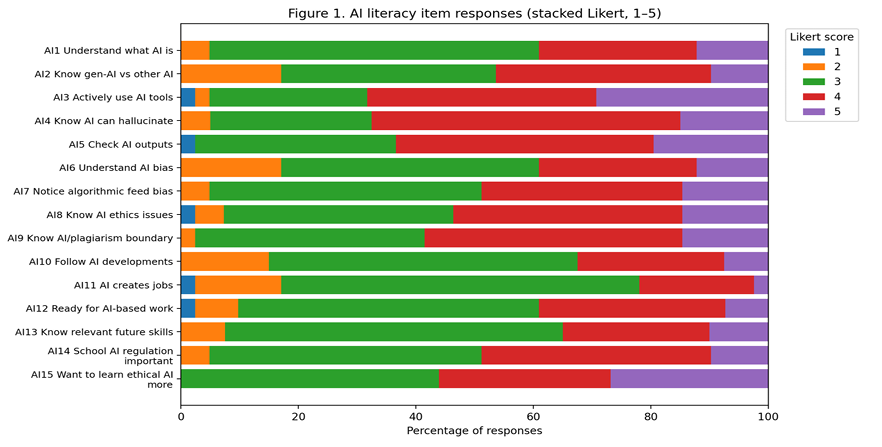
Generative artificial intelligence has transformed from a niche research tool into an ambient feature of daily life for Generation Z (Gen Z), reshaping how this cohort learns, thinks, and prepares for professional futures. This manuscript synthesizes evidence from a systematic literature review (SLR) of 65 peer-reviewed sources spanning 2016 to 2026 with empirical findings from a cross-sectional descriptive-correlational study of 41 high school students at SMK Pembangunan JAYA YAKAPI, Indonesia. Following the PRISMA 2020 protocol, the SLR draws on Scopus, CRIS Reference, and Google Scholar databases. The empirical study assessed students' AI literacy across three subscales—AI understanding and usage, critical and ethical AI literacy, and career and future readiness—and examined their responses to a structured AI literacy workshop. Preliminary Cronbach's alpha values of 0.886 for the AI literacy scale and 0.940 for the workshop response scale indicate strong instrument reliability. A Spearman rank correlation of approximately 0.60 (p < 0.001) between AI literacy and workshop response scores was found among matched respondents, indicating a moderately strong positive association. The synthesis reveals a persistent paradox: while the majority of Gen Z students regularly use AI tools, fewer than 25% can demonstrate foundational knowledge of how these systems operate or govern user data. The AI Literacy is proposed as a practical and theoretically grounded curriculum framework integrating functional, critical, and ethics literacy dimensions. The evidence collectively positions AI ethics literacy as the most consequential lever available to educators seeking to protect intellectual autonomy in an AI-saturated learning environment.
References
1) Ang, C.-S. (2025). When knowing becomes compliance: Reframing AI literacy in a measured world. AI & Ethics.
2) Bandura, A. (1986). Social foundations of thought and action: A social cognitive theory. Prentice-Hall.
3) Belludi, S., & Kopackova, H. (2025). Beyond AI-powered shopping: Can Gen Z apply generative AI for business decision? Computers in Human Behavior.
4) Celik, I., & Dogan, S. (2025). Intelligent-TPACK for AI-assisted literacy instruction. Computers & Education.
5) Chan, C. K. Y., & Lee, K. K. W. (2023). The AI generation gap: Are Gen Z students more interested in adopting generative AI such as ChatGPT in teaching and learning than their Gen X and millennial generation teachers? Smart Learning Environments, 10(1). https://doi.org/10.1186/s40561-023-00269-3
6) Chiu, T. K. F. (2025). From student artificial intelligence (AI) literacy to AI competency: Essential skills for the next generation. Computers and Education: Artificial Intelligence.
7) Cox, A. (2024). Algorithmic literacy, AI literacy and responsible generative AI literacy. In X. O'Dea & D. T. K. Ng (Eds.), Effective practices in AI literacy education: Case studies and reflections. Emerald.
8) Donnelly, R., & Kennelly, I. (2024). A framework-based cross-institutional CPD for academic staff in Gen-AI literacy, critical inquiry, and authentic assessment. In X. O'Dea & D. T. K. Ng (Eds.), Effective practices in AI literacy education: Case studies and reflections. Emerald. https://doi.org/10.1108/978-1-83608-852-320241006
9) European Commission. (2024). Regulation (EU) 2024/1689 of the European Parliament and of the Council — the AI Act. Official Journal of the European Union.
10) Hasselwander, M., & Lah, O. (2026). Agentic AI arrives: How Gen Z adopts autonomous AI agents. Technology in Society.
11) Illingworth, S., & Gow, S. (2025). Generative AI literacy. Bristol University Press.
12) Jiang, J., & Shao, A. (2024). Generative AI divide: How college students' backgrounds affect their Gen AI literacy. openRxiv. https://doi.org/10.1101/2024.12.01.626259
13) Kong, J., Liu, J., Chen, G., & Shang, W. (2025). Assessing AI literacy in college students: The mediating role of self-efficacy in motivational commitment pathways. Education and Information Technologies.
14) Lintner, T. (2024). A systematic review of AI literacy scales. Computers & Education: Artificial Intelligence. https://doi.org/10.1016/j.caeai
15) Meesook, K., Imjai, N., Usman, B., Vongchavalitkul, B., & Aujirapongpan, S. (2025). The influence of AI literacy on risk management skills and the roles of diagnostic capabilities and prognostic capabilities: Empirical insight from Thai Gen Z accounting students. International Journal of Management Education. https://doi.org/10.1016/j.ijme.2025
16) Mishra, P., & Koehler, M. J. (2006). Technological pedagogical content knowledge: A framework for teacher knowledge. Teachers College Record, 108(6), 1017–1054.
17) Ng, D. T. K., Leung, J. K. L., Su, M. J., Yim, I. H. Y., Qiao, M. S., & Chu, S. K. W. (2022). AI literacy for all. In AI literacy in K-16 classrooms. Springer.
18) Ng, D. T. K., Leung, J. K. L., O'Dea, X., & Chu, S. K. W. (2025). From AI literacy to generative AI literacy: Conceptualization and frameworks. In Effective practices in AI literacy education. Emerald.
19) Nunnally, J. C. (1978). Psychometric theory (2nd ed.). McGraw-Hill.
20) O'Dea, X., & Ng, D. T. K. (2024). AI literacy and Gen-AI literacy frameworks. In Effective practices in AI literacy education: Case studies and reflections (pp. 21–27). Emerald Publishing. https://doi.org/10.1108/978-1-83608-852-320241003
21) OECD. (2026). OECD digital education outlook 2026. OECD Publishing.
22) Page, M. J., McKenzie, J. E., Bossuyt, P. M., Boutron, I., Hoffmann, T. C., Mulrow, C. D., & Moher, D. (2021). The PRISMA 2020 statement: An updated guideline for reporting systematic reviews. The BMJ, 372, n71.
23) Paolini e Silva, M., Tamo-Larrieux, A., & Ammann, O. (2025). AI literacy under the AI Act: Tracing the evolution of a weakened norm. European Law Journal.
24) Pretorius, L., & Cahusac de Caux, B. (2025). The AI literacy framework for higher education. Frontiers in Education.
25) Promma, W., Imjai, N., Usman, B., & Aujirapongpan, S. (2025). The influence of AI literacy on complex problem-solving skills through systematic thinking skills and intuition thinking skills: An empirical study in Thai Gen Z accounting students. Computers and Education: Artificial Intelligence, 8. https://doi.org/10.1016/j.caeai.2025.100382
26) Savin, P. S., Rusu, G., & Prelipcean, M. (2024). Cognitive shifts: Exploring the impact of AI on Generation Z and millennials. Frontiers in Psychology.
27) Setsoafia, P., & Ng, D. T. K. (2025). Can we be AI-literate? The state of GenAI literacy in African countries: Ghana as a case study. Computers and Education: Artificial Intelligence.
28) Singh, E., Vasishta, P., & Singla, A. (2025). AI-enhanced education: Exploring the impact of AI literacy on generation Z's academic performance in Northern India. Quality Assurance in Education, 33(2), 185–202. https://doi.org/10.1108/QAE-02-2024-0037
29) Sun, Z., Lin, C. H., You, J., Shen, H. J., Hu, S., & Luo, L. (2023). Improving English-speaking skills of young learners through AI chatbot-assisted dynamic assessment. Language Learning & Technology, 27(1), 1–24.
30) Thomas, J., & Harden, A. (2008). Methods for the thematic synthesis of qualitative research in systematic reviews. BMC Medical Research Methodology, 8(1), 45.
31) Tian, J., & Zhang, R. (2025). Learners' AI dependence and critical thinking: The psychological mechanism of fatigue and the social buffering role of AI literacy. Learning and Individual Differences.
32) UNESCO. (2021). Recommendation on the ethics of artificial intelligence. United Nations Educational, Scientific and Cultural Organization.
33) UNESCO. (2024). AI competency frameworks for students and teachers. United Nations Educational, Scientific and Cultural Organization.
34) Xu, L., Ng, D. T. K., Deng, H., & Leung, J. K. L. (2025). A systematic review of empirical studies fostering generative AI literacy in higher education. Computers & Education.
35) Yang, M., Luo, J., & Yang, Y. (2024). Cultivating AI literacy skills: How GenAI tools prepare students in humanities and social sciences to write with ethical and critical insight. Computers and Education: Artificial Intelligence.
36) Yang, Y., He, W., Li, X., & Zheng, Y. (2025). Navigating the landscape of AI literacy education: Insights from a decade of research (2014–2024). Computers & Education.
37) Yordudom, T., Nui-Suk, C., Imjai, N., Sumiati, S., & Aujirapongpan, S. (2026). Developing open innovation competency in Gen Z entrepreneurship students: Roles of absorptive capacity, AI literacy and algorithmic thinking skills. Technovation.
38) Zhang, S., Ganapathy Prasad, P., & Schroeder, N. L. (2024). Learning about AI: A systematic review of reviews on AI literacy. Educational Research Review.
Downloads
Published
Issue
Section
License
Copyright (c) 2026 Eka Sudarmaji, Herlan ., M. Rubiul Yatim, Satria Yunas, Roy Prakoso, Rika Kaniati, Octavia Tyara Ramadh, Sabrina Nurulfarah Juwanto (Author)

This work is licensed under a Creative Commons Attribution 4.0 International License.