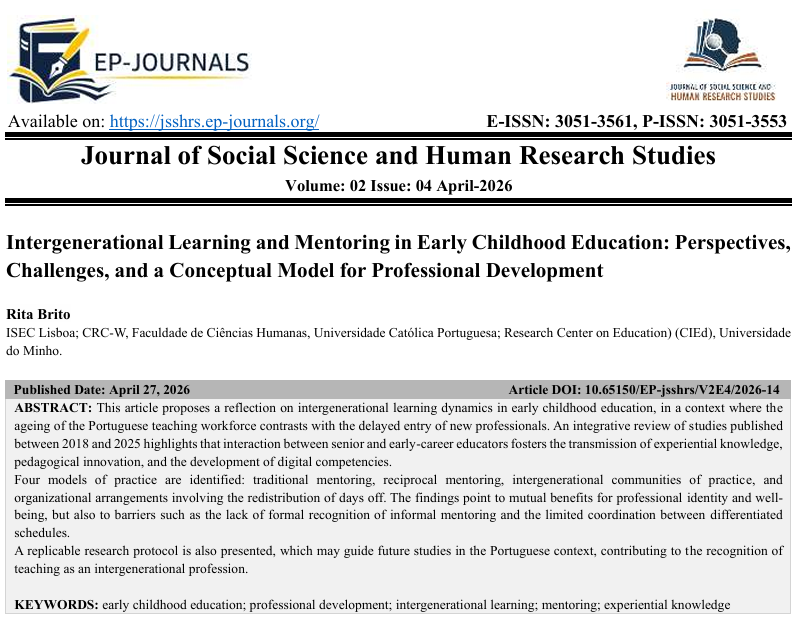
Intergenerational Learning and Mentoring in Early Childhood Education: Perspectives, Challenges, and a Conceptual Model for Professional Development
DOI:
https://doi.org/10.65150/EP-jsshrs/V2E4/2026-14Keywords:
early childhood education, professional development, intergenerational learning, mentoring, experiential knowledgeAbstract
This article proposes a reflection on intergenerational learning dynamics in early childhood education, in a context where the ageing of the Portuguese teaching workforce contrasts with the delayed entry of new professionals. An integrative review of studies published between 2018 and 2025 highlights that interaction between senior and early-career educators fosters the transmission of experiential knowledge, pedagogical innovation, and the development of digital competencies.
Four models of practice are identified: traditional mentoring, reciprocal mentoring, intergenerational communities of practice, and organizational arrangements involving the redistribution of days off. The findings point to mutual benefits for professional identity and well-being, but also to barriers such as the lack of formal recognition of informal mentoring and the limited coordination between differentiated schedules.
A replicable research protocol is also presented, which may guide future studies in the Portuguese context, contributing to the recognition of teaching as an intergenerational profession.
References
Akiri, E., & Dori, Y. J. (2021). Mentoring novice teachers in a three-tiered system: Implications for teacher professional growth. Teaching and Teacher Education, 104, 103367. https://doi.org/10.1016/j.tate.2021.103367
Aubrey, C. (2011). Leading and managing in the early years (2ª ed.). Sage.
Babić, M., & Ivanović, V. (2023). Early career teachers’ social and emotional competencies, self efficacy and burnout: a mediation model. BMC Psychology, 13, 9. https://doi.org/10.1186/s40359-024-02323-2
Batista, P., Mouraz, A., Viana, I., & Graça, A. (2024). Intergenerational learning among teachers’ professional development and lifelong learning: An integrative review of primary research. European Journal of Educational Research, 13(3), 1275–1290. https://doi.org/10.12973/eu-jer.13.3.1275
Brücknerová, K., & Novotný, P. (2017). Becoming a mentor: The role of reflection in shaping novice teachers’ identities. Teaching and Teacher Education, 63, 254–262. https://doi.org/10.1016/j.tate.2017.01.013
Campbell, M., McKenzie, J. E., Sowden, A., Katikireddi, S. V., Brennan, S. E., Ellis, S., Hartmann‑Boyce, J., Ryan, R., Shepperd, S., Thomas, J., Welch, V., & Thomson, H. (2020). Synthesis without meta‑analysis (SWiM) in systematic reviews: reporting guideline. BMJ, 368, l6890. https://doi.org/10.1136/bmj.l6890
Darling-Hammond, L. (2021). Teacher education around the world: What can we learn from international practice? European Journal of Teacher Education, 44(1), 3–18. https://doi.org/10.1080/02619768.2020.1856685
Davis, T. (2025). A systematic review of early career teacher wellbeing: Impacts of stressors and protective factors including mentoring and collegial networks. Education Sciences, 15(8), 996. https://doi.org/10.3390/educsci15080996
Dikilitaş, K., Mede, E., & Atay, D. (Eds.). (2018). Mentorship strategies in teacher education. IGI Global. https://doi.org/10.4018/978-1-5225-4050-2
European Commission/EACEA/Eurydice. (2021). Teachers in Europe: Careers, development and well-being. Publications Office of the European Union.
Hobson, A. J., Ashby, P., Malderez, A., & Tomlinson, P. D. (2009). Mentoring beginning teachers: What we know and what we don’t. Teaching and Teacher Education, 25(1), 207–216. https://doi.org/10.1016/j.tate.2008.09.001
Hobson, A. J., Ashby, P., Malderez, A., & Tomlinson, P. D. (2009). Mentoring beginning teachers: What we know and what we don’t. Teaching and Teacher Education, 25(1), 207–216. https://doi.org/10.1016/j.tate.2008.09.001
Ingersoll, R. M., & Strong, M. (2011). The impact of induction and mentoring programs for beginning teachers: A critical review of the research. Review of Educational Research, 81(2), 201–233. https://doi.org/10.3102/0034654311403323
Ingersoll, R. M., & Strong, M. (2011). The impact of induction and mentoring programs for beginning teachers: A critical review of the research. Review of Educational Research, 81(2), 201–233. https://doi.org/10.3102/0034654311403323
Ingersoll, R. M., & Strong, M. (2011). The impact of induction and mentoring programs for beginning teachers: A critical review of the research. Review of Educational Research, 81(2), 201–233. https://doi.org/10.3102/0034654311403323
Keese, J., et al. (2023). A worthwhile endeavor? A meta analysis of research on formalized novice teacher induction programs. Teaching and Teacher Education, 161, 105061. https://doi.org/10.1016/j.tate.2025.105061
Kowalczuk-Walędziak, M., Lopes, A., Menezes, I., & Torres, C. A. (2022). Teacher education and professional development in Europe: Trends, tensions and opportunities. European Journal of Teacher Education, 45(5), 1–15.
Krishna, L. K. R., Kwok, H. Y. F., Ravindran, N., et al. (2024). A systematic scoping review of mentoring support on professional identity formation. BMC Medical Education, 24, 1380. https://doi.org/10.1186/s12909-024-06357-3
Kutsyuruba, B., & Bezzina, C. (2024). Teacher induction and mentoring in Malta: A review of the literature. Education Thinking, 4(1), 39–59. Retrieved from https://pub.analytrics.org/article/17/
Longley, J. M. (2020). Supporting mentors of preservice early childhood education teachers: A literature review. Journal of Early Childhood Teacher Education, 36(90–99).
Lopes, A., & Thomas Dotta, L. (2024). Intergenerational professional development in teaching: Challenges and perspectives. Teaching and Teacher Education, 135, 104308.
Mori, A. (2024). The power of mentorship: Enhancing teacher leadership through educational mentoring. Journal of Educational Leadership, 12(2), 45–63. https://www.abacademies.org/articles/the-power-of-mentorship-enhancing-teacher-leadership-through-educational-mentoring-17157.html
Mumtaz, S. (2000). Factors affecting teachers’ use of information and communications technology: A review of the literature. Journal of Information Technology for Teacher Education, 9(3), 319–342. https://doi.org/10.1080/14759390000200096
OECD. (2020). Teachers and school leaders as lifelong learners. OECD Publishing.
Organisation for Economic Co-operation and Development (OECD). (2025). Education at a Glance 2025: OECD indicators — Portugal. OECD Publishing.
Page, M. J., McKenzie, J. E., Bossuyt, P. M., Boutron, I., Hoffmann, T. C., Mulrow, C. D., Shamseer, L., Tetzlaff, J. M., Akl, E. A., Brennan, S. E., Chou, R., Glanville, J., Grimshaw, J. M., Hróbjartsson, A., Lalu, M. M., Li, T., Loder, E. W., Mayo Wilson, E., McDonald, S., McGuinness, L. A., … and Moher, D. (2021). The PRISMA 2020 statement: An updated guideline for reporting systematic reviews. BMJ, 372, n71. https://doi.org/10.1136/bmj.n71
Raberger, J., Gkaravelas, K., & Froehlich, D. E. (2024). Reverse mentoring in teacher professional development: Integrating evidence-based practices. Education Sciences, 14(9), 993. https://doi.org/10.3390/educsci14090993
Rodgers, M., Sowden, A., Petticrew, M., Arai, L., Roberts, H., Britten, N., & Popay, J. (2009). Testing methodological guidance on the conduct of narrative synthesis in systematic reviews: Effectiveness of interventions to promote smoke alarm ownership and function. Evaluation, 15(1), 49–73. https://doi.org/10.1177/1356389008097871
Roeser, R. W., Skinner, E., Beers, J., & Jennings, P. A. (2013). Mindfulness training and teachers’ professional development: A multilevel longitudinal study. Teaching and Teacher Education, 31, 25–38. https://doi.org/10.1111/j.1750-8606.2012.00238.x
Snyder, H. (2019). Literature review as a research methodology: An overview and guidelines. Journal of Business Research, 104, 333–339. https://doi.org/10.1016/j.jbusres.2019.07.039
Thomas Dotta, L., Ribeiro, N., & Lopes, A. (2025). Teacher shortages and professional attractiveness in Europe. European Journal of Education, 60(1), 45–63.
Thomas, J., & Harden, A. (2008). Methods for the thematic synthesis of qualitative research in systematic reviews. BMC Medical Research Methodology, 8(45). https://doi.org/10.1186/1471-2288-8-45
Valente, A., & Migueis, A. (2023). Programmes for teacher well-being in early childhood education: Design, implementation and evaluation challenges. Early Childhood Education Journal, 51, 789 805. https://doi.org/10.1007/s10643-023-01457-x
van der Gucht, K., & Stevens, M. (2023). Teacher well-being interventions: Systematic review of effects on stress, burnout and professional development. Educational Psychology Review, 35(1), 105 132. https://doi.org/10.1007/s10648-023-09654-1
Whittemore, R., & Knafl, K. (2005). The integrative review: Updated methodology. Journal of Advanced Nursing, 52(5), 546–553. https://doi.org/10.1111/j.1365-2648.2005.03621.x
Xu, J., Patton, K., & Li, Y. (2022). Intergenerational teacher mentoring: Tacit knowledge transfer and job crafting in schools. Teaching and Teacher Education, 113, 103636. https://doi.org/10.1016/j.tate.2022.103636
Downloads
Published
Issue
Section
License
Copyright (c) 2026 Rita Brito (Author)

This work is licensed under a Creative Commons Attribution 4.0 International License.