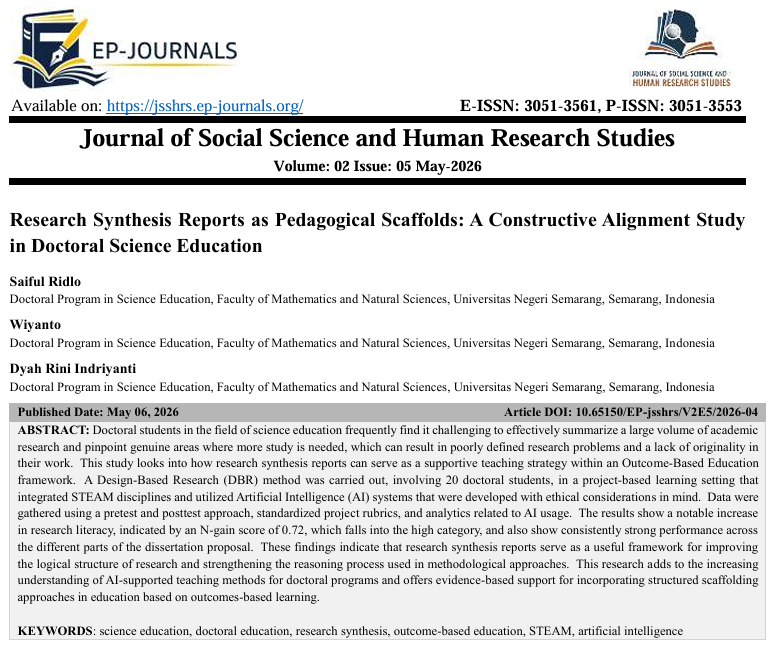
Research Synthesis Reports as Pedagogical Scaffolds: A Constructive Alignment Study in Doctoral Science Education
DOI:
https://doi.org/10.65150/EP-jsshrs/V2E5/2026-04Keywords:
science education, doctoral education, research synthesis, outcome-based education, STEAM, artificial intelligenceAbstract
Doctoral students in the field of science education frequently find it challenging to effectively summarize a large volume of academic research and pinpoint genuine areas where more study is needed, which can result in poorly defined research problems and a lack of originality in their work. This study looks into how research synthesis reports can serve as a supportive teaching strategy within an Outcome-Based Education framework. A Design-Based Research (DBR) method was carried out, involving 20 doctoral students, in a project-based learning setting that integrated STEAM disciplines and utilized Artificial Intelligence (AI) systems that were developed with ethical considerations in mind. Data were gathered using a pretest and posttest approach, standardized project rubrics, and analytics related to AI usage. The results show a notable increase in research literacy, indicated by an N-gain score of 0.72, which falls into the high category, and also show consistently strong performance across the different parts of the dissertation proposal. These findings indicate that research synthesis reports serve as a useful framework for improving the logical structure of research and strengthening the reasoning process used in methodological approaches. This research adds to the increasing understanding of AI-supported teaching methods for doctoral programs and offers evidence-based support for incorporating structured scaffolding approaches in education based on outcomes-based learning.
References
Amanova, A. K., Khalykov, K. B., Baimukhanbetova, G. S., & Yermagambetov, M. B. (2025). Systematic review of STEAM implementation. EURASIA Journal of Mathematics, Science and Technology Education. https://doi.org/10.29333/ejmste/15894
Asamoah, M. K., & Amarteifio, J. (2025). Exploring the role and ethical concerns of generative AI. SN Social Sciences, 5(1), 184. https://doi.org/10.1007/s43545-025-01184-9
Bascopé, M., Perasso, P., & Reiss, K. (2019). Systematic review of education for sustainable development. Sustainability. https://doi.org/10.3390/su11030719
Biggs, J. (1996). Constructive alignment in university teaching. Higher Education. https://doi.org/10.1007/BF00138871
Biggs, J., Tang, C., & Kennedy, G. (2022). Teaching for quality learning at university (5th ed.). Open University Press. https://www.mheducation.co.uk/teaching-for-quality-learning-at-university-5e-9780335250820-emea-group
Borrego, M., Foster, M. J., & Froyd, J. E. (2019). Systematic literature reviews in engineering education. Journal of Engineering Education, 103(1), 45–76. https://doi.org/10.1002/jee.20273
Bridges, L., Tewell, E., & Guzman, K. (2025). Critical AI literacy in library and information science. The Electronic Library. https://doi.org/10.1108/EL-05-2024-0123
Chan, C. K. Y. (2024). A comprehensive framework for AI literacy in higher education. Routledge.
Chen, J., & Yang, S. C. (2019). Promoting 21st century skills in PS-PBL: A case study of a city architecture project. Journal of Educational Computing Research, 57(1), 117–145. https://doi.org/10.1177/0735633117746167
Clow, D., & Ferguson, R. (2022). Learning analytics in higher education. In The SAGE handbook of learning and instruction. SAGE Publications.
Conradty, C., & Bogner, F. X. (2020). From STEM to STEAM: How to monitor creativity. Creativity Research Journal, 32(3).
Creswell, J. W., & Plano Clark, V. L. (2017). Designing and conducting mixed methods research (3rd ed.). Sage.
Doo, M. Y., Bonk, C., & Heo, H. (2020). Scaffolding effects in online learning. International Review of Research in Open and Distributed Learning. https://doi.org/10.19173/irrodl.v21i3.4638
Elliot, D. L., Bengtsen, S. S., Guccione, K., & Huang, R. (2020). The doctoral journey as an emotional and social experience. Springer Nature. https://doi.org/10.1007/978-3-030-41039-1
Fu, Y., & Weng, Z. (2024). Ethical terrain of AI in education. Computers and Education: Artificial Intelligence, 5, 100172. https://doi.org/10.1016/j.caeai.2024.100172
Ghani, A. S. A., Abdul Rahim, A. F., Yusoff, M. S. B., & Hadie, S. N. H. (2021). Effective learning behavior in problem-based learning: A scoping review. Medical Science Educator, 31(3), 1199–1211. https://doi.org/10.1007/s40670-021-01292-0
Greene, J. A. (2016). The role of epistemic cognition in learning. Journal of Educational and Behavioral Statistics, 41(4), 421–437. https://doi.org/10.3102/1076998616638584
Guo, Q., Jamil, H., Ismail, L., Luo, S., & Sun, Z. (2024). Effects of problem-based learning on EFL learning: A systematic review. PLOS ONE, 19(12), e0307819. https://doi.org/10.1371/journal.pone.0307819
Haningsih, S., & Rohmi, P. (2022). Hybrid learning effectiveness post-COVID-19. European Journal of Educational Research, 11(4), 2129–2140. https://doi.org/10.12973/eu-jer.11.4.2129
Harzing, A. W. (2022). Publish or perish (Version 8) [Software]. https://harzing.com/resources/publish-or-perish
Hockly, N. (2023). Artificial intelligence in English language teaching: The good, the bad and the ugly. ELT Journal, 77(2), 235–244. https://doi.org/10.1093/elt/ccad008
Hossain, M. S., Chen, S., & Mashau, K. E. (2025). Measuring AI literacy of teachers. System, 128, 103855. https://doi.org/10.1016/j.system.2024.103855
Inouye, K., & McAlpine, L. (2019). Developing academic identity: A review of the literature on doctoral writing and feedback. International Journal of Doctoral Studies, 14, 1-31. https://doi.org/10.28945/4168
Kamler, B., & Thomson, P. (2021). Helping doctoral students write: Pedagogies for supervision (2nd ed.). Routledge.
Kementerian Pendidikan Tinggi, Sains, dan Teknologi. (2025). Peraturan Menteri Pendidikan Tinggi, Sains, dan Teknologi Republik Indonesia Nomor 39 Tahun 2025 tentang Penjaminan Mutu Pendidikan Tinggi. https://jdih.kemendikdasmen.go.id/
Krajcik, J. S., & Shin, N. (2022). Project-based learning. In R. K. Sawyer (Ed.), The Cambridge handbook of the learning sciences (3rd ed., pp. 311–327). Cambridge University Press. https://doi.org/10.1017/9781108888295.020
Lachance, K., et al. (2020). Performance of research skills in biology education. CBE—Life Sciences Education. https://doi.org/10.1187/cbe.19-07-0142
Larmer, J., Mergendoller, J., & Boss, S. (2020). Setting the standard for project based learning. ASCD.
Lee, K., Fanguy, M., Bligh, B., & Azizi, Z. (2024). Systematic review of online doctoral programs. Distance Education, 45(1), 44–71. https://doi.org/10.1080/0158037X.2022.2135499
Lovitts, B. E. (2019). Making the implicit explicit: Creating performance expectations for the dissertation. Stylus Publishing.
Makransky, G., & Petersen, G. B. (2021). The Cognitive Affective Model of Immersive Learning (CAMIL): A theoretical framework-based review of learning in immersive virtual reality. Educational Psychology Review, 33, 937–958. https://doi.org/10.1007/s10648-020-09586-2
McKenney, S., & Reeves, T. C. (2019). Conducting educational design research (2nd ed.). Routledge. https://doi.org/10.4324/9781315105642
Miao, F., & Holmes, W. (2023). Guidance for generative AI in education and research. UNESCO. https://doi.org/10.54675/EWZM9535
Ngulube, P. (2023). Improving the quality of reporting findings using computer data analysis applications. Heliyon, 9(10), e20357. https://doi.org/10.1016/j.heliyon.2023.e20357
Paas, F., & van Merriënboer, J. J. G. (2020). Cognitive-load theory: Methods to manage working memory load in self-regulated learning. Educational Psychologist, 55(4), 213–226. https://doi.org/10.1080/00461520.2020.1785580
Page, M. J., McKenzie, J. E., Bossuyt, P. M., et al. (2021). The PRISMA 2020 statement. BMJ, 372, n71. https://doi.org/10.1136/bmj.n71
Page, M. J., et al. (2021). PRISMA 2020 explanation and elaboration. BMJ, 372, n160. https://doi.org/10.1136/bmj.n160
Perignat, E., & Katz-Buonincontro, J. (2019). STEAM in practice and research: An integrative literature review. Thinking Skills and Creativity, 31, 227–243. https://doi.org/10.1016/j.tsc.2018.10.002
Pradhan, S. (2021). Institutional commitment to outcome-based education. Higher Education Quarterly, 75(3), 479–495. https://doi.org/10.1111/hequ.12345
Ridlo, S., Wiyanto, W., & Indriyanti, D. R. (2024). Tren penelitian pendidikan IPA Periode 2020–2023: Laporan akhir penelitian kerjasama antar lembaga. Universitas Negeri Semarang. https://apps.unnes.ac.id/12
Rolling Jr, J. H. (2020). STEAM in a time of crisis and change. Art Education, 73(6).
Sarrico, C. S., McCowan, T., & Dimitrov, G. (2022). Expansion and differentiation of doctoral education. Higher Education, 84(6), 1199–1215. https://doi.org/10.1007/s10734-022-00946-1
Scott, E. E. (2021). Design-based research in biology education. CBE—Life Sciences Education. https://doi.org/10.1187/cbe.21-01-0012
Siemens, G., & Dawson, S. (2022). Preparing for the digital university: A review of the history and current state of distance, blended, and online learning. Linköping University Press.
Sipos, Y., Battisti, B., & Grimm, K. (2020). Achieving transformative sustainability learning: Engaging head, hands and heart. International Journal of Sustainability in Higher Education, 21(5). https://doi.org/10.1108/IJSHE-02-2020-0048
Spyropoulou, N., & Kameas, A. (2025). STEAM education: Authentic interdisciplinarity. Education Sciences, 15(10), 1300. https://doi.org/10.3390/educsci15101300
Stanciu, I. D., et al. (2025). Evolution in learning analytics. Computers in Human Behavior. https://doi.org/10.1016/j.chb.2024.107875
Sweller, J., Ayres, P., & Kalyuga, S. (2011). Cognitive load theory. Springer. https://doi.org/10.1007/978-1-4419-8126-4.
Thomson, P., & Walker, M. (2021). The Routledge doctoral supervisor’s companion: Supporting effective research in education and the social sciences (2nd ed.). Routledge. https://doi.org/10.4324/9781003025382
Tight, M. (2018). The changing nature of doctoral education. Studies in Higher Education, 43(3), 475–490. https://doi.org/10.1080/03075079.2016.1147723
UNESCO. (2020). Education for sustainable development: A roadmap. https://doi.org/10.54675/YFRE1448
UNESCO. (2023). ChatGPT and artificial intelligence in higher education: Quick start guide. International Institute for Higher Education in Latin America and the Caribbean.
Wiggins, G., & McTighe, J. (2005). Understanding by design (2nd ed.). ASCD.
Yang, S. C., Liou, S. J., Liu, Y. M., & Hung, S. C. (2025). Exploring research literacy in graduate students. Studies in Higher Education. https://doi.org/10.1080/03075079.2025.2520417
Yew, E. H. J., & Goh, K. (2016). Problem-based learning: An overview of its process and impact on learning. Health Professions Education, 2(2), 75–79. https://doi.org/10.1016/j.hpe.2016.01.004
Zhu, H., Sun, Y., & Yang, J. (2025). Responsible AI in education. Humanities and Social Sciences Communications. https://doi.org/10.1057/s41599-025-05252-6
Downloads
Published
Issue
Section
License
Copyright (c) 2026 Saiful Ridlo, Wiyanto, Dyah Rini Indriyanti (Author)

This work is licensed under a Creative Commons Attribution 4.0 International License.