Bridging Theory and Practice: A Multi-Disciplinary Approach to Language and Communication Development for Learners with Complex Disabilities in Morocco
DOI:
https://doi.org/10.65150/EP-jsshrs/V2E4/2026-12Keywords:
Special Education, Applied Linguistics, Multi-Disciplinary Approach, Intellectual Disability, Cerebral Palsy, Inclusive Pedagogy, Language Development, MoroccoAbstract
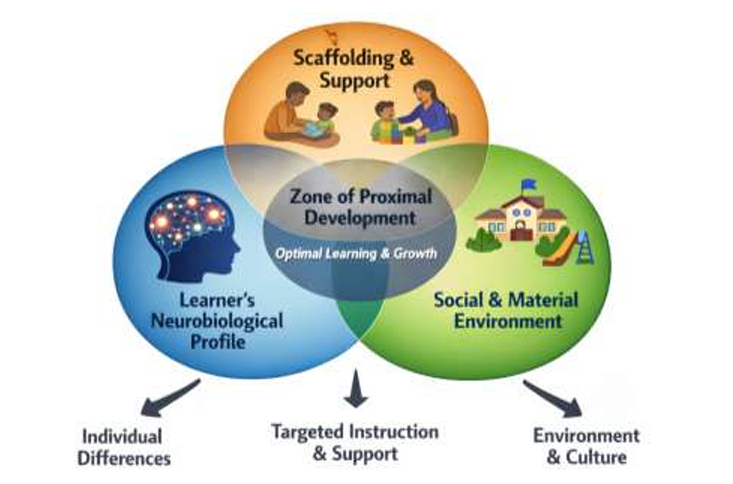
This paper is a qualitative case study analysis of two learners with two complicated neurodevelopmental disorders, namely profound intellectual disability and cerebral palsy, in a special education center in Beni Mellal, Morocco. This research uses the theoretical perspectives of the Sociocultural Theory and the Universal Design for Learning (UDL) as its theoretical framework to investigate the spurring up, implementation and effects of individualized, multi-disciplinary intervention programs. The dominant issue is the intersection of the special education and language teaching, i.e. how specific interventions related to communication, motor skills, and social interaction may contribute to developmental benefits. The competency assessment that was implemented based on initial and continuing competency assessments, individualized education plans (IEPs), and observation notes was the source of data that had to be gathered by a multi-disciplinary team. Results show that the essential domains of visual attention, simple academic skills, and social interaction have shown considerable improvement even though there are still issues with expressive language and motor coordination. The study is an addition to the current research on inclusive pedagogies, one that promotes adopting a competency-based model of holistic approach that incorporates principles of applied linguistics, occupational therapy and special education instead of adopting a deficit-based approach.
References
1) Abbeduto, L., Brady, N., & Kover, S. T. (2007). Language development and fragile X syndrome: Profiles, syndrome-specificity, and within-syndrome differences. Mental Retardation and Developmental Disabilities Research Reviews, 13(1), 36–46.
2) Arssi, A. (2024). Towards the inclusion of children with disabilities in Morocco. The International Journal of Technology, Innovation, and Education, 2(1), 87–105.
3) Braun, V., & Clarke, V. (2006). Using thematic analysis in psychology. Qualitative Research in Psychology, 3(2), 77–101.
4) CAST. (2018). Universal Design for Learning guidelines version 2.2. CAST.
5) Johnstone, C. J., & Chapman, D. W. (2009). Contributions and constraints to the implementation of inclusive education in Lesotho. International Journal of Disability, Development and Education, 56(2), 131–148.
6) Kozulin, A., Gindis, B., Ageyev, V. S., & Miller, S. M. (Eds.). (2003). Vygotsky's educational theory in cultural context. Cambridge University Press.
7) Kadiri, F. (2022). Morocco’s inclusive education program through the lens of ethnography. International Journal of Linguistics, Literature and Translation, 5(6), 100–110.
8) Lidz, C. S. (2003). Early childhood assessment. John Wiley & Sons.
9) Mundy, P., Block, J., Delgado, C., Pomares, Y., Van Hecke, A. V., & Parlade, M. V. (2007). Individual differences and the development of joint attention in infancy. Child Development, 78(3), 938–954.
10) Romski, M., & Sevcik, R. A. (2005). Augmentative communication and early intervention: Myths and realities. Infants & Young Children, 18(3), 174–185.
11) Rose, D. H., & Meyer, A. (2002). Teaching every student in the digital age: Universal Design for Learning. Association for Supervision and Curriculum Development.
12) Thompson, J. R., Wehmeyer, M. L., Hughes, C., Shogren, K. A., Palmer, S. B., & Seo, H. (2014). The supports intensity scale–children's version: Preliminary reliability and validity. Inclusion, 2(2), 140–149.
13) UNESCO. (2017). A guide for ensuring inclusion and equity in education. UNESCO.
14) Vygotsky, L. S. (1978). Mind in society: The development of higher psychological processes. Harvard University Press.
15) World Health Organization. (2001). International classification of functioning, disability and health (ICF). WHO.
16) World Health Organization. (2011). World report on disability. WHO Press.
17) Yin, R. K. (2018). Case study research and applications: Design and methods (6th ed.). SAGE Publications.