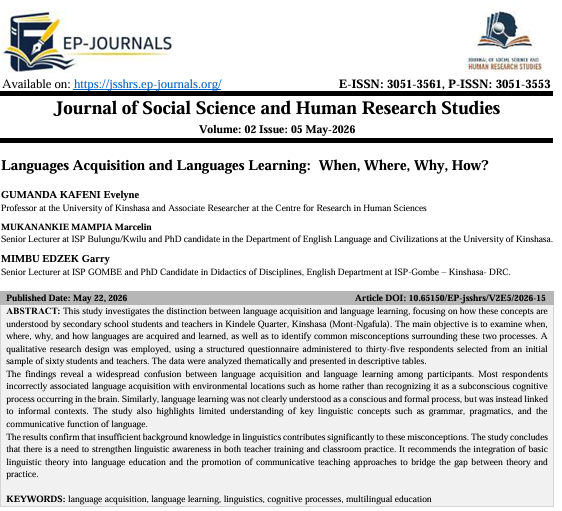
Languages Acquisition and Languages Learning: When, Where, Why, How?
DOI:
https://doi.org/10.65150/EP-jsshrs/V2E5/2026-15Keywords:
language acquisition, language learning, linguistics, cognitive processes, multilingual educationAbstract
This study investigates the distinction between language acquisition and language learning, focusing on how these concepts are understood by secondary school students and teachers in Kindele Quarter, Kinshasa (Mont-Ngafula). The main objective is to examine when, where, why, and how languages are acquired and learned, as well as to identify common misconceptions surrounding these two processes. A qualitative research design was employed, using a structured questionnaire administered to thirty-five respondents selected from an initial sample of sixty students and teachers. The data were analyzed thematically and presented in descriptive tables.
The findings reveal a widespread confusion between language acquisition and language learning among participants. Most respondents incorrectly associated language acquisition with environmental locations such as home rather than recognizing it as a subconscious cognitive process occurring in the brain. Similarly, language learning was not clearly understood as a conscious and formal process, but was instead linked to informal contexts. The study also highlights limited understanding of key linguistic concepts such as grammar, pragmatics, and the communicative function of language.
The results confirm that insufficient background knowledge in linguistics contributes significantly to these misconceptions. The study concludes that there is a need to strengthen linguistic awareness in both teacher training and classroom practice. It recommends the integration of basic linguistic theory into language education and the promotion of communicative teaching approaches to bridge the gap between theory and practice.
References
1) Chomsky, N. (1968). Language and mind. Harcourt, Brace & World.
2) Chomsky.N (1995) . The Logical structure of linguistics. Mimeo, MIT
3) Fishman, J (1965). Who speaks what language to whom and why . N2: 67-98
4) Hagen, E. (1972). Language learning and teaching in the classroom. (Details not fully provided in manuscript; please verify full source).
5) Halliday, M. A. K. (1975). Learning how to mean: Explorations in the development of language. Edward Arnold.
6) Haugen.E (1972). The Ecology of Language. Stanford: SUP
7) Majambo (2024). Semantic analysis Methods. (Unpublished) Kinshasa: UNIKIN
8) Malekani, D. (2024). Introduction to linguistics and language studies. (Publication details not fully provided; please verify publisher/place).
9) Malekani. K.A (2023). Sociolinguistics course. (Unpublished) Kinshasa: UNIKIN
10) Malekani. M.D (2024). How do children acquire and Learn languages? Memoire (Unpublished) Kinshasa: UNIKIN
11) Nelson. K. (1973). Structure and Strategy in Learning to Talk. Monographs of the Society for Research in Child Development 149 (1-2), 1-137
12) Nsimambote. Z.R (2024). Linguistics yesterday and today. (Unpublished) Kinshasa
13) Sangabau, (2024). Linguistic code and communication systems. (Unpublished) Kinshasa
14) Saxton. W. (2010). Child Language Acquisition and Development. London: S.P
15) Teguete, & Iaini. (2019). Language acquisition and language learning in multilingual contexts.
16) Wardhaugh, R. (1989). An introduction to sociolinguistics. Basil Blackwell.
17) Webster’s English Dictionary. (2000). Definition of acquisition. Merriam-Webster.
Downloads
Published
Issue
Section
License
Copyright (c) 2026 GUMANDA KAFENI Evelyne , MUKANANKIE MAMPIA Marcelin , MIMBU EDZEK Garry (Author)

This work is licensed under a Creative Commons Attribution 4.0 International License.