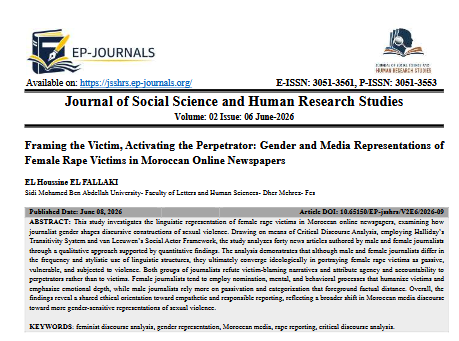
Framing the Victim, Activating the Perpetrator: Gender and Media Representations of Female Rape Victims in Moroccan Online Newspapers
DOI:
https://doi.org/10.65150/EP-jsshrs/V2E6/2026-09Keywords:
feminist discourse analysis, gender representation, Moroccan media, rape reporting, critical discourse analysisAbstract
This study investigates the linguistic representation of female rape victims in Moroccan online newspapers, examining how journalist gender shapes discursive constructions of sexual violence. Drawing on means of Critical Discourse Analysis, employing Halliday’s Transitivity System and van Leeuwen’s Social Actor Framework, the study analyzes forty news articles authored by male and female journalists through a qualitative approach supported by quantitative findings. The analysis demonstrates that although male and female journalists differ in the frequency and stylistic use of linguistic structures, they ultimately converge ideologically in portraying female rape victims as passive, vulnerable, and subjected to violence. Both groups of journalists refute victim-blaming narratives and attribute agency and accountability to perpetrators rather than to victims. Female journalists tend to employ nomination, mental, and behavioral processes that humanize victims and emphasize emotional depth, while male journalists rely more on passivation and categorization that foreground factual distance. Overall, the findings reveal a shared ethical orientation toward empathetic and responsible reporting, reflecting a broader shift in Moroccan media discourse toward more gender-sensitive representations of sexual violence.
References
1) Belarbi, N. (2020). Gender, media, and moral discourse in Moroccan news reporting. Rabat: Moroccan Institute for Gender Studies.
2) Berns, N. (2017). Framing the victim: Domestic violence, media, and social problems. New York: Routledge.
3) Bohner, G., Eyssel, F., Pina, A., Siebler, F., & Viki, G. T. (2009). Rape myth acceptance: Cognitive, affective, and social factors. European Review of Social Psychology, 19(1), 17–45.
4) Carter, C., Branston, G., & Allan, S. (1998). News, gender and power. Routledge.
5) Carter, C., Steiner, L., & McLaughlin, L. (Eds.). (2014). The Routledge companion to media and gender. New York: Routledge.
6) Cuklanz, L. M. (2000). Rape on trial: How the mass media construct legal reform and social change. University of Pennsylvania Press.
7) Easteal, P., Holland, K., & Judd, K. (2019). Enduring themes and emerging challenges in media representations of sexual violence. Women’s Studies International Forum, 72, 56–64.
8) El-Tayeb, S. (2017). Women, media, and moral politics in North Africa. Cairo University Press.
9) Fairclough, N. (1995). Critical discourse analysis: The critical study of language. Longman.
10) Fairclough, N. (1995). Media discourse. London: Edward Arnold.
11) Fowler, R. (1991). Language in the news: Discourse and ideology in the press. Routledge.
12) Franiuk, R., Seefelt, J. L., Cepress, S. L., & Vandello, J. A. (2008). Prevalence and effects of rape myths in print journalism: The Kobe Bryant case. Violence Against Women, 14(3), 287–309.
13) Gavey, N. (2013). Just sex? The cultural scaffolding of rape. Routledge.
14) Guessous, N. (2019). Gender, morality, and modernity in contemporary Morocco. Middle East Report, 50(292), 12–17.
15) Hafez, S. (2011). An Islam of her own: Reconsidering religion and secularism in women’s Islamic movements. NYU Press.
16) Halliday, M. A. K. (1994). An introduction to functional grammar (2nd ed.). Edward Arnold.
17) Halliday, M. A. K., & Matthiessen, C. M. I. M. (2014). Halliday’s introduction to functional grammar (4th ed.). Routledge.
18) Lazar, M. M. (2005). Feminist critical discourse analysis: Gender, power and ideology in discourse. Palgrave Macmillan.
19) Meyers, M. (2004). News coverage of violence against women: Engendering blame. Sage.
20) Mills, S. (2008). Language and sexism. Cambridge University Press.
21) Richardson, J. E. (2007). Analysing newspapers: An approach from critical discourse analysis. Palgrave Macmillan.
22) Serisier, T. (2017). Speaking out: Feminism, rape and narrative politics. Palgrave Macmillan.
23) Van Dijk, T. A. (1991). Racism and the press. Routledge.
24) van Dijk, T. A. (1998). Ideology: A multidisciplinary approach. London: Sage.
25) van Leeuwen, T. (1996). The representation of social actors. In C. R. Caldas-Coulthard & M. Coulthard (Eds.), Texts and practices: Readings in critical discourse analysis (pp. 32–70). Routledge.
26) van Leeuwen, T. (2008). Discourse and practice: New tools for critical discourse analysis. Oxford University Press.
27) Wodak, R. (2015). The politics of fear: What right-wing populist discourses mean. Sage.
28) Wood, J. T. (2005). Gendered lives: Communication, gender, and culture. Wadsworth.
Downloads
Published
Issue
Section
License
Copyright (c) 2026 EL HOUSSINE EL FALLAKI (Author)

This work is licensed under a Creative Commons Attribution 4.0 International License.












