Synergy for Sustainability: Stakeholder Collaboration to Ecological Resilience in Gili Tramena, West Nusa Tenggara
DOI:
https://doi.org/10.65150/EP-jsshrs/V2E6/2026-14Keywords:
Tourism stakeholder, collaboration, ecological resilience, sustainable tourism, environmental managementAbstract
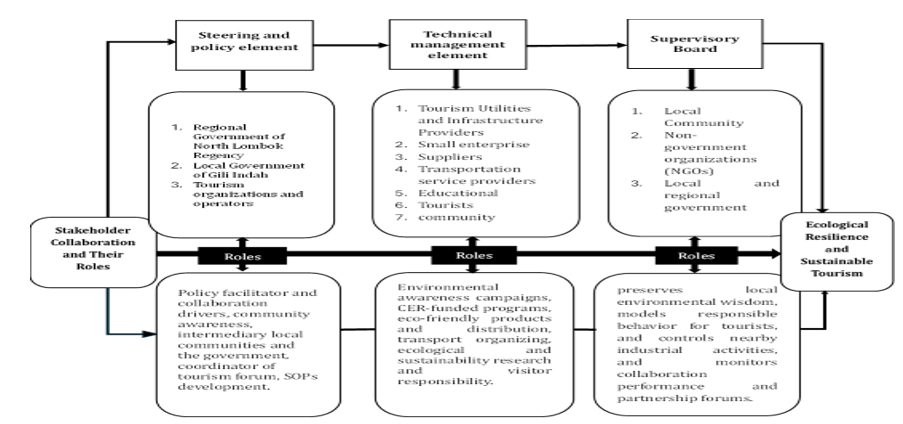
The sustainability of tourism in the Gili Tramena (Trawangan, Meno, Air) is under serious threat due to environmental damage from waste, sewage, and overexploitation of resources. This study aims to explore collaboration among stakeholders in sustainable tourism and ecological resilience. Using a qualitative approach with observation, in-depth interviews, and NVivo analysis. The results show that collaboration through routine activities such as a recycling tour, Friday cleanup, integrated waste processing, and coral reef restoration using biorock technology has helped improve ecological conditions. The resilience strategies are regulatory strengthening, empowerment of community organizations, environmental education, active participation of business actors, and stakeholder communication forums. To strengthen the role of stakeholders in enhancing ecological resilience, the GITEC (Gili Tramena Ecology and Tourism Multi-Stakeholder Collaboration) framework was developed with three main elements: steering element, a technical management element, and a supervisory board.
References
1) Aquino, J., & Andereck, K. L. (2024). Stakeholder perceptions of volunteer tourism community impact. International Journal of Tourism Cities, 10(2), 562–576. https://doi.org/10.1108/IJTC-05-2022-0116.
2) Ballard, H. L., Lindell, A. J., & Jadallah, C. C. (2024). Environmental education outcomes of community and citizen science: a systematic review of empirical research. Environmental Education Research, 30(6), 1007–1040. https://doi.org/10.1080/13504622.2024.2348702.
3) Barthel, S., Folke, C., & Colding, J. (2010). Social-ecological memory in urban gardens: Retaining the Capacity for Management of Ecosystem Services. Global Environmental Change, 20(2), 255-265. https://doi.org/10.1016/j.gloenvcha.2010.01.001.
4) Bello, F. G., Lovelock, B., & Carr, N. (2018). Enhancing Community Participation In Tourism Planning Associated with Protected Areas in Developing Countries: Lessons from Malawi. Tourism and Hospitality Research, 18(3), 309–320.https://doi.org/10.1177/1467358416647763.
5) Boqué-Ciurana, A., Saladié, Ò., Rovira-Soto, M. T., Garcia-Lozano, C., Martí, C., Tonda, M., Borràs, G., & Aguilar, E. (2025). How Can Stakeholder Co-Creation Foster Climate-Resilient Coastal Tourism Through Integrated Management of Climate, Water-Energy, and Beach-Dune Systems? Sustainability (Switzerland), 17(22). https://doi.org/10.3390/su172210163.
6) Brizga, J., Ozolins, M., & Ernsteins, R. (2024). Environmental Governance in Latvia: Good Governance Framing and Implementation Review. Inżynieria Mineralna, 1(1). https://doi.org/10.29227/IM-2024-01-68.
7) Buckley, R. (2020). Nature Tourism and Mental Health: Parks, Happiness, and Causation. Journal of Sustainable Tourism, 28(9), 1409–1424. https://doi.org/10.1080/09669582.2020.1742725.
8) Burton, A. M., & Pachucki, C. (2026). Better together? Stakeholder collaboration as a driver for ecological innovation in community model destinations. Journal of Destination Marketing & Management, 39, 101058. https://doi.org/10.1016/j.jdmm. 2025.101058.
9) Cameron Ali Memon David G Simmons John R Fairweather, A. M.,Whare Wiina, T., & Aora, O. (t.t.). Evolving Role of Local Government in Promoting Sustainable Tourism Development on the West Coast Westland Case Study.
10) Chairunnisa, N. K., Adam, Moh. A., Kristianto, S., Aidil Candri, D., Shofi Talbia, H., Aprilia, M., Mutia, T., Masruroh, H., Iswara, A. P., & Prayogo, W. (2025). Linking the Tourism Activity to the Occurrence and Distribution of Microplastics. Civil Engineering Journal, 11(7), 2811–2825. https://doi.org/10.28991/CEJ-2025-011-07-010.
11) Chatterjee, P., & Datta, S. K. (2024). Preserving environmental quality of ecotourism sites through community participation in Purulia District of West Bengal, India. Regional Sustainability, 5(3). https://doi.org/10.1016/j.regsus.2024.100163.
12) Clark, C., Nyaupane, G. P., & Xiao, X. (2026). Building Community Resilience and Adaptive Capacity Through Investments in Tourism and Conservation. Journal of Travel Research, 65(2), 392–410. https://doi.org/10.1177/00472875241304482.
13) Conefrey, A., Hanrahan, J., McTiernan, C., Borges, M. do R., Lima, J., Serra, J., Yu, J. (Jerry), Iglesias, M. C. B., Mercedes Galan-Ladero, M., Gómez-Ullate, M., Tato-Jiménez, J.-L., Badulescu, A., Bâc, D.-P., & Tătar, C.-F. (2025). Tourism education in Europe and the road to Net-Zero: Are universities doing enough? Journal of Cleaner Production, 536, 147039. https://doi.org/10.1016/j.jclepro.2025.147039.
14) Creswell, J. W. (2014). Research Design: Qualitative, Quantitative, and Mixed Methods Approaches (4th ed.). California: SAGE Publications.
15) Dananjaya, A. G. (2025a). Kolaborasi Pentahelix dalam Pengembangan Pariwisata Berkelanjutan di Ibu Kota Nusantara. Masyarakat Pariwisata : Journal of Community Services in Tourism, 6(1), 30–47. https://doi.org/10.34013/mp.v6i1.1983.
16) Dananjaya, A. G. (2025b). Profit Over Paradise: Exposing the Unsustainable Trajectory of Foreign Property in Canggu’s Tourism Development. Journal of Indonesian Tourism and Development Studies, 13(2), 70–77.https://doi.org/10.21776/ub.jitode.2025.013.02.03.
17) Das, A., & Mishra, S. (2026). A destination-scale framework for regenerative tourism integrating circular economy and community resilience. Green Technology, Resilience, and Sustainability, 6(1), 2. https://doi.org/10.1007/s44173-026-00027-x.
18) Dłużewska, A., & Giampiccoli, A. (2024a). From Corporate Social Responsibility to ‘Corporate Environmental Responsibility’ and Back: Rebalancing and Enhancing CSR towards a More Just Tourism Sector. Sustainability (Switzerland), 16(19).https://doi.org/10.3390/su16198438.
19) Duan, H., Yu, X., Zhang, L., Xia, S., Liu, Y., Mao, D., & Zhang, G. (2022). An evaluating system for wetland ecological risk: Case study in coastal mainland China. Science of The Total Environment, 828, 154535. https://doi.org/10.1016/j. scitotenv. 2022. 154535.
20) Firdaus, Hardjosoekarto, S., & Lawang, R. M. Z. (2021a). The Role of Local Government on Rural Tourism Development: Case Study of Desa Wisata Pujonkidul, Indonesia. International Journal of Sustainable Development and Planning, 16(7), 1299–1307. https://doi.org/10.18280/ijsdp.160710.
21) Fontanari, M., & Traskevich, A. (2025). Confidence-Model: Cooperative networks to develop destination resilience. Journal of Destination Marketing & Management, 35, 100962. https://doi.org/10.1016/j.jdmm.2024.100962.
22) Gannon, M., Rasoolimanesh, S. M., & Taheri, B. (2021). Assessing the Mediating Role of Residents’ Perceptions toward Tourism Development. Journal of Travel Research, 60(1), 149–171. https://doi.org/10.1177/0047287519890926.
23) Graci, S. (2013). Collaboration and Partnership Development for Sustainable Tourism. Tourism Geographies, 15(1), 25–42.
https://doi.org/10.1080/14616688. 2012. 675513.
24) Hajar, S., Ramlan, & Kholik, K. (2025). Why is adaptive policy important in geosite governance as an effort to realize sustainable tourism in the Toba Caldera Geopark Area of Samosir Regency? Frontiers in Political Science, 7.
https://doi.org/10.3389/fpos. 2025. 1713478.
25) Herutomo, Ch., & Istiyanto, S. B. (2021). KOMUNIKASI LINGKUNGAN DALAM MENGEMBANGKAN KELESTARIAN HUTAN. WACANA: Jurnal Ilmiah Ilmu Komunikasi, 1–13. https://doi.org/10.32509/wacana.v20i1.1165.
26) Iddawela, Y., Lee, N., & Rodríguez-Pose, A. (2021). Quality of Sub-national Government and Regional Development in Africa. The Journal of Development Studies, 57(8), 1282–1302. https://doi.org/10.1080/00220388.2021.1873286.
27) Indrarosa, D., Mariyono, J., Santoso, S. I., & Sutaryo, S. (2025). The effectiveness of community-based eco-farm waste management training on enhancing farmers’ environmental awareness: The role of government support and sustainability attitudes. Cleaner Waste Systems, 12, 100394. https://doi.org/10.1016/j.clwas.2025.100394.
28) Jamal, T., & Stronza, A. (2009). Collaboration theory and tourism practice in protected areas: stakeholders, structuring and sustainability. Journal of Sustainable Tourism, 17(2), 169–189. https://doi.org/10.1080/09669580802495741.
29) Kasa, V. P., Brahmandam, A. K. S. V., Samal, B., Cheela, V. R. S., Dubey, B. K., & Pathak, K. (2025). Assessment Of Coastal Litter Trends in Tourist Vs. Non-Tourist Beaches: A Case Study from Indian Coastal Smart City. Science of The Total Environment, 959, 178339. https://doi.org/10.1016/j.scitotenv.2024.178339.
30) Kavitha, K., & Ravi, G. R. (2024). Culinary Heritage as a Sustainable Tourism Product (hlm. 60–76). https://doi.org/10.4018/979-8-3693-4135-3.ch004.
31) Kerti, M. N. L., Effendy, K., Fitriati, R., & Faisal, F. (2025). Collaborative Governance of Tourism Policy of Bali Province, Policy Study based on Local Wisdom Sad Kerthi. Jurnal Manajemen Pelayanan Publik, 9(3), 774-787. https://doi.org/10. 24198/jmpp. v9i3. 65333.
32) Kurniawan, F., Adrianto, L., Bengen, D. G., & Prasetyo, L. B. (2023). Hypothetical effects assessment of tourism on coastal water quality in the Marine Tourism Park of the Gili Matra Islands, Indonesia. Environment, Development and Sustainability, 25(8), 7959–7985. https://doi.org/10.1007/s10668-022-02382-8.
33) Kutzner, D. (2019). Environmental change, resilience, and adaptation in nature-based tourism: conceptualizing the social-ecological resilience of birdwatching tour operations. Journal of Sustainable Tourism, 27(8), 1142–1166. https://doi.org/10.1080/09669582.2019.1601730.
34) Li, Z., & Yaakop, M. R. (2025). Engaging Non-Governmental Organizations in Global Climate Governance: A Systematic Review of Journal Publications From 2014 To 2024. Frontiers In Political Science, 7. https://doi.org/10.3389/fpos.2025.1604680.
35) Liu, Z. (2003). Sustainable Tourism Development: A Critique. Journal of Sustainable Tourism, 11(6), 459–475.
https://doi.org/10.1080/09669580308667216.
36) Lu, X., Yao, S., Fu, G., Lv, X., & Mao, Y. (2019). Dynamic simulation test of a model of ecological system security for a coastal tourist city. Journal of Destination Marketing & Management, 13, 73–82. https://doi.org/10.1016/j.jdmm.2019.05.004.
37) Lubis, L., Tamrin, M. H., & Musleh, Moh. (2024a). Collaborative Governance Networks Supporting Sustainable Ecotourism: A Case Study of Gili Iyang Island, Indonesia. Society, 12(1), 94–110. https://doi.org/10.33019/society.v12i1.663.
38) Mandić, A., Spenceley, A., & Leung, Y.-F. (2025). Toward Resilient Nature-Based Tourism in the Post-Pandemic Era: Integrating Governance, Visitor Dynamics, Finance, and Ecosystem Integrity. Tourism Planning & Development, 22(5), 617–631.
https://doi.org/10.1080/21568316.2025.2553500.
39) Markatos, G., Efthymiou, L., & Morphitis, A. (2024). Collaborative Government Initiatives for Implementing Tourism Carrying Capacity in the Context of Sustainable Development (hlm. 233–260). https://doi.org/10.1007/978-3-031-62534-3_10.
40) Maturbongs, E. E., & Lekatompessy, R. L. (2025). Collaborative Governance of the Tourism Potential Development in Merauke District. Jurnal Ilmu Sosial dan Humaniora, 14(2), 361–371. https://doi.org/10.23887/jish.v14i2.91755.
41) Mcloughlin, E., & Hanrahan, J. (2025a). Funding and governance dynamics in sustainable planning for tourism: Insights from the republic of Ireland. Tourism and hospitality management, 31(2), 189–196. https://doi.org/10.20867/thm.31.2.2.
42) Melenez-Roman, J., & Font, X. (2026). Collective actions for sustainable tourism innovation. Annals of Tourism Research, 116, 104090. https://doi.org/10.1016/j. annals. 2025. 104090.
43) Mertha, I. W., Yunita, P. I., & Tirtawati, N. M. (2025). Creating Quality Tourism Destinations: The Crucial Role of Community Participation and Government Support in Batur UNESCO Global Geopark - Bali. E-Journal of Tourism, 178–197.
https://doi.org/10.24922/eot.v12i2.2173.
44) Miccini, R., Ciappei, C., & Liberatore, G. (2026). To regulate or not to regulate: The destination management dilemma in handling the intensity of tourism. Tourism Management, 115, 105399. https://doi.org/10.1016/j.tourman.2026.105399.
45) Moreno‐serna, J., Sánchez‐chaparro, T., Stott, L., Mazorra, J., Carrasco‐gallego, R., & Mataix, C. (2021). Feedback loops and facilitation: Catalyzing Transformational Multi‐Stakeholder Refugee Response Partnerships. Sustainability (Switzerland), 13(21). https://doi.org/10.3390/su132111705.
46) Nawari, Thamrin, Nofrizal, Syahza, A., Muhammad, J., & Islami, N. (2022). Community based ecotourism management to strengthen environmental ethics and supports sustainable development in Pelalawan district, Indonesia. IOP Conference Series: Earth and Environmental Science, 1041(1). https://doi.org/10.1088/1755-1315/1041/1/012036.
47) Novianti, K. D. P., Sanjiwani, I. G. A. M., Trisnadewi, K. S., & Kusuma, I. B. S. (2025). Batuan Xperience: Harnessing Local Community Power for Sustainable Tourism Development (hlm. 486–493). https://doi.org/10.2991/978-94-6463-882-0_55.
48) Partelow, S., Fujitani, M., Williams, S., Robbe, D., & Saputra, R. A. (2023). Disaster impacts, resilience, and sustainability opportunities for Gili Trawangan, Indonesia: transdisciplinary reflections following COVID‐19. Disasters, 47(2), 499–518.https://doi.org/10.1111/disa.12554.
49) Purmintasari, Y. D., Santoso, D., Uli, I., Breman, S., & Lizawati. (2025). Heritage in Harmony: Preserving Traditional Ecological Knowledge to Develop Sustainable Cultural Tourism in Borneo Island, Indonesia. Journal of Marine and Island Cultures, 14(3).
https://doi.org/10.21463/jmic.2025.14.3.07.
50) Quang, N. H. (2025). Perceptions Of Tourists and Locals on Tourism Infrastructure and Environmental Protection in Rural Sustainable Tourism. International Journal of Tourism Policy, 15(5), 457–471. https://doi.org/10.1504/IJTP.2025.149787.
51) Rahman, A. Z., Pradana, A. E., & Rakhma, N. A. (2025a). Sustainable Tourism Development in Glawan Village: Balancing Infrastructure Growth and Environment through Local Governance. IOP Conference Series: Earth and Environmental Science, 1537(1).
https://doi.org/10.1088/1755-1315/1537/1/012001.
52) Räikkönen, J. (t.t.). Advancing environmental sustainability through nature-based science tourism: The potential of universities.
53) Rasoolimanesh, S. M., Ramakrishna, S., Hall, C. M., Esfandiar, K., & Seyfi, S. (2023). A systematic scoping review of sustainable tourism indicators in relation to the sustainable development goals. Journal of Sustainable Tourism, 31(7), 1497–1517.
https://doi.org/10.1080/09669582.2020.1775621.
54) Ratner, B. D., Larson, A. M., Sarmiento Barletti, J. P., Eldidi, H., Catacutan, D., Flintan, F., Suhardiman, D., Falk, T., & Meinzen-Dick, R. (2022). Multistakeholder platforms for natural resource governance: lessons from eight landscape-level cases. Ecology and Society, 27(2). https://doi.org/10.5751/ES-13168-270202.
55) Rifai, H., Lukman, K. M., Quevedo, J. M. D., Francis, P., Sjafrie, N. D. M., Triyono, Mckenzie, L., Hidayat, R., Nugraha, A. H., Kuriandewa, T. E., Suryawati, S. H., Prayudha, B., Suraji, S., Risandi, J., & Hernawan, U. E. (2024). Understanding stakeholders’ perception on developing seagrass-associated tourism: Evidence from marine protected areas of Bintan Island, Indonesia. Marine Pollution Bulletin, 209, 117063. https://doi.org/10.1016/j.marpolbul.2024.117063.
56) Rizqi, B., & Eko Kusratmoko. (2025). Role of the Physical Environment in the Development of Tourism Villages in Indonesia: International Journal of Sustainable Competitiveness on Tourism, 4(02), 1–13. https://doi.org/10.34013/ijscot. v4i02. 1972.
57) Salat, A. J., Mohamed, A. M., & Hussein, M. (2025). Influence of Education Levels on Land Conservation Initiatives in Wajir West Sub-County, Kenya. East African Journal of Environment and Natural Resources, 8(3), 1–11. https://doi.org/10. 37284/eajenr. 8. 3.3634.
58) Sarhan, M., Pernecky, T., Orams, M., & Lück, M. (2025). Exploring collaborative governance and community participation in tourism and conservation—insights from Waiheke Island, New Zealand. Frontiers in Sustainable Tourism, 4.
https://doi.org/10.3389/frsut.2025.1567048.
59) Selvia, S. I., & Iemaaniah, Z. M. (2024). Comparison Of Carbon Stock Based on Existing Land Cover and Spatial Pattern Plans in Gili Matra. Geoeco, 10(2), 221. Https://Doi.Org/10.20961/Ge.V10i2.86109.
60) Shang, F., Goh, H. C., & Masud, M. M. (2025). Stakeholder perceptions of tourism’s impacts on the ecological environment of island destinations based on a systematic review and meta-analysis. Scientific Reports, 15 (1). https://doi.org/10. 1038/s41598- 025- 05196- 6.
61) Sharifi, A., Najafabadi, M. O., & Korom, R. A. (2025). A qualitative paradigmatic model of resilience for sustainable ecotourism: Evidence from Kerman County, Iran. Journal of the Saudi Society of Agricultural Sciences, 24(7). https://doi.org/10.1007/s44447-025-00048-1.
62) Simanihuruk, M., Arafah, W., & Rahmanita, M. (2024). The Role of Governance, Social Welfare, and Community Participation on Sustainable Tourism Village: A Case Study in Pioneering Tourism Village, Bogor Regency, Indonesia. International Journal of Research and Review, 11(6), 432–439. https://doi.org/10.52403/ijrr.20240650.
63) Sitohang, L. L., Winulyo, W. P., Adib, M., Fitriani, A. N., Martin, S., & Zulfah, Z. (2024a). The Role of The Local Government in Supporting Sustainable Tourism (A Case Study in Ubud, Gianyar Regency, Bali). Jurnal Kepariwisataan, 23(2), 1–13. https://doi.org/10.52352/jpar.v23i2.1390.
64) Ssekajja, G. (2025). The inter-community domain of commons governance: A framework for analyzing collaborative management of shared environmental resources. Journal of Environmental Management, 389, 126086. https://doi.org/10.1016/j.jenvman.2025.126086.
65) Suana, W., & Ahyadi, H. (2012). Mapping Of Ecosystem Management Problems in Gili Meno, Gili Air And Gili Trawangan (Gili Matra) Through Participative Approach. 16(1), 94–101.
66) Sulistyo, A., Rijanta, R., Hadna, A. H., & Giyarsih, S. R. (2023). Group of Community-Based Tourism Awareness (Pokdarwis) Strategies in Addressing Conflicts in Utilization and Conservation of the Environment. Forum Ilmu Sosial, 50(2), 70–83. https://doi.org/10.15294/fis.v50i2.44799.
67) Surya, A. P. (2024). The Role of Ecotourism in Promoting Sustainable Economic Development in Indonesia. Journal of World Economy, 3(1), 43–48. https://doi.org/10.56397/JWE.2024.03.06.
68) Susilo, R. K. (2025). From Collaboration to Participation Deficit: Dynamic Of Environmental Conservation Movement in Responding to Tourism Policy. Jkap (Jurnal Kebijakan dan Administrasi Publik), 29(2), 1. https://doi.org/10.22146/jkap.97159.
69) van Onselen, V. M., Bayrak, M. M., Gladfelter, S., & Lin, T. Y. (2025). Community insights on tourism development and nature-based solutions for increased resilience to coastal hazards at Caota sand dunes Geopark in Taiwan. Progress in Disaster Science, 28. https://doi.org/10.1016/j.pdisas.2025.100472.
70) Vergara Romero, A., Durán-Román, J. L., Jimber-Del Rio, J. A., & Collado-González, J. C. (2025). Business management of sustainable destinations and its effect on ecotourism entrepreneurship to mitigate overtourism. Humanities and Social Sciences Communications, 12(1). https://doi.org/10.1057/s41599-025-05149-4.
71) Widianto, A., Bengen, D. G., Budiharsono, S., & Koropitan, A. F. (2026). Rapid economic valuation and sustainability analysis for managing ecotourism in Gili Matra Marine Conservation Area, West Nusa Tenggara Province. BIO Web of Conferences, 220. https://doi.org/10.1051/bioconf/202622001001.
72) Wirawan, P. E. (2025). Pariwisata Berbasis Kearifan Lokal di Desa Wisata Ubud: Antara Komersialisasi dan Pelestarian Budaya. Jurnal Ilmiah Pariwisata, 30(2), 249. https://doi.org/10.30647/jip.v30i2.1891.
73) Wu, J., Yang, Y., Zuo, J., Cao, Q., Guo, D., & Liu, S. (2024). Evaluation and influencing factors of ecological resilience in tourism villages from farmers’ perspectives: a case study of Chinese minority settlement areas. Frontiers in Environmental Science, 12. https://doi.org/10.3389/fenvs.2024.1400546.
Downloads
Published
Issue
Section
License
Copyright (c) 2026 I Wayan Suteja, Syech Idrus, Siluh Putu Damayanti, Mochammad Taufiqi Imam Ijlal, Anita Anggriana Albaar (Author)

This work is licensed under a Creative Commons Attribution 4.0 International License.












