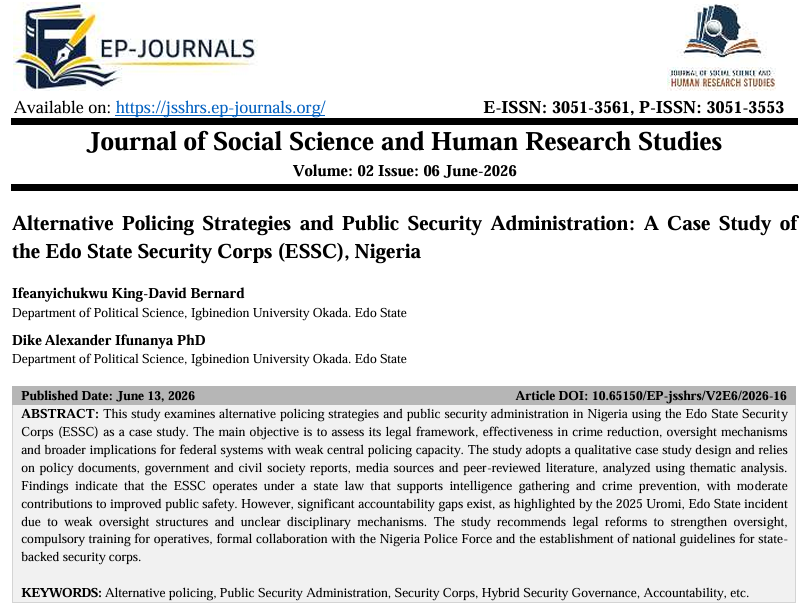
Alternative Policing Strategies and Public Security Administration: A Case Study of the Edo State Security Corps (ESSC), Nigeria
DOI:
https://doi.org/10.65150/EP-jsshrs/V2E6/2026-16Keywords:
Alternative policing, Public Security Administration, Security Corps, Hybrid Security Governance, Accountability, etc.Abstract
This study examines alternative policing strategies and public security administration in Nigeria using the Edo State Security Corps (ESSC) as a case study. The main objective is to assess its legal framework, effectiveness in crime reduction, oversight mechanisms and broader implications for federal systems with weak central policing capacity. The study adopts a qualitative case study design and relies on policy documents, government and civil society reports, media sources and peer-reviewed literature, analyzed using thematic analysis. Findings indicate that the ESSC operates under a state law that supports intelligence gathering and crime prevention, with moderate contributions to improved public safety. However, significant accountability gaps exist, as highlighted by the 2025 Uromi, Edo State incident due to weak oversight structures and unclear disciplinary mechanisms. The study recommends legal reforms to strengthen oversight, compulsory training for operatives, formal collaboration with the Nigeria Police Force and the establishment of national guidelines for state-backed security corps.
References
1) Adelepoju, A. (2025, March 18). Uromi lynching: Edo govt suspends security corps commander, orders probe. Premium Times. https://www.premiumtimesng.com
2) Alemika, E. E. O., & Chukwuma, I. C. (2004). Police–community partnership in Nigeria: Problems and prospects. CLEEN
Foundation.
3) Bagayoko, N., Hutchful, E., & Luckham, R. (2016). Hybrid security governance in Africa: Rethinking the foundations of security, justice and legitimate public authority. Conflict, Security & Development, 16(1), 1–32.
https://doi.org/10.1080/14678802.2016.1136137
4) Baker, B. (2005). Multi-choice policing in Africa. Nordic Africa Institute.
5) Braun, V., & Clarke, V. (2006). Using thematic analysis in psychology. Qualitative Research in Psychology, 3(2), 77–101.
6) CLEEN Foundation. (2023). Public perception of state security corps in Edo State: Survey report. CLEEN Foundation Publications.
7) Edo State Government. (2020). Edo State Security Corps Law, 2020. Edo State Gazette.
8) Edo State Ministry of Justice. (2024). Security sector performance report 2021–2023. Government Printer.
9) Hills, A. (2008). Policing in Africa: Internal security and the limits of liberalization. African Affairs, 107(429), 621–640.
10) Human Rights Watch. (2010). “Everyone’s in on the game”: Vigilante violence and police abuse in Nigeria. Human Rights Watch.
11) Human Rights Writers Association of Nigeria. (2025, March 20). Press release: HURIWA calls for disbandment of all state security corps following Uromi killings. https://huriwa.org
12) Meagher, K. (2012). The strength of weak states: Non-state security forces and hybrid governance in Africa. Development and Change, 43(5), 1073–1101.
13) Nigeria Police Force. (2022). Operational guidelines for collaboration with non-state security actors. NPF Headquarters.
14) Nwankwo, C. F. (2023). State-backed community policing in Nigeria: The case of the Edo State Security Network. African Journal of Criminology and Justice Studies, 14(1), 65–89.
15) Okoro, P. O., & Eze, N. C. (2022). The Atalakpa model of community security in Edo State: Promises and pitfalls. Journal of African
Security Studies, 8(2), 112–134.
16) Premium Times. (2025, March 16). Three suspected robbers lynched by vigilante in Uromi, Edo. Premium Times. https://www.premiumtimesng.com
17) The Guardian. (2024, November 5). ESSC operatives accused of illegal detention in Benin City. The Guardian (Nigeria).
18) Vanguard. (2023, August 22). ESSC operative dismissed for assault, but no prosecution – sources. Vanguard.
19) Yin, R. K. (2018). Case study research and applications: Design and methods (6th ed.). SAGE Publications.
Downloads
Published
Issue
Section
License
Copyright (c) 2026 Ifeanyichukwu King-David Bernard, Dike Alexander Ifunanya PhD (Author)

This work is licensed under a Creative Commons Attribution 4.0 International License.












