Indigenous Play-Based Learning and Cognitive Development in Early Childhood Education Across African Contexts
DOI:
https://doi.org/10.65150/EP-jsshrs/V2E6/2026-19Keywords:
indigenous play-based learning, cognitive development, early childhood education across African contextsAbstract
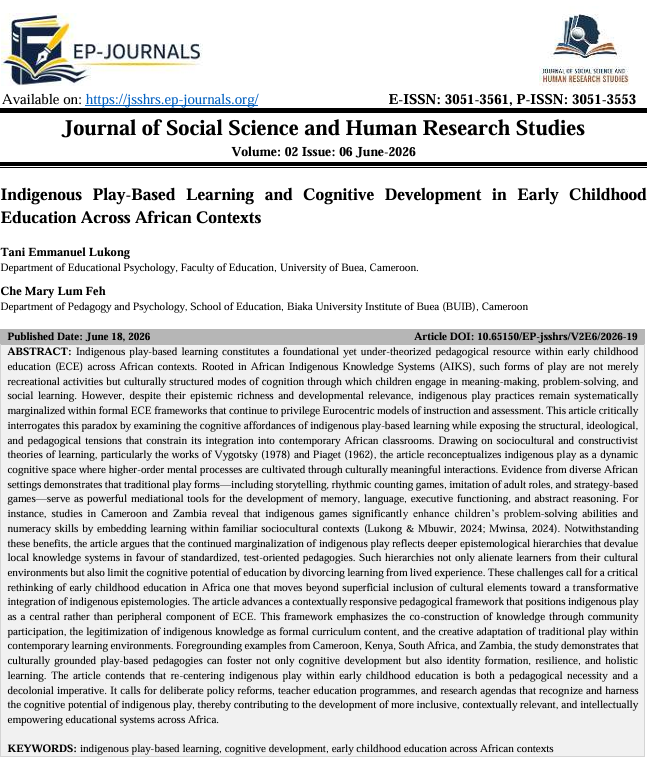
Indigenous play-based learning constitutes a foundational yet under-theorized pedagogical resource within early childhood education (ECE) across African contexts. Rooted in African Indigenous Knowledge Systems (AIKS), such forms of play are not merely recreational activities but culturally structured modes of cognition through which children engage in meaning-making, problem-solving, and social learning. However, despite their epistemic richness and developmental relevance, indigenous play practices remain systematically marginalized within formal ECE frameworks that continue to privilege Eurocentric models of instruction and assessment. This article critically interrogates this paradox by examining the cognitive affordances of indigenous play-based learning while exposing the structural, ideological, and pedagogical tensions that constrain its integration into contemporary African classrooms. Drawing on sociocultural and constructivist theories of learning, particularly the works of Vygotsky (1978) and Piaget (1962), the article reconceptualizes indigenous play as a dynamic cognitive space where higher-order mental processes are cultivated through culturally meaningful interactions. Evidence from diverse African settings demonstrates that traditional play forms—including storytelling, rhythmic counting games, imitation of adult roles, and strategy-based games—serve as powerful mediational tools for the development of memory, language, executive functioning, and abstract reasoning. For instance, studies in Cameroon and Zambia reveal that indigenous games significantly enhance children’s problem-solving abilities and numeracy skills by embedding learning within familiar sociocultural contexts (Lukong & Mbuwir, 2024; Mwinsa, 2024). Notwithstanding these benefits, the article argues that the continued marginalization of indigenous play reflects deeper epistemological hierarchies that devalue local knowledge systems in favour of standardized, test-oriented pedagogies. Such hierarchies not only alienate learners from their cultural environments but also limit the cognitive potential of education by divorcing learning from lived experience. These challenges call for a critical rethinking of early childhood education in Africa one that moves beyond superficial inclusion of cultural elements toward a transformative integration of indigenous epistemologies. The article advances a contextually responsive pedagogical framework that positions indigenous play as a central rather than peripheral component of ECE. This framework emphasizes the co-construction of knowledge through community participation, the legitimization of indigenous knowledge as formal curriculum content, and the creative adaptation of traditional play within contemporary learning environments. Foregrounding examples from Cameroon, Kenya, South Africa, and Zambia, the study demonstrates that culturally grounded play-based pedagogies can foster not only cognitive development but also identity formation, resilience, and holistic learning. The article contends that re-centering indigenous play within early childhood education is both a pedagogical necessity and a decolonial imperative. It calls for deliberate policy reforms, teacher education programmes, and research agendas that recognize and harness the cognitive potential of indigenous play, thereby contributing to the development of more inclusive, contextually relevant, and intellectually empowering educational systems across Africa.
References
1) Abah, F. I., Mboshi, N. S., & Muki, A. N. (2025). Indigenous games and knowledge acquisition among children (7–11 years old) of Moghamo in Cameroon. International Journal of Trend in Scientific Research and Development, 9(2), 1170–1181.
2) African Population and Health Research Center (APHRC). (2025). Integrating African indigenous practices and digital tools in early childhood education.
3) Awopegba, P. O. (2017). Indigenous games and cognitive development among children in West Africa. Journal of African Educational Research, 12(2), 45–59.
4) Brock-Utne, B. (2017). Multilingualism and education in Africa: The role of language in learning. International Review of Education, 63(4), 499–517.
5) Dei, G. J. S. (2014). Indigenous philosophies and critical education: A reader on cultural knowledge and pedagogy. Peter Lang.
6) Ekeha, M. C. (2024). The pedagogic role of indigenous play for early-grade learners. African Journal of Education Studies.
7) Hadebe-Ndlovu, B., & Khalane, T. (2022). Teachers’ experiences of indigenous games in the early grades. South African Journal of Childhood Education, 12(1).
8) Lukong, T. E., & Mbuwir, K. M. (2024). Imperativeness of indigenous games on the development of cognitive skills for African learners and learning: Pedagogic implications for Cameroon adolescents. International Journal of Humanities Social Sciences and Education, 11(4), 15–31.
9) Mwaura, P. (2015). Oral traditions and cognitive development in East African childhood.
10) Mwinsa, G. M. (2024). Efficacy of indigenous games on literacy and numeracy skills in early childhood education. South African Journal of Childhood Education.
11) Mwinsa, G. M. (2025). Play-based learning as a pedagogical approach for social and cognitive development in Zambia. Early Childhood Education Journal.
12) Piaget, J. (1962). Play, dreams and imitation in childhood. Norton.
13) Serpell, R., & Marfo, K. (2014). Child development in Africa: Views from inside. New Directions for Child and Adolescent Development, 146, 1–8.
14) Vygotsky, L. S. (1978). Mind in society: The development of higher psychological processes. Harvard University Press.
15) Wadende, P., Oburu, P. O., & Morara, A. (2016). African indigenous care-giving practices: Stimulating early childhood development and education in Kenya. South African Journal of Childhood Education, 6(2).
Downloads
Published
Issue
Section
License
Copyright (c) 2026 Tani Emmanuel Lukong, Che Mary Lum Feh (Author)

This work is licensed under a Creative Commons Attribution 4.0 International License.












