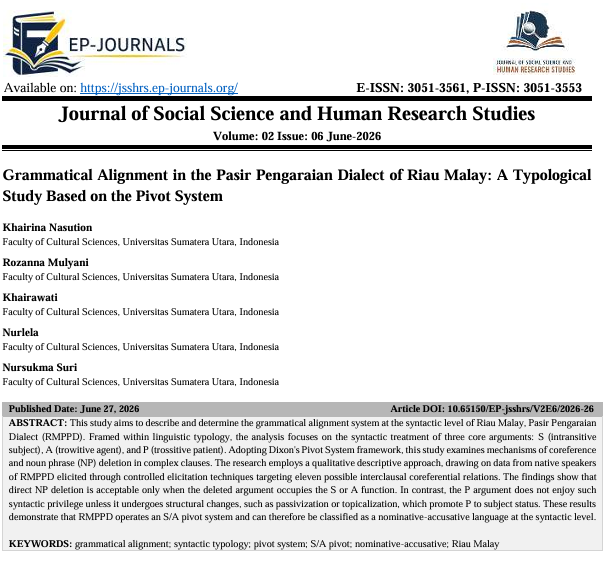
Grammatical Alignment in the Pasir Pengaraian Dialect of Riau Malay: A Typological Study Based on the Pivot System
DOI:
https://doi.org/10.65150/EP-jsshrs/V2E6/2026-26Keywords:
grammatical alignment, syntactic typology, pivot system, S/A pivot, nominative-accusative, Riau MalayAbstract
This study aims to describe and determine the grammatical alignment system at the syntactic level of Riau Malay, Pasir Pengaraian Dialect (RMPPD). Framed within linguistic typology, the analysis focuses on the syntactic treatment of three core arguments: S (intransitive subject), A (trowitive agent), and P (trossitive patient). Adopting Dixon's Pivot System framework, this study examines mechanisms of coreference and noun phrase (NP) deletion in complex clauses. The research employs a qualitative descriptive approach, drawing on data from native speakers of RMPPD elicited through controlled elicitation techniques targeting eleven possible interclausal coreferential relations. The findings show that direct NP deletion is acceptable only when the deleted argument occupies the S or A function. In contrast, the P argument does not enjoy such syntactic privilege unless it undergoes structural changes, such as passivization or topicalization, which promote P to subject status. These results demonstrate that RMPPD operates an S/A pivot system and can therefore be classified as a nominative-accusative language at the syntactic level.
References
1) Artawa, K., & Jufrizal. (2018). Tipologi linguistik: Konsep dasar dan aplikasinya. Denpasar: Larasan Artwa.
2) Budiarta, I. W. (2012). Aliansi gramatikal Bahasa Dawan: Kajian tipologi bahasa. Linguistika: Buletin Ilmiah Program Magister Linguistik Universitas Udayana, 19(1).
3) Comrie, B. (1989). Language universals and linguistic typology: Syntax and morphology (2nd ed.). University of Chicago Press.
4) Croft, W. (2022). Typology and universals (2nd ed.). Cambridge University Press.
5) Dixon, R. M. W. (1994). Ergativity. Cambridge University Press.
6) Handayani, D., & Ritonga, M. (2022). Sistem pivot Bahasa Mandailing: Kajian tipologi bahasa. KODE: Jurnal Bahasa, 11(1), 88–97.
https://doi.org/10.24114/kjb.v11i1.30547
7) Himmelmann, N. P. (2005). The Austronesian languages of Asia and Madagascar: Typological characteristics. In A. Adelaar & N. P. Himmelmann (Eds.), The Austronesian languages of Asia and Madagascar (pp. 110–181). Routledge.
8) Jufrizal. (2009). Fenomena tipologi gramatikal Bahasa Minangkabau: Akusatif, ergatif, atau campur? Leksika, 3(1).
https://doi.org/10.30595/lks.v3i1.2236
9) Kartika, R., & Mulyadi. (2024). Grammatical alliance in the Acehnese language. Journal of Language Development and Linguistics, 3(2), 109–122. https://doi.org/10.55927/jldl.v3i2.9481
10) Mallinson, G., & Blake, B. J. (1981). Language typology: Cross-linguistic studies in syntax. North-Holland Publishing Company.
11) Manning, C. D. (1994). Ergativity: Argument structure and grammatical relations. CSLI Publications.
12) Payne, T. E. (2002). Describing morphosyntax: A guide for field linguists. Cambridge University Press.
13) Seržant, I. A., Say, S., Hölzl, A., Zakharova, A., Gao, X., & Pregla, A. (2025). A typology of positional differential argument marking. Linguistic Typology. https://doi.org/10.1515/lingty-2024-0021
14) Sinaga, L., & Mulyadi. (2023). Grammatical alliance and pivot system of Batak Simalungun language: A syntactic typology study. LINGUA: Jurnal Ilmu Bahasa dan Sastra, 17(2), 237–246. https://doi.org/10.18860/ling.v17i2.16673
15) Sneddon, J. N. (2003). The Indonesian language: Its history and role in modern society. UNSW Press.
16) Song, J. J. (2014). Linguistic typology: Morphology and syntax. Oxford University Press.
17) Soraya, R., & Mulyadi. (2024). Grammatical alliance in Malay language: A study of linguistic typology. Journal of Language Development and Linguistics, 3(2), 123–138. https://doi.org/10.55927/jldl.v3i2.9485
18) Sudaryanto. (2015). Metode dan aneka teknik analisis bahasa. Duta Wacana University Press.
19) Sukma, S., Widayati, D., Dardanila, D., & Lubis, T. (2024). Perubahan bunyi Bahasa Proto Austronesia ke dalam Bahasa Melayu Riau Dialek Pasir Pengaraian. Deskripsi Bahasa, 7(2), 99–121. https://doi.org/10.22146/db.13997
20) Van Valin, R. D., Jr., & LaPolla, R. J. (1997). Syntax: Structure, meaning, and function. Cambridge University Press.
21) Velupillai, V. (2012). An introduction to linguistic typology. John Benjamins.
Downloads
Published
Issue
Section
License
Copyright (c) 2026 Khairina Nasution, Rozanna Mulyani, Khairawati (Author); Nurlela (Translator); Nursukma Suri (Author)

This work is licensed under a Creative Commons Attribution 4.0 International License.












