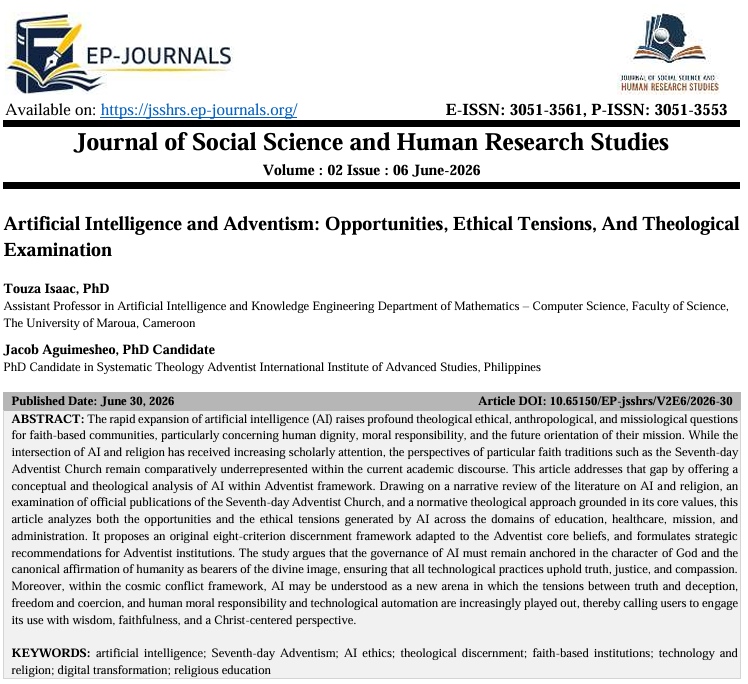
Artificial Intelligence and Adventism: Opportunities, Ethical Tensions, And Theological Examination
DOI:
https://doi.org/10.65150/EP-jsshrs/V2E6/2026-30Keywords:
artificial intelligence, Seventh-day Adventism, AI ethics, theological discernment, faith-based institutions, technology and religion, digital transformation, religious educationAbstract
The rapid expansion of artificial intelligence (AI) raises profound theological ethical, anthropological, and missiological questions for faith-based communities, particularly concerning human dignity, moral responsibility, and the future orientation of their mission. While the intersection of AI and religion has received increasing scholarly attention, the perspectives of particular faith traditions such as the Seventh-day Adventist Church remain comparatively underrepresented within the current academic discourse. This article addresses that gap by offering a conceptual and theological analysis of AI within Adventist framework. Drawing on a narrative review of the literature on AI and religion, an examination of official publications of the Seventh-day Adventist Church, and a normative theological approach grounded in its core values, this article analyzes both the opportunities and the ethical tensions generated by AI across the domains of education, healthcare, mission, and administration. It proposes an original eight-criterion discernment framework adapted to the Adventist core beliefs, and formulates strategic recommendations for Adventist institutions. The study argues that the governance of AI must remain anchored in the character of God and the canonical affirmation of humanity as bearers of the divine image, ensuring that all technological practices uphold truth, justice, and compassion. Moreover, within the cosmic conflict framework, AI may be understood as a new arena in which the tensions between truth and deception, freedom and coercion, and human moral responsibility and technological automation are increasingly played out, thereby calling users to engage its use with wisdom, faithfulness, and a Christ-centered perspective.
References
1) Bostrom, N. (2014). Superintelligence: Paths, dangers, strategies. Oxford University Press.
2) Crawford, K. (2021). Atlas of AI: Power, politics, and the planetary costs of artificial Intelligence. Yale University Press.
3) Floridi, L., et al. (2018). AI4People — An ethical framework for a good AI society. Minds and Machines, 28(4), 689–707; White, E. G. (1911). The great controversy. Pacific Press Publishing Association;
4) General Conference of Seventh-day Adventists. (2015). Adventist education: a statement of consensus. Silver Spring, MD: General Conference; Knight, G. R. (2000). A search for identity: The development of Seventh-day Adventist beliefs. Review and Herald; Knight, G. R. (2012). A brief history of Seventh-day Adventists (3rd ed.). Review and Herald.
5) Herzfeld, N. (2009). Technology and religion: remaining human in a co-created world. Templeton Press. White, E. G. (1905). The ministry of healing. Pacific Press Publishing Association ; White, E. G. (1911). The great controversy. Pacific Press Publishing Association; Landless, P. N., & Charles-Marcel, Z. L. (2021). Adventist health message: Ridiculous or serious? Adventist Review.
6) Knight, G. R. (2001). Philosophy and education: an introduction in christian perspective. Andrews University Press; Numberger, K., & Bowers, P. (Eds.). (1998). The silent church: Human rights and Adventist social ethics. Palgrave Macmillan; Du Preez, R. (2016). Interpreting and applying biblical ethics. In G. W. Reid (Ed.), Understanding Scripture: An Adventist approach (pp. 285–310). Review and Herald; Norman R. Gulley. (2012). Systematic theology: Creation, Christ, salvation. Andrews University Press.
7) Kurzweil, R. (2005). The singularity is near: When humans transcend biology. Viking.
8) Minsky, M. (1986). The society of mind. Simon & Schuster.
9) Noble, S. U. (2018). Algorithms of oppression: how search engines reinforce racism. New York University Press.
10) O'Neil, C. (2016). Weapons of math destruction: How big data increases inequality and threatens democracy. Crown Publishers.
11) Pontifical Academy for Life. (2020). Rome calls for ai ethics. Vatican City.
12) Russell, S., & Norvig, P. (2021). Artificial intelligence: A modern approach (4th ed.). Pearson.
13) Schwab, K. (2016). The fourth industrial revolution. World Economic Forum.
14) Tegmark, M. (2017). Life 3.0: Being human in the age of artificial intelligence. Knopf.
15) UNESCO. (2021). Recommendation on the ethics of artificial intelligence. Paris: UNESCO.
16) White, E. G. (1903). Education. Pacific Press Publishing Association; Gulley, N. R. (2003). Systematic theology: Prolegomena. Andrews University Press; Peckham, J. C. (2016). Canonical theology: The biblical canon, sola Scriptura, and theological method. Eerdmans; Reid, G. W. (Ed.). (2016). Understanding Scripture: An Adventist approach. Review and Herald.
17) Zuboff, S. (2019). The age of surveillance capitalism. Public Affairs.
Downloads
Published
Issue
Section
License
Copyright (c) 2026 Touza Isaac, PhD, Jacob Aguimesheo, PhD Candidate (Author)

This work is licensed under a Creative Commons Attribution 4.0 International License.












