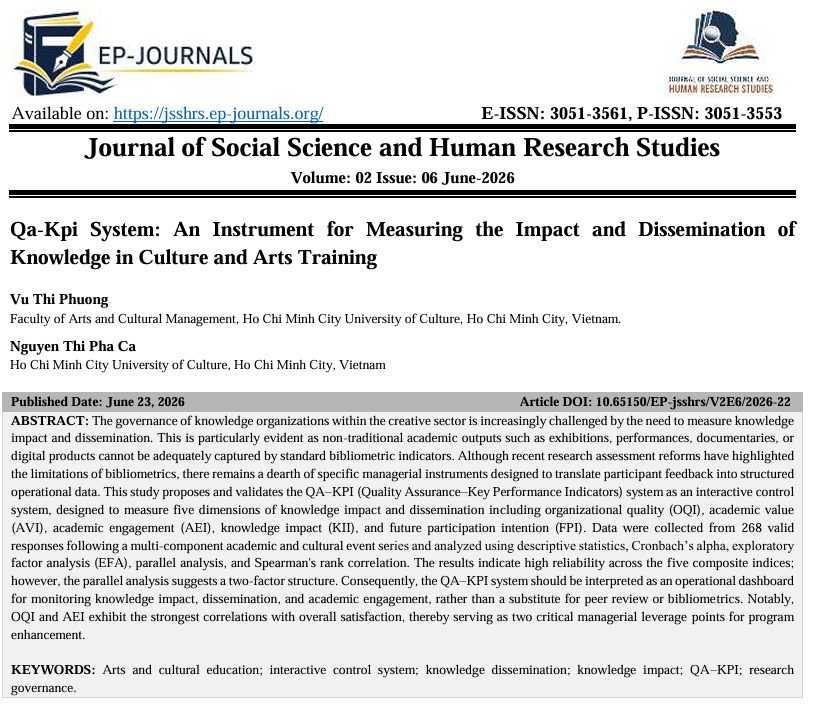
Qa-Kpi System: An Instrument for Measuring the Impact and Dissemination of Knowledge in Culture and Arts Training
DOI:
https://doi.org/10.65150/EP-jsshrs/V2E6/2026-22Keywords:
Arts and cultural education, interactive control system, knowledge dissemination, knowledge impact, QA–KPI, research governance.Abstract
The governance of knowledge organizations within the creative sector is increasingly challenged by the need to measure knowledge impact and dissemination. This is particularly evident as non-traditional academic outputs such as exhibitions, performances, documentaries, or digital products cannot be adequately captured by standard bibliometric indicators. Although recent research assessment reforms have highlighted the limitations of bibliometrics, there remains a dearth of specific managerial instruments designed to translate participant feedback into structured operational data. This study proposes and validates the QA–KPI (Quality Assurance–Key Performance Indicators) system as an interactive control system, designed to measure five dimensions of knowledge impact and dissemination including organizational quality (OQI), academic value (AVI), academic engagement (AEI), knowledge impact (KII), and future participation intention (FPI). Data were collected from 268 valid responses following a multi-component academic and cultural event series and analyzed using descriptive statistics, Cronbach’s alpha, exploratory factor analysis (EFA), parallel analysis, and Spearman's rank correlation. The results indicate high reliability across the five composite indices; however, the parallel analysis suggests a two-factor structure. Consequently, the QA–KPI system should be interpreted as an operational dashboard for monitoring knowledge impact, dissemination, and academic engagement, rather than a substitute for peer review or bibliometrics. Notably, OQI and AEI exhibit the strongest correlations with overall satisfaction, thereby serving as two critical managerial leverage points for program enhancement.
References
1) Australian Research Council. (2022). ERA 2023 evaluation framework. https://zenodo.org/records/13480728
2) Bisbe, J., & Otley, D. (2004). The effects of the interactive use of management control systems on product innovation. Accounting, Organizations and Society, 29(8), 709–737. https://doi.org/10.1016/j.aos.2003.10.010
3) Coalition for Advancing Research Assessment. (2022). Agreement on reforming research assessment. https://www.coara.org/wp-content/uploads/2025/11/2022_07_19_rra_agreement_final.pdf-3.pdf
4) DORA. (2024). Guidance on the responsible use of quantitative indicators in research assessment.
https://doi.org/10.5281/zenodo.10979644
5) Hicks, D., Wouters, P., Waltman, L., de Rijcke, S., & Rafols, I. (2015). Bibliometrics: The Leiden Manifesto for research metrics. Nature, 520(7548), 429–431. https://doi.org/10.1038/520429a
6) Kaplan, R. S., & Norton, D. P. (1992). The balanced scorecard: Measures that drive performance. Harvard Business Review, 70(1), 71–79.
7) Letmathe, P., & Meyer, C. (2025). Levers of control: Impact on innovation. Journal of Corporate Accounting & Finance. Advance online publication. https://doi.org/10.1002/jcaf.70000
8) Lewandowska, K., Ochsner, M., & Kulczycki, E. (2024). Research quality criteria in the creative arts. Studies in Higher Education, 49(4), 639–653. https://doi.org/10.1080/03075079.2023.2272152
9) Neely, A., Gregory, M., & Platts, K. (2005). Performance measurement system design: A literature review and research agenda. International Journal of Operations & Production Management, 25(12), 1228–1263. https://doi.org/10.1108/01443570510633639 (Original work published 1995)
10) OECD, European Union, & EC-JRC. (2008). Handbook on constructing composite indicators: Methodology and user guide. OECD Publishing. https://doi.org/10.1787/9789264043466-en
11) Research Excellence Framework. (2022). Overview report by Main Panel D and Sub-panels 25 to 34.
https://www.ref.ac.uk/publications/overview-report-by-main-panel-d-and-sub-panels-25-to-34/
12) Simons, R. (1991). Strategic orientation and top management attention to control systems. Strategic Management Journal, 12(1), 49–62. [suspicious link removed]
13) Tessier, S., & Otley, D. (2012). A conceptual development of Simons’ levers of control framework. Management Accounting Research, 23(3), 171–185. https://doi.org/10.1016/j.mar.2012.04.003
14) UNECE. (2019). Guidelines on producing leading, composite and sentiment indicators. United Nations Economic Commission for Europe.
15) Wilsdon, J., Allen, L., Belfiore, E., Campbell, P., Curry, S., Hill, S., Jones, R., Kain, R., Kerridge, S., Thelwall, M., Tinkler, J., Viney, I., Wouters, P., Hill, J., & Johnson, B. (2015). The metric tide: Independent review of the role of metrics in research assessment and management. Higher Education Funding Council for England. https://responsiblemetrics.org/the-metric-tide/
Downloads
Published
Issue
Section
License
Copyright (c) 2026 Vu Thi Phuong, Nguyen Thi Pha Ca (Author)

This work is licensed under a Creative Commons Attribution 4.0 International License.












