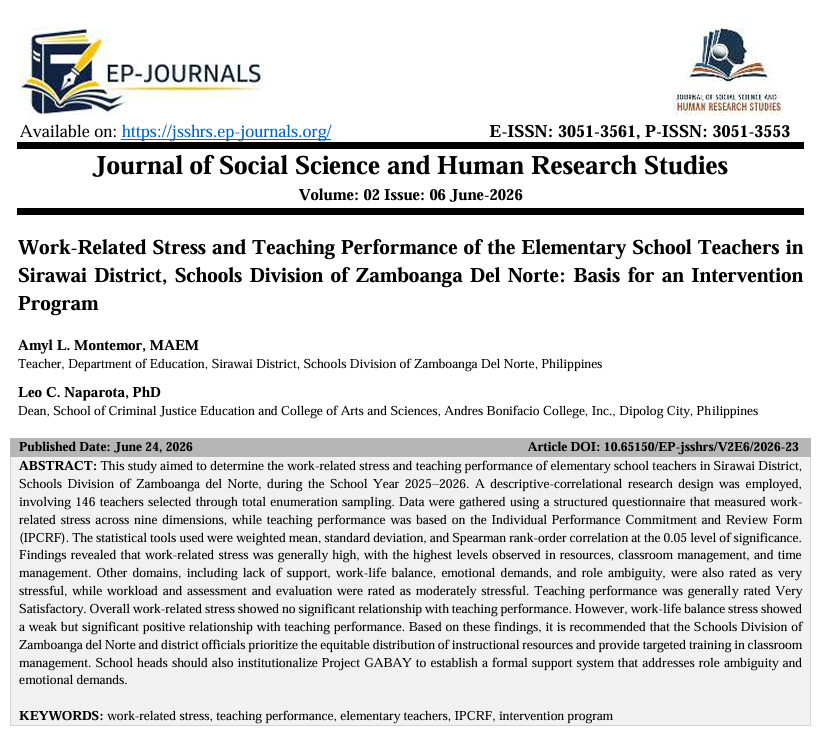
Work-Related Stress and Teaching Performance of the Elementary School Teachers in Sirawai District, Schools Division of Zamboanga Del Norte: Basis for an Intervention Program
DOI:
https://doi.org/10.65150/EP-jsshrs/V2E6/2026-23Keywords:
work-related stress, teaching performance, elementary teachers, IPCRF, intervention programAbstract
This study aimed to determine the work-related stress and teaching performance of elementary school teachers in Sirawai District, Schools Division of Zamboanga del Norte, during the School Year 2025–2026. A descriptive-correlational research design was employed, involving 146 teachers selected through total enumeration sampling. Data were gathered using a structured questionnaire that measured work-related stress across nine dimensions, while teaching performance was based on the Individual Performance Commitment and Review Form (IPCRF). The statistical tools used were weighted mean, standard deviation, and Spearman rank-order correlation at the 0.05 level of significance. Findings revealed that work-related stress was generally high, with the highest levels observed in resources, classroom management, and time management. Other domains, including lack of support, work-life balance, emotional demands, and role ambiguity, were also rated as very stressful, while workload and assessment and evaluation were rated as moderately stressful. Teaching performance was generally rated Very Satisfactory. Overall work-related stress showed no significant relationship with teaching performance. However, work-life balance stress showed a weak but significant positive relationship with teaching performance. Based on these findings, it is recommended that the Schools Division of Zamboanga del Norte and district officials prioritize the equitable distribution of instructional resources and provide targeted training in classroom management. School heads should also institutionalize Project GABAY to establish a formal support system that addresses role ambiguity and emotional demands.
References
1) Agyapong, B., Obuobi-Donkor, G., Burback, L., & Wei, Y. (2022). Stress, burnout, anxiety and depression among teachers: A scoping review. International Journal of Environmental Research and Public Health, 19(17), Article 10706.
https://doi.org/10.3390/ijerph191710706
2) Aiken, L. S., & West, S. G. (1991). Multiple regression: Testing and interpreting interactions. Sage Publications.
3) Aldrup, K., Klusmann, U., Lüdtke, O., Göllner, R., & Trautwein, U. (2018). Student misbehavior and teacher well-being: Testing the mediating role of the teacher–student relationship. Learning and Instruction, 58, 126–136.
https://doi.org/10.1016/j.learninstruc.2018.06.006
4) Algar, R. G. J., Basañes, M. G., De La Luna, A. T., Jentelizo, J. A. A., Salbibia, M. G. A., & Trecho, R. C. (2025). Balancing act: Exploring the impact of ancillary duties on Filipino teachers’ professional lives. International Journal of Research and Innovation in Social Science, 9(3), 846–855. https://doi.org/10.47772/IJRISS.2025.90300066
5) Angel, M. T., & Cruz, Y. P. (2025). Teachers’ self-awareness, work engagement, and performance: Basis for personality enhancement program. Journal of Interdisciplinary Perspectives, 3(7), 46–54. https://doi.org/10.69569/jip.2025.248
6) Armentano, J. G. (2024). Teachers’ performance management of the RPMS-COT indicators: Development plan for program implementation. Psychology and Education: A Multidisciplinary Journal, 17(9), 865–880. https://doi.org/10.5281/zenodo.10806093
7) Asaloei, S. I., Wolomasi, A. K., & Werang, B. R. (2020). Work-related stress and performance among primary school teachers. International Journal of Evaluation and Research in Education, 9(2), 352–358. https://doi.org/10.11591/ijere.v9i2.20335
8) Bacus, R. C., Picardal, M. T., Perez, N. B., & Balo, V. T. M. (2024). Predictors of beginning teachers’ teaching performance. Frontiers in Education, 9, Article 1375726. https://doi.org/10.3389/feduc.2024.1375726
9) Bakker, A. B., & Demerouti, E. (2007). The job demands–resources model: State of the art Journal of Managerial Psychology, 22(3), 309–328. https://doi.org/10.1108/02683940710733115
10) Bakker, A. B., & Demerouti, E. (2017). Job demands–resources theory: Taking stock and looking forward. Journal of Occupational Health Psychology, 22(3), 273–285. https://doi.org/10.1037/ocp0000056
11) Bottiani, J. H., Duran, C. A. K., Pas, E. T., & Bradshaw, C. P. (2019). Teacher stress and burnout in urban middle schools: Associations with job demands, resources, and effective classroom practices. Journal of School Psychology, 77, 36–51.
https://doi.org/10.1016/j.jsp.2019.10.002
12) Burgos, E. H., & Meer, T. Q. (2021). Determinants affecting the Individual Performance Commitment and Review Form (IPCRF) in relation to work satisfaction among elementary teachers of Iba District, Division of Zambales, Philippines. International Journal of Recent Advances in Multidisciplinary Topics, 2(7), 116–123. https://journals.ijramt.com/index.php/ijramt/article/view/1022
13) Cadag, C. E. (2024). The effectiveness of Individual Performance Commitment Review Form as an evaluation tool to improve teachers’ performance: Basis for technical assistance. International Journal of Multidisciplinary: Applied Business and Education Research, 5(2), 724–747. https://doi.org/10.11594/ijmaber.05.02.30
14) Centers for Disease Control and Prevention, National Institute for Occupational Safety and Health. (n.d.). Stress at work.
https://www.cdc.gov/niosh/topics/stress/
15) Cohen, J., Cohen, P., West, S. G., & Aiken, L. S. (2013). Applied multiple regression/correlation analysis for the behavioral sciences (3rd ed.). Routledge. https://doi.org/10.4324/9780203774441
16) Day, C., & Gu, Q. (2014). Resilient teachers, resilient schools: Building and sustaining quality in testing times. Routledge.
17) Demerouti, E., Bakker, A. B., Nachreiner, F., & Schaufeli, W. B. (2001). The job demands–resources model of burnout. Journal of Applied Psychology, 86(3), 499–512.https://doi.org/10.1037/0021-9010.86.3.499
18) Department of Education. (2015). DepEd Order No. 2, s. 2015: Guidelines on the establishment and implementation of the Results-Based Performance Management System (RPMS) in the Department of Education. DepEd.
19) Department of Education. (2015). DepEd Order No. 8, s. 2015: Policy guidelines on classroom assessment for the K to 12 basic education program. DepEd.
20) Gonzales, A. A. (2024). Work-related stress and teaching performance of public elementary school teachers of San Francisco Cluster IV. International Journal of Research and Scientific Innovation, 11(5), 43–94. https://doi.org/10.51244/IJRSI.2024.1105003
21) Gudelos, J. T., & Mabitad, B. D. (2025). Work-related stress, workloads, and performance: A case of senior high school teachers. International Journal of Research and Innovation in Social Science, 9(1), 1457–1471. https://doi.org/10.47772/IJRISS.2025.9010121
22) Hattie, J. (2003). Teachers make a difference: What is the research evidence? Australian Council for Educational Research. https://research.acer.edu.au/research_conference_2003/4/
23) Hawkins, K. (2023). Mindful teacher, mindful school: Improving wellbeing in teaching and learning. SAGE Publications.
24) Herman, K. C., Hickmon-Rosa, J., & Reinke, W. M. (2018). Empirically derived profiles of teacher stress, burnout, self-efficacy, and coping and associated student outcomes. Journal of Positive Behavior Interventions, 20(2), 90–100.
https://doi.org/10.1177/1098300717732066
25) Jennings, P. A. (2015). Mindfulness for teachers: Simple skills for peace and productivity in the classroom. W. W. Norton & Company.
26) Jerrim, J., & Sims, S. (2021). School accountability and teacher stress: International evidence from the OECD TALIS study.
Educational Assessment, Evaluation and Accountability, 33, 427– 454. https://doi.org/10.1007/s11092-021-09360-0
27) Kariou, A., Panayiotou, G., Poole, L., & Sikka, P. (2021). Emotional labor and burnout among teachers: A systematic review. International Journal of Environmental Research and Public Health, 18(23), Article 12760. https://doi.org/10.3390/ijerph182312760
28) Lacandazo, M.-H. S., Saibudin, D. L. S., & Claveria, V. R. (2022). Job satisfaction and performance of public secondary school teachers in Bataraza, Palawan. Psychology and Education: A Multidisciplinary Journal, 5(1), 726–731. https://doi.org/10.5281/zenodo.7342180
29) Learning Policy Institute. (2017). Does teaching experience increase teacher effectiveness? A review of the research.
30) Li, Y., Ni, X., Zhang, W., Wang, J., Yu, C., & Zou, H. (2024). The relationship between work–family conflict and job burnout among primary and secondary school teachers: The role of depression and cognitive reappraisal. Frontiers in Psychology, 15, Article 1438933. https://doi.org/10.3389/fpsyg.2024.1438933
31) Maas, J., Schoch, P., & Scholz, U. (2021). Teachers’ perceived time pressure, emotional exhaustion and the role of social support from the school principal. Social Psychology of Education, 24, 441–463. https://doi.org/10.1007/s11218-021-09616-8
32) Madigan, D. J., Kim, L. E., Glandorf, H. L., & Kavanagh, O. (2023). Teacher burnout and physical health:A systematic review.
International Journal of Educational Research, 119, Article 102173. https://doi.org/10.1016/j.ijer.2023.102173
33) Maloloy-on, M. C., & Arnado, A. A. (2023). Elementary school teachers’ proficiency: Philippine Professional Standards under flexible teaching modality. International Journal of Membrane Science and Technology, 10(2), 857–865.
https://doi.org/10.15379/ijmst.v10i2.1286
34) Nwoko, J. C., Emeto, T. I., Malau-Aduli, A. E. O., & Malau-Aduli, B. S. (2023). A systematic review of the factors that influence teachers’ occupational wellbeing. International Journal of Environmental Research and Public Health, 20(12), Article 6070.
https://doi.org/10.3390/ijerph20126070
35) Obedencio, S. J. D. (2025). Teachers’ demographic profile and the use of artificial intelligence in education. Psychology and Education: A Multidisciplinary Journal, 43(6), 752–762. https://doi.org/10.70838/pemj.430606
36) Organisation for Economic Co-operation and Development. (2023). Unravelling the layers of teachers’ work-related stress (Teaching in Focus No. 46). OECD Publishing. https://doi.org/10.1787/bca86c20-en
37) Oplas, S. B. (2024). Socio-demographic characteristics and behavioral competence of public elementary school teachers in relation to school performance. International Journal of Research and Innovation in Social Science, 8(8), 3213–3227.
https://doi.org/10.47772/IJRISS.2024.8080236
38) Oriel, J. M. P., & Estrellan, J. C. (2025). Bridging gaps and realizing gains: Lived experiences of teachers in the implementation of Philippine Professional Standards for Teachers (PPST). International Journal of Science Architecture Technology and Environment. https://doi.org/10.63680/bh6evt66ve3vg7byt
39) Pretorius, T. B., & Padmanabhanunni, A. (2022). Perceived vulnerability to disease and the relationship with teacher satisfaction in South Africa during COVID-19: The serial role of burnout, role conflict, and ambiguity. International Journal of Environmental Research and Public Health, 19(12), Article 7354. https://doi.org/10.3390/ijerph19127354
40) Remo, R. M., & Marcia, A. V. (2025). Teachers’ demographic profile and learning resource management skills. Psychology and Education: A Multidisciplinary Journal, 34(6), 720–728. https://doi.org/10.70838/pemj.340606
41) Sarabia, A., & Collantes, L. M. (2020). Work-related stress and teaching performance of teachers in selected school in the Philippines. Indonesian Research Journal in Education, 4(2), 312–323. https://doi.org/10.22437/irje.v4i2.8084
42) Sebastian, M., Banate, R., & Saquin, M. (2022). Gender roles among public elementary teachers: Basis for gender-responsive intervention activities. International Online Journal of Primary Education, 11(2), 401–411.
https://www.iojpe.org/index.php/iojpe/article/view/243
43) Skaalvik, E. M., & Skaalvik, S. (2018). Job demands and job resources as predictors of teacher motivation and well-being. Social Psychology of Education, 21, 1251–1275. https://doi.org/10.1007/s11218-018-9464-8
44) Sun, P., Wang, L., Chen, X., Cui, M., Ma, K., & Yan, L. (2025). How emotional labor leads to turnover intention: The mediating role of job burnout and the moderating role of social support among rural physical education teachers in China. Frontiers in Psychology, 16, Article 1596750. https://doi.org/10.3389/fpsyg.2025.1596750
45) UNESCO. (2024). Global report on teachers: Addressing teacher shortages and transforming the profession. https://www.unesco.org/en/articles/global-report-teachers-addressing-teacher- shortages-and-transforming-profession
46) Valtierra, K. M. (2024). Preparing early career teachers to thrive: Sustaining purpose, navigating tensions, and cultivating self-care. Teachers College Press.
47) Veera Brindha, K., & Muthukumaran, C. K. (2026). Unpacking work-related stress through the academic lens: Evidence from engineering college teachers in Tamil Nadu. International Journal of Research in Commerce and Management Studies, 8(1), 839–845.
48) Velasquez, S. B., & Carbonell, S. S. (2025). K to 3 teachers’ utilization and challenges in the implementation of learning resource management and development system. PANTAO International Journal of the Humanities and Social Sciences, 4(2), 630–639. https://doi.org/10.69651/PIJHSS040262
49) von der Embse, N. P., Sandilos, L. E., Pendergast, L., & Mankin, A. (2016). The influence of test- based accountability policies on teacher stress and school climate. Educational Psychology, 36(6), 1094–1112. https://doi.org/10.1080/01443410.2016.1152952
50) Wahab, N. Y. A. A., Rahman, R. A., Mahat, H., Hudin, N. S., Ramdan, M. R., Ab Razak, M. N.,& Mohd Yadi, N. N. (2024). Impacts of workload on teachers’ well-being: A systematic literature review. TEM Journal, 13(3), 2544–2556.
https://doi.org/10.18421/TEM133-80
51) Wettstein, A., Stutz, M., Scherzinger, M., & Ramseier, E. (2023). Teachers’ perception of aggressive student behavior through the lens of attribution: A sequential mixed-methods study. Frontiers in Education, 8, Article 1166868.
https://doi.org/10.3389/feduc.2023.1166868
52) Zhao, W., Chen, X., Zhang, Q., & Wang, Y. (2022). The relationship between teacher job stress and burnout: A moderated mediation model. Frontiers in Psychology, 13, Article 831151. https://doi.org/10.3389/fpsyg.2022.831151
Downloads
Published
Issue
Section
License
Copyright (c) 2026 Amyl L. Montemor, MAEM, Leo C. Naparota, PhD (Author)

This work is licensed under a Creative Commons Attribution 4.0 International License.












