The Weight of International Relations on Language Policy & Planning in Morocco
DOI:
https://doi.org/10.65150/EP-jsshrs/V2E7/2026-08Keywords:
Globalization - de facto - international relations - de jure – soft power - language policies - official language - standardizationAbstract
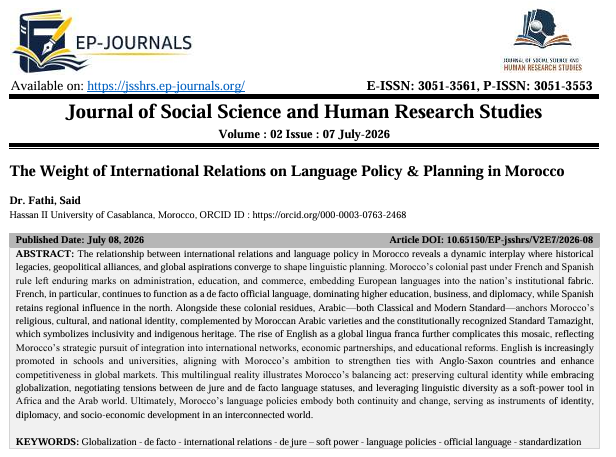
The relationship between international relations and language policy in Morocco reveals a dynamic interplay where historical legacies, geopolitical alliances, and global aspirations converge to shape linguistic planning. Morocco’s colonial past under French and Spanish rule left enduring marks on administration, education, and commerce, embedding European languages into the nation’s institutional fabric. French, in particular, continues to function as a de facto official language, dominating higher education, business, and diplomacy, while Spanish retains regional influence in the north. Alongside these colonial residues, Arabic—both Classical and Modern Standard—anchors Morocco’s religious, cultural, and national identity, complemented by Moroccan Arabic varieties and the constitutionally recognized Standard Tamazight, which symbolizes inclusivity and indigenous heritage. The rise of English as a global lingua franca further complicates this mosaic, reflecting Morocco’s strategic pursuit of integration into international networks, economic partnerships, and educational reforms. English is increasingly promoted in schools and universities, aligning with Morocco’s ambition to strengthen ties with Anglo-Saxon countries and enhance competitiveness in global markets. This multilingual reality illustrates Morocco’s balancing act: preserving cultural identity while embracing globalization, negotiating tensions between de jure and de facto language statuses, and leveraging linguistic diversity as a soft-power tool in Africa and the Arab world. Ultimately, Morocco’s language policies embody both continuity and change, serving as instruments of identity, diplomacy, and socio-economic development in an interconnected world.
References
1) ABBASSI, A. (1977). A Sociolinguistic Analysis of Multilingualism in Morocco. Unpublished Ph.D. Thesis, University of Texas at Austin,
2) AGER, D. (2001) Motivation in Language Planning & Language Policy. Multilingual Matters Ltd
3) Bulletin Officiel N° 5964 bis, July 30th, 2001. P. 1904
4) COOPER, R.L. (1989) Language Planning & Social Change. CUP
5) ENEVER, J. (2020) “Global language policies: Moving English up the educational escalator”, in Language Teaching for Young Learners, Vol. 2, N° 2, p. 162 - 191
6) ENNAJI, M. (2005) Multilingualism, Cultural Identity and Education in Morocco. Springer Publishing
7) FATHI, S. (2002) “Who needs a second official language?”, unpublished paper delivered in a round-table organized in Fez, Morocco on Planning Languages: Planning Equity on February 15th-17th, 2002
8) FATHI, S. (2017) “An overview of the Moroccan sociolinguistic situation” in Sciences, langage et communication Vol. 1, N° 3, pp 1-8
9) FATHI, S. (2023) “Official or National Language”, in Jadir, M. (ed.) (2023) Recherches en Littérature, Traductologie & Linguistique. Editions Universitaires Européennes
10) FATHI, S. (2024) “Dual Diglossia in Morocco: A new sociolinguistic phenomenon”, in International Journal of Language, Linguistics, Literature & Culture, Vol. 3, N° 4, pp. 1-9.
11) FATHI, S. (2025) Discovering Sociolinguistics, Psycholinguistics & Discourse Analysis, World Copy Younes, ISBN: 978-9920-29-723-3
12) FERGUSON, C. A. (1959) “Diglossia” in Word Vol. 15, N° 2, pp. 325-40.
13) FERGUSON, G. (2006) Language Planning & Education. Edinburgh University Press.
14) FISHMAN, J. (1974) Advances in Language Planning. Mouton
15) GUMPERZ, J.J. (ed.)(1982) Language & Social Identity. CUP
16) HAUGEN, E. (1972) “Dialect, language & nation’’ in Pride, J.B. & J. Holmes (eds.) Sociolinguistics. Penguin, pp. 97-111.
17) HITCHING, H. (2011) The Language Wars. Farrar, Straus & Giroux
18) JOSEPH, J.E. (2004) Language and Identity. National, Ethnic and Religious. Palgrave McMillan
19) Xhemaili, M. (2022) “The importance of the English language in public diplomacy & international relations”, in Journal of Liberty and International Affairs, Vol. 8, N° 1, pp. 322-39.
20) WRIGHT, S. (2016) Language Planning & Language Policy: From Nationalism to Globalization. Palgrave Macmillan
21) www.hcp.ma
22) www.ires.ma
23) www.moroccoworldnews.com
Downloads
Published
Issue
Section
License
Copyright (c) 2026 Dr. Fathi, Said (Translator)

This work is licensed under a Creative Commons Attribution 4.0 International License.












