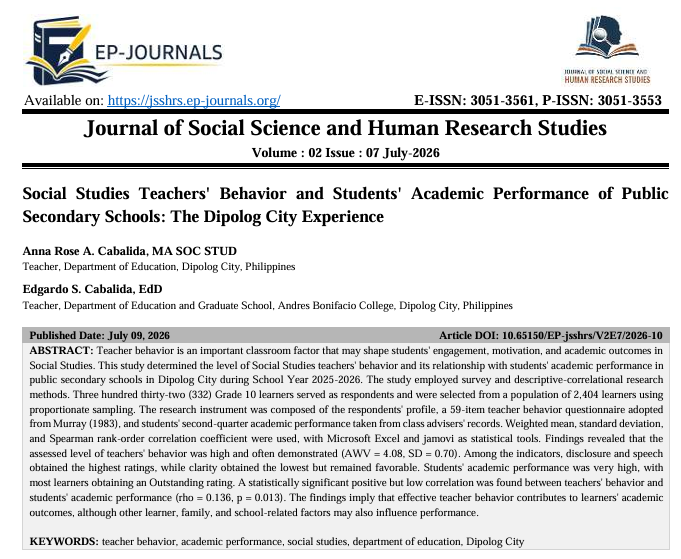
Social Studies Teachers' Behavior and Students' Academic Performance of Public Secondary Schools: The Dipolog City Experience
DOI:
https://doi.org/10.65150/EP-jsshrs/V2E7/2026-10Keywords:
teacher behavior, academic performance, social studies, department of education, Dipolog CityAbstract
Teacher behavior is an important classroom factor that may shape students' engagement, motivation, and academic outcomes in Social Studies. This study determined the level of Social Studies teachers' behavior and its relationship with students' academic performance in public secondary schools in Dipolog City during School Year 2025-2026. The study employed survey and descriptive-correlational research methods. Three hundred thirty-two (332) Grade 10 learners served as respondents and were selected from a population of 2,404 learners using proportionate sampling. The research instrument was composed of the respondents' profile, a 59-item teacher behavior questionnaire adopted from Murray (1983), and students' second-quarter academic performance taken from class advisers' records. Weighted mean, standard deviation, and Spearman rank-order correlation coefficient were used, with Microsoft Excel and jamovi as statistical tools. Findings revealed that the assessed level of teachers' behavior was high and often demonstrated (AWV = 4.08, SD = 0.70). Among the indicators, disclosure and speech obtained the highest ratings, while clarity obtained the lowest but remained favorable. Students' academic performance was very high, with most learners obtaining an Outstanding rating. A statistically significant positive but low correlation was found between teachers' behavior and students' academic performance (rho = 0.136, p = 0.013). The findings imply that effective teacher behavior contributes to learners' academic outcomes, although other learner, family, and school-related factors may also influence performance.
References
1) Bhattacherjee, A. (2019). Social science research: Principles, methods, and practices. University of South Florida.
2) Bihag, J. G. Q., Celso, R. B., Arabbi, A. A., Ladjakahal, M. I., Idlana, N. J., Karim, S. N. I., Sahidul, Z. A., Tandih, M. I., & Naparota, L. C. (2025). Teachers' instructional practices and learners' performance in Araling Panlipunan.
3) Bouhafa, S., Bharaj, H., & Simpson, A. (2023). Teacher self-disclosure and student engagement.
4) Chen, X., & Lu, L. (2022). How classroom management and instructional clarity relate to students' academic emotions. Frontiers in Psychology.
5) Cohen, P., West, S. G., & Aiken, L. S. (2014). Applied multiple regression/correlation analysis for the behavioral sciences. Routledge.
6) Department of Education. (2016). Policy guidelines on awards and recognition for the K to 12 basic education program (DepEd Order No. 36, s. 2016).
7) Department of Education. (2019). PISA 2018 Philippine national report. DepEd.
8) Department of Education. (2020). Interim policy guidelines for assessment and grading in light of the Basic Education Learning Continuity Plan (DepEd Order No. 031, s. 2020).
9) Falcón, S., Admiraal, W., & León, J. (2023). Teachers' engaging messages and their relationship with students' performance.
10) Fuentes-Moreno, C., Sabariego-Puig, M., & Ambros-Pallarés, A. (2020). Developing social and civic competence in secondary education.
11) Göktaş, E., & Kaya, M. (2023). The effects of teacher relationships on student academic achievement: A second-order meta-analysis.
12) Jebbour, M., & Mouaid, F. (2019). The impact of teacher self-disclosure on student participation in the university English language classroom.
13) Korpershoek, H., Harms, T., de Boer, H., van Kuijk, M., & Doolaard, S. (2016). A meta-analysis of the effects of classroom management strategies and classroom management programs on students' academic, behavioral, emotional, and motivational outcomes. Review of Educational Research, 86(3), 643-680.
14) Kuhzad, S., & Zarfsaz, E. (2023). The relationship between teachers' self-disclosure and EFL students' motivation for class participation.
15) Mertler, C. A. (2019). Introduction to educational research. SAGE Publications.
16) Murray, H. G. (1983). Low-inference classroom teaching behaviors and student ratings of college teaching effectiveness. Journal of Educational Psychology, 75(1), 138-149.
17) Nicolas, R. E. (2022). Selected profile and factors affecting the academic performance in Social Studies of Grade 10 students.
18) Patall, E. A., Yates, N., Lee, J., Chen, M., Bhat, B. H., Lee, K., Beretvas, S. N., Lin, S., Yang, S. M., Jacobson, N. G., & Hanson, D. J. (2023). A meta-analysis of teachers' provision of structure and its association with students' achievement and engagement.
19) Roorda, D. L., Jak, S., Zee, M., Oort, F. J., & Koomen, H. M. Y. (2017). Affective teacher-student relationships and students' school engagement and achievement: A meta-analytic update and test of the mediating role of engagement.
20) Ryan, R. M., & Deci, E. L. (2017). Self-determination theory: Basic psychological needs in motivation, development, and wellness. Guilford Press.
21) Song, Y. (2022). The constructive role of teacher enthusiasm and clarity in reducing students' boredom. Frontiers in Psychology.
22) Subedi, K. R., Shrestha, S. K., & Subedi, S. (2024). Teachers' academic behaviors on students' academic achievement. Bharatpur Pragya: Journal of Multidisciplinary Studies, 2(01), 66-79.
23) Tao, Y., & Chen, G. (2024). The relationship between teacher talk and students' academic achievement: A meta-analysis.
24) Valentín, A., Mateos, P. M., González-Tablas, M. M., & López, E. (2022). Effects of teacher enthusiasm and type of text on students' motivation and achievement.
25) Wedel, K. (2021). Instruction time and student achievement: The moderating role of teacher qualifications. Economics of Education Review.
Downloads
Published
Issue
Section
License
Copyright (c) 2026 Anna Rose A. Cabalida, MA SOC STUD, Edgardo S. Cabalida, EdD (Author)

This work is licensed under a Creative Commons Attribution 4.0 International License.












