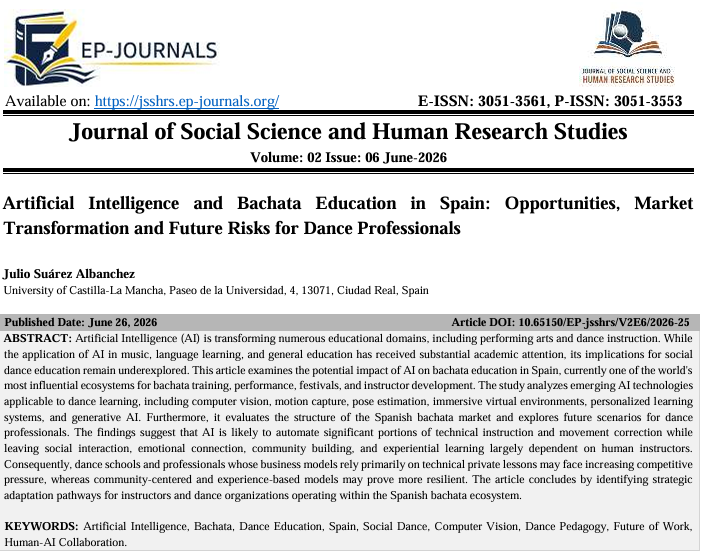
Artificial Intelligence and Bachata Education in Spain: Opportunities, Market Transformation and Future Risks for Dance Professionals
DOI:
https://doi.org/10.65150/EP-jsshrs/V2E6/2026-25Keywords:
Artificial Intelligence, Bachata, Dance Education, Spain, Social Dance, Computer Vision, Dance Pedagogy, Future of Work, Human-AI Collaboration.Abstract
Artificial Intelligence (AI) is transforming numerous educational domains, including performing arts and dance instruction. While the application of AI in music, language learning, and general education has received substantial academic attention, its implications for social dance education remain underexplored. This article examines the potential impact of AI on bachata education in Spain, currently one of the world's most influential ecosystems for bachata training, performance, festivals, and instructor development. The study analyzes emerging AI technologies applicable to dance learning, including computer vision, motion capture, pose estimation, immersive virtual environments, personalized learning systems, and generative AI. Furthermore, it evaluates the structure of the Spanish bachata market and explores future scenarios for dance professionals. The findings suggest that AI is likely to automate significant portions of technical instruction and movement correction while leaving social interaction, emotional connection, community building, and experiential learning largely dependent on human instructors. Consequently, dance schools and professionals whose business models rely primarily on technical private lessons may face increasing competitive pressure, whereas community-centered and experience-based models may prove more resilient. The article concludes by identifying strategic adaptation pathways for instructors and dance organizations operating within the Spanish bachata ecosystem.
References
1) Alter, J. B. (1997). Why dance students pursue dance: Studies of dance students from 1953 to 1993. Dance Research Journal, 29(2), 70–89. https://doi.org/10.2307/1478449
2) Anderson, C. (2006). The long tail: Why the future of business is selling less of more. Hyperion.
3) Akgun, O., Greenhow, C., & Blankenship, R. (2024). Artificial intelligence in education: A systematic review of emerging pedagogical applications. Computers & Education: Artificial Intelligence, 6, 100197.
4) Autor, D. H. (2015). Why are there still so many jobs? The history and future of workplace automation. Journal of Economic Perspectives, 29(3), 3–30.
5) Baumeister, R. F., & Leary, M. R. (1995). The need to belong: Desire for interpersonal attachments as a fundamental human motivation. Psychological Bulletin, 117(3), 497–529. https://doi.org/10.1037/0033-2909.117.3.497
6) Bazarevsky, V., Grishchenko, I., Raveendran, K., Zhu, T., Zhang, F., & Grundmann, M. (2020). BlazePose: On-device real-time body pose tracking. arXiv Preprint arXiv:2006.10204. https://doi.org/10.48550/arXiv.2006.10204 Boden, M. A. (2016). AI: Its nature and future. Oxford University Press.
7) Bourdieu, P. (1986). The forms of capital. In J. G. Richardson (Ed.), Handbook of theory and research for the sociology of education (pp. 241–258). Greenwood Press.
8) Brynjolfsson, E., & McAfee, A. (2014). The second machine age. W.W. Norton.
9) Brynjolfsson, E., Hu, Y., & Simester, D. (2011). Goodbye Pareto principle, hello long tail: The effect of search costs on the concentration of product sales. Management Science, 57(8), 1373–1386. https://doi.org/10.1287/mnsc.1110.1371
10) Cacioppo, J. T., & Patrick, W. (2008). Loneliness: Human nature and the need for social connection. W. W. Norton.
11) Calvert, T., Wilke, W. L., Ryman, R., & Fox, I. (2005). Applications of computers to dance. IEEE Computer Graphics and Applications, 25(2), 6–12. https://doi.org/10.1109/MCG.2005.40
12) Cao, Z., Hidalgo Martinez, G., Simon, T., Wei, S. E., & Sheikh, Y. (2019). OpenPose: Realtime multi-person 2D pose estimation using part affinity fields. IEEE Transactions on Pattern Analysis and Machine Intelligence, 43(1), 172–186.
https://doi.org/10.1109/TPAMI.2019.2929257
13) Chen, L., Chen, P., & Lin, Z. (2020). Artificial intelligence in education: A review. IEEE Access, 8, 75264–75278.
14) Csordas, T. J. (1990). Embodiment as a paradigm for anthropology. Ethos, 18(1), 5–47. https://doi.org/10.1525/eth.1990.18.1.02a00010
15) Deci, E. L., & Ryan, R. M. (2000). The "what" and "why" of goal pursuits: Human needs and the self-determination of behavior. Psychological Inquiry, 11(4), 227–268. https://doi.org/10.1207/S15327965PLI1104_01
16) Dignum, V. (2019). Responsible artificial intelligence. Springer.
17) European Commission. (2024). Artificial intelligence and education: Guidelines for educators. Publications Office of the European Union.
18) Fawns, T. (2022). An entangled pedagogy for AI-enhanced education. Postdigital Science and Education, 4(2), 356–376.
19) Floridi, L., Cowls, J., Beltrametti, M., Chatila, R., Chazerand, P., Dignum, V., Luetge, C., Madelin, R., Pagallo, U., Rossi, F., Schafer, B., Valcke, P., & Vayena, E. (2018). AI4People—An ethical framework for a good AI society: Opportunities, risks, principles, and recommendations. Minds and Machines, 28(4), 689–707. https://doi.org/10.1007/s11023-018-9482-5
20) Gardner, H. (2011). Frames of mind: The theory of multiple intelligences. Basic Books.
21) Gilbert, A. G. (2015). Creative dance for all ages (2nd ed.). Human Kinetics.
22) Goodfellow, I., Bengio, Y., & Courville, A. (2016). Deep learning. MIT Press.
23) Hattie, J. (2009). Visible learning. Routledge.
24) Holmes, W., Bialik, M., & Fadel, C. (2019). Artificial intelligence in education. Center for Curriculum Redesign.
25) Holmes, W., Persson, J., Chounta, I., Wasson, B., & Dimitrova, V. (2022). Artificial intelligence and education. UNESCO Report.
26) Holt-Lunstad, J., Smith, T. B., & Layton, J. B. (2010). Social relationships and mortality risk: A meta-analytic review. PLoS Medicine, 7(7), e1000316. https://doi.org/10.1371/journal.pmed.1000316
27) Hutchinson, S. (2014). Tiger in the street and other stories: Gender, identity and culture in Dominican dance. University of Illinois Press.
28) Jordanous, A. (2016). Four PPPPerspectives on computational creativity in theory and practice. Connection Science, 28(2), 194–216.
29) Kalyuga, S. (2007). Expertise reversal effect and its implications for learnertailored instruction. Educational Psychology Review, 19(4), 509–539.
30) Kassing, G., & Jay, D. M. (2020). Dance teaching methods and curriculum design: Comprehensive K–12 dance education (3rd ed.). Human Kinetics.
31) Luckin, R. (2018). Machine learning and human intelligence. UCL Press.
32) Lugaresi, C., Tang, J., Nash, H., McClanahan, C., Uboweja, E., Hays, M.,
33) Zhang, F., Chang, C., Yong, M., Lee, J., Chang, W., Hua, W., Georg, M., & Grundmann, M. (2019). MediaPipe: A framework for building perception pipelines. arXiv Preprint arXiv:1906.08172. https://doi.org/10.48550/arXiv.1906.08172
34) Mayer, R. E. (2021). Multimedia learning (3rd ed.). Cambridge University Press.
35) McMains, J. (2015). Spinning mambo into salsa: Caribbean dance in global commerce (2nd ed.). Oxford University Press.
36) Mou, X. (2023). Artificial intelligence and educational transformation. Educational Technology Research and Development, 71(4), 1823–1842.
37) Ofli, F., Chaudhry, R., Kurillo, G., Vidal, R., & Bajcsy, R. (2014). Sequence of the most informative joints (SMIJ): A new representation for human skeletal action recognition. Journal of Visual Communication and Image Representation, 25(1), 24–38.
https://doi.org/10.1016/j.jvcir.2013.04.007
38) Pacini Hernández, D. (1995). Bachata: A social history of a Dominican popular music. Temple University Press.
39) Parasuraman, R., & Riley, V. (1997). Humans and automation. Human Factors, 39(2), 230–253.
40) Peng, X. B., Ma, Z., Abbeel, P., Levine, S., & Kanazawa, A. (2023). Learning human motion models for embodied agents. Nature Machine Intelligence, 5(7), 698–707.
41) Risner, D. (2010). Dance education matters: Rebuilding postsecondary dance education for twenty-first century relevance and resonance. Arts Education Policy Review, 111(4), 123–135. https://doi.org/10.1080/10632910903455870
42) Russell, S., & Norvig, P. (2021). Artificial intelligence: A modern approach (4th ed.). Pearson.
43) Shapiro, L. (2019). Embodied cognition (2nd ed.). Routledge.
44) Shotton, J., Fitzgibbon, A., Cook, M., Sharp, T., Finocchio, M., Moore, R., Kipman, A., & Blake, A. (2011). Real-time human pose recognition in parts from single depth images. In Proceedings of the IEEE Conference on Computer Vision and Pattern Recognition (pp. 1297–1304). IEEE. https://doi.org/10.1109/CVPR.2011.5995316
45) Shneiderman, B. (2022). Human-centered AI. Oxford University Press.
46) Siemens, G. (2005). Connectivism: A learning theory for the digital age. International Journal of Instructional Technology and Distance Learning, 2(1), 3–10.
47) Sutton, R. S., & Barto, A. G. (2018). Reinforcement learning (2nd ed.). MIT Press.
48) Tajfel, H., & Turner, J. C. (1986). The social identity theory of intergroup behavior. In S. Worchel & W. G. Austin (Eds.), Psychology of intergroup relations (2nd ed., pp. 7–24). Nelson-Hall.
49) UNESCO. (2023). Guidance for generative AI in education and research. UNESCO.
50) Wenger, E. (1998). Communities of practice: Learning, meaning, and identity. Cambridge University Press.
51) Whatley, S. (2012). Dance and the digital: New technologies and shifting paradigms. Dance Research, 30(2), 198–212.
Downloads
Published
Issue
Section
License
Copyright (c) 2026 Julio Suárez Albanchez (Author)

This work is licensed under a Creative Commons Attribution 4.0 International License.












