Strengthening the Capacity of the Village Consultative Body (Bamuskal) in Village Head Elections Amid Digital Transformation: A Good Governance and Public Accountability Perspective
DOI:
https://doi.org/10.65150/EP-jsshrs/V2E6/2026-27Keywords:
digital transformation, institutional capacity, local electoral governance, participatory oversight, rural governanceAbstract
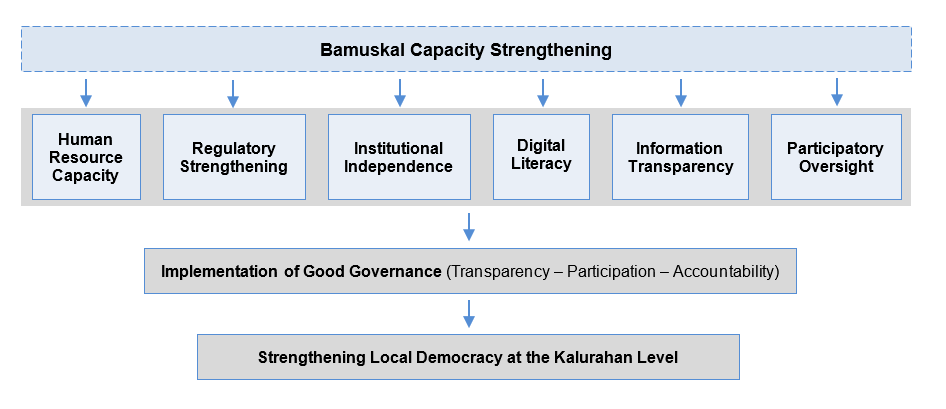
Village head elections play a central role in strengthening local democracy by ensuring that leadership succession processes are conducted in a participatory, transparent, and accountable manner. In the Special Region of Yogyakarta, the Village Consultative Body (Bamuskal) serves as a representative institution responsible for channeling community aspirations, overseeing local governance, and safeguarding the integrity of village head elections. Despite its strategic role, Bamuskal continues to face institutional challenges related to technical competence, regulatory understanding, oversight effectiveness, and adaptation to digital governance practices. This study examines Bamuskal’s capacity in village head elections and explores capacity-strengthening strategies from the perspectives of good governance and public accountability. A qualitative case study approach was employed in several kalurahan in Bantul Regency, Yogyakarta. Data were collected through in-depth interviews, observation, and document analysis and were analyzed using an interactive qualitative framework. The findings indicate that Bamuskal’s capacity remains uneven across regulatory, operational, and human resource dimensions, limiting its ability to consistently promote transparency, participation, and accountability throughout the election process. The study further shows that strengthening institutional capacity requires not only continuous technical training and regulatory support but also the development of digital literacy, participatory oversight mechanisms, and institutional independence. Strengthening these dimensions is essential for improving the quality of village head elections and for fostering more democratic and accountable local governance in the era of digital transformation.
References
1) Abdillah, A. F., Pujiyati, W., & Muhammad, A. S. (2025). Metodologi Penelitian Kuantitatif, Kualitatif dan Gabungan. Saba Jaya Publisher.
2) Alexander, J., & Fernandez, K. (2020). The Impact of Neoliberalism on Civil Society and Nonprofit Advocacy. Nonprofit Policy Forum, 12(2), 367–394. https://doi.org/10.1515/npf-2020-0016
3) Ansell, C., & Gash, A. (2008). Collaborative Governance in Theory and Practice. Journal of Public Administration Research and Theory, 18(4), 543–571. https://doi.org/10.1093/jopart/mum032
4) Borge, R., Balcells, J., & Padró-Solanet, A. (2023). Democratic Disruption or Continuity? Analysis of the Decidim Platform in Catalan Municipalities. American Behavioral Scientist, 67(7), 926–939. https://doi.org/10.1177/00027642221092798
5) Bovens, M. (2007). Analysing and Assessing Accountability: A Conceptual Framework 1. European Law Journal, 13(4), 447–468. https://doi.org/10.1111/j.1468-0386.2007.00378.x
6) Bovens, M., Goodin, R. E. , & Schillemans, T. (2014). The Oxford Handbook of Public Accountability. Oxford University Press (OUP).
7) Busco, C., González, F., Fariña, P., Vivas, J., Saavedra, F. M., & Ávalos, L. (2025). Introducing the Municipal Digital Offering Index for Evaluating Online Services and Addressing the Digital Divide. Peerj Computer Science, 11, e3049. https://doi.org/10.7717/peerj-cs.3049
8) Elayah, M. (2025). Transformative Pathways in Qatar’s E‐Government: Integrating Societal Engagement and NGO Partnerships for Sustainable Digital Governance. Public Administration and Development, 45(3), 228–241. https://doi.org/10.1002/pad.2102
9) Grindle, M. S. (2004). Good Enough Governance: Poverty Reduction and Reform in Developing Countries. Governance, 17(4), 525–548. https://doi.org/10.1111/j.0952-1895.2004.00256.x
10) Hernández-Bonivento, J. (2024). Does Compliance Imply Openness? An Institutional Analysis of Open Government Reforms in Three Municipalities in Chile. Information Polity, 29(3), 351–365. https://doi.org/10.3233/ip-220011
11) Hossain, A. N. M. Z. (2021). Local Government Response to COVID-19: Revitalizing Local Democracy in Bangladesh. International Journal of Sustainable Development and Planning, 16(4), 701–712. https://doi.org/10.18280/ijsdp.160410
12) McBride, K., van Noordt, C., Misuraca, G., & Hammerschmid, G. (2021). Towards a Systematic Understanding on the Challenges of Procuring Artificial Intelligence in the Public Sector. https://doi.org/10.31235/osf.io/un649
13) Menéndez-Blanco, M., & Bjørn, P. (2022). Designing Digital Participatory Budgeting Platforms: Urban Biking Activism in Madrid. Computer Supported Cooperative Work (Cscw), 31(4), 567–601. https://doi.org/10.1007/s10606-022-09443-6
14) Miles, M. B., Huberman, A. M., & Saldana, J. (2014). Qualitative Data Analysis, A Methods Sourcebook (3rd ed.). SAGE Publications, Inc.
15) Muhammad, A. S., Suswaini, E., & Sugiyanto. (2025). Urgensi Partisipasi Dalam Demokrasi Di Era Digital. Journal Peqguruang: Conference Series, 7(2), 465. https://doi.org/10.35329/jp.v7i2.6743
16) Nciweni, N., Matsilele, T., & Abrahams, R. (2023). The Role of Digital Transformation in Enhancing Communication: A Case Study of OR Tambo District Municipality in South Africa. Communitas, 28, 161–176. https://doi.org/10.38140/com.v28i.7614
17) Ndzabela, O., Lukman, Y., & Yakobi, K. (2025). Citizen Trust in E-Government Strategies. International Journal of Public Administration in the Digital Age, 12(1), 1–28. https://doi.org/10.4018/ijpada.385699
18) Nkgapele, S. M. (2024). The Usability of E-Government as a Mechanism to Enhance Public Service Delivery in the South African Government. Digital Policy Studies, 3(1), 116–132. https://doi.org/10.36615/w2sjk817
19) OECD. (2016). Open Government The Global Context and The Way Forward. OECD Publishing.
20) Safarov, N. (2023). Administrative Literacy in the Digital Welfare State: Migrants Navigating Access to Public Services in Finland. Social Policy and Society, 23(4), 908–921. https://doi.org/10.1017/s1474746422000719
21) Sánchez-Soriano, M., Arango-Ramírez, P. M., Pérez-López, E. I., & García-Montalvo, I. A. (2024). Inclusive governance: empowering communities and promoting social justice. Frontiers in Political Science, 6. https://doi.org/10.3389/fpos.2024.1478126
22) Seo, H., & Myeong, S. (2022). Effects of Application of Information on the Expectations of Benefits From GaaP: Moderating Effects From Perceptions of IIT. Sustainability, 14(3), 1624. https://doi.org/10.3390/su14031624
23) Seo, Y. (2024). Influential Factors in General Public Opposition and Public Servant Concerns Toward Municipal DX Promotion in Japan. Transforming Government People Process and Policy, 18(4), 803–824. https://doi.org/10.1108/tg-07-2024-0161
24) Sobrino-García, I. (2021). Artificial Intelligence Risks and Challenges in the Spanish Public Administration: An Exploratory Analysis through Expert Judgements. Administrative Sciences, 11(3), 102. https://doi.org/10.3390/admsci11030102
25) Sørensen, E., & Torfing, J. (2021). Accountable Government through Collaborative Governance? Administrative Sciences, 11(4), 127. https://doi.org/10.3390/admsci11040127
26) Touchton, M., McNulty, S., & Wampler, B. (2023). Participatory Budgeting And well-Being: Governance And sustainability In comparative Perspective. Journal of Public Budgeting Accounting & Financial Management, 36(1), 105–123.
https://doi.org/10.1108/jpbafm-04-2022-0067
27) UNDP. (1997). Governance for sustainable human development. United Nations Development Programme.
28) Utami, P., Anggraini, Y., Sudira, P., Fajaryati, N., & Rinawan, R. B. (2025). Exploring Deep Learning Pedagogy Through Aibased Sentiment and Emotion Analysis in Vocational Schools. 2025 International Conference on Artificial Intelligence, Blockchain, Cloud Computing, and Data Analytics (ICoABCD), 1–8. https://doi.org/10.1109/ICoABCD67551.2025.11470740
29) Wardani, R. Y., Tryatmoko, M. W., & Lim, S. (2025). The Effects of E‐Government Elements on E‐Political Participation Through Political Efficacy in Indonesia. Asian Politics & Policy, 17(4). https://doi.org/10.1111/aspp.70041
Downloads
Published
Issue
Section
License
Copyright (c) 2026 Adji Suradji Muhammad, Pipit Utami, Eka Suswaini (Author)

This work is licensed under a Creative Commons Attribution 4.0 International License.












