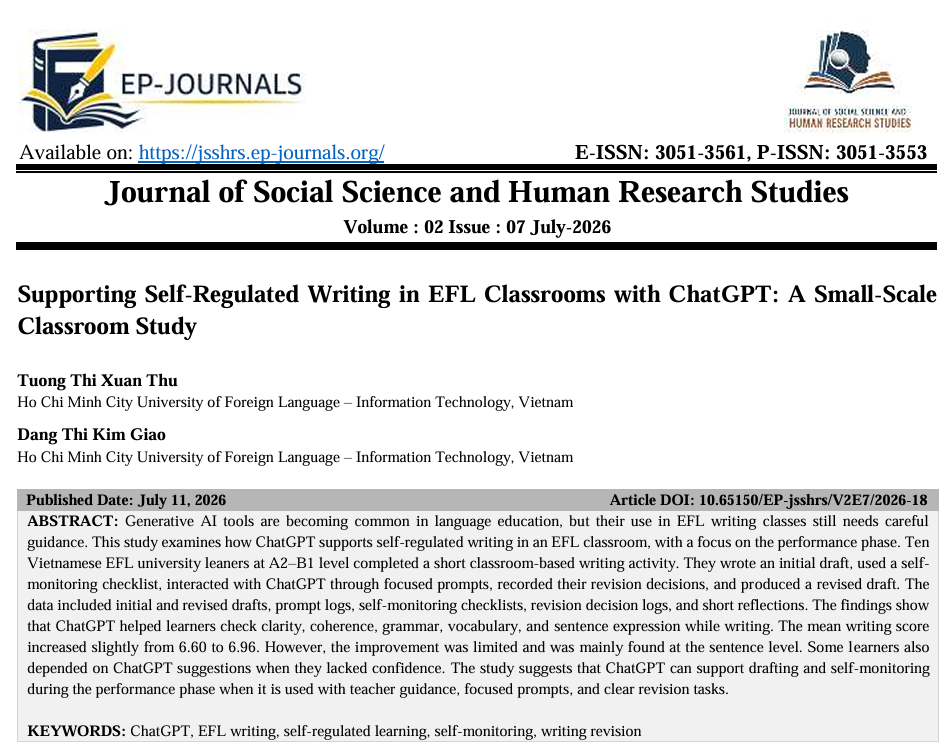
Supporting Self-Regulated Writing in EFL Classrooms with ChatGPT: A Small-Scale Classroom Study
DOI:
https://doi.org/10.65150/EP-jsshrs/V2E7/2026-18Keywords:
ChatGPT, EFL writing, self-regulated learning, self-monitoring, writing revisionAbstract
Generative AI tools are becoming common in language education, but their use in EFL writing classes still needs careful guidance. This study examines how ChatGPT supports self-regulated writing in an EFL classroom, with a focus on the performance phase. Ten Vietnamese EFL university leaners at A2–B1 level completed a short classroom-based writing activity. They wrote an initial draft, used a self-monitoring checklist, interacted with ChatGPT through focused prompts, recorded their revision decisions, and produced a revised draft. The data included initial and revised drafts, prompt logs, self-monitoring checklists, revision decision logs, and short reflections. The findings show that ChatGPT helped learners check clarity, coherence, grammar, vocabulary, and sentence expression while writing. The mean writing score increased slightly from 6.60 to 6.96. However, the improvement was limited and was mainly found at the sentence level. Some learners also depended on ChatGPT suggestions when they lacked confidence. The study suggests that ChatGPT can support drafting and self-monitoring during the performance phase when it is used with teacher guidance, focused prompts, and clear revision tasks.
References
1) Bai, B., Guo, W., & Wang, C. (2024). Relationships between struggling EFL writers’ motivation, self-regulated learning (SRL), and writing competence in Hong Kong primary schools. Applied Linguistics Review. https://doi.org/10.1515/applirev-2020-0131
2) Chang, K.-S. (1998). Writing as a recursive and messy process and some implications for EFL writing classes. 영어어문교육, 4, 1–14.
3) Guo, W., Bai, B., & Song, H. (2021). Influences of process-based instruction on leaners’ use of self-regulated learning strategies in EFL writing. System, 101, 102578. https://doi.org/10.1016/j.system.2021.102578
4) Han, J., Yoo, H., Kim, Y., Myung, J., Kim, M., Lim, H., Kim, J., Lee, T. Y., Hong, H., Ahn, S.-Y., & Oh, A. (2023). RECIPE: How to integrate ChatGPT into EFL writing education. In Proceedings of the Tenth ACM Conference on Learning @ Scale (L@S ’23). Association for Computing Machinery. https://doi.org/10.1145/3573051.3596200
5) Han, Y., Zhao, S., & Ng, L.-L. (2021). How technology tools impact writing performance, lexical complexity, and perceived self-regulated learning strategies in EFL academic writing: A comparative study. Frontiers in Psychology, 12, Article 752793. https://doi.org/10.3389/fpsyg.2021.752793
6) Rong, M., Yao, Y., Li, Q., & Chen, X. (W.). (2025). Exploring student engagement with artificial intelligence-guided chatbot feedback in EFL writing: Interactions and revisions. Computer Assisted Language Learning, 1-30. https://doi.org/10.1080/09588221.2025.2539979
7) Song, C., & Song, Y. (2023). Enhancing academic writing skills and motivation: Assessing the efficacy of ChatGPT in AI-assisted language learning for EFL leaners. Frontiers in Psychology, 14, Article 1260843. https://doi.org/10.3389/fpsyg.2023.1260843
8) Woo, D. J., Guo, K., & Susanto, H. (2023). Cases of EFL secondary leaners’ prompt engineering pathways to complete a writing task with ChatGPT. arXiv preprint arXiv:2307.05493
9) Yang, K., Raković, M., Liang, Z., Yan, L., Zeng, Z., Fan, Y., Gašević, D., & Chen, G. (2025). Modifying AI, enhancing essays: How active engagement with generative AI boosts writing quality. In LAK25: The 15th International Learning Analytics and Knowledge Conference. Association for Computing Machinery. https://doi.org/10.1145/3706468.3706544
10) Zimmerman, B. J. (2002). Becoming a self-regulated learner: An overview. Theory Into Practice, 41(2), 64–70.
Downloads
Published
Issue
Section
License
Copyright (c) 2026 Tuong Thi Xuan Thu, Dang Thi Kim Giao (Author)

This work is licensed under a Creative Commons Attribution 4.0 International License.












