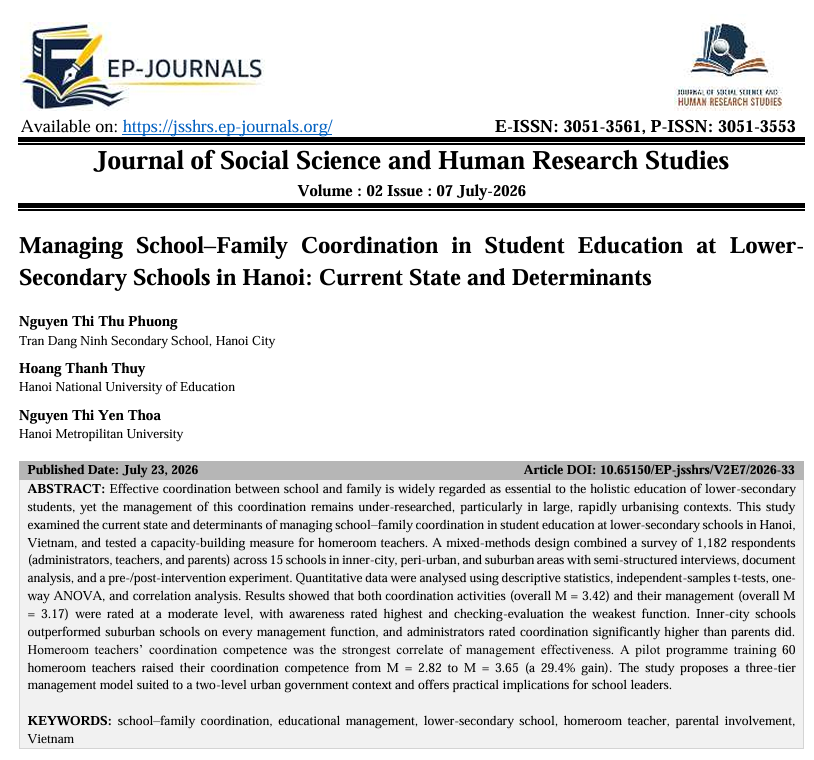
Managing School–Family Coordination in Student Education at Lower-Secondary Schools in Hanoi: Current State and Determinants
DOI:
https://doi.org/10.65150/EP-jsshrs/V2E7/2026-33Keywords:
school–family coordination, educational management, lower-secondary school, homeroom teacher, parental involvement, VietnamAbstract
Effective coordination between school and family is widely regarded as essential to the holistic education of lower-secondary students, yet the management of this coordination remains under-researched, particularly in large, rapidly urbanising contexts. This study examined the current state and determinants of managing school–family coordination in student education at lower-secondary schools in Hanoi, Vietnam, and tested a capacity-building measure for homeroom teachers. A mixed-methods design combined a survey of 1,182 respondents (administrators, teachers, and parents) across 15 schools in inner-city, peri-urban, and suburban areas with semi-structured interviews, document analysis, and a pre-/post-intervention experiment. Quantitative data were analysed using descriptive statistics, independent-samples t-tests, one-way ANOVA, and correlation analysis. Results showed that both coordination activities (overall M = 3.42) and their management (overall M = 3.17) were rated at a moderate level, with awareness rated highest and checking-evaluation the weakest function. Inner-city schools outperformed suburban schools on every management function, and administrators rated coordination significantly higher than parents did. Homeroom teachers’ coordination competence was the strongest correlate of management effectiveness. A pilot programme training 60 homeroom teachers raised their coordination competence from M = 2.82 to M = 3.65 (a 29.4% gain). The study proposes a three-tier management model suited to a two-level urban government context and offers practical implications for school leaders.
References
1) Bass, B. M., & Riggio, R. E. (2006). Transformational leadership (2nd ed.). Lawrence Erlbaum Associates.
2) Boonk, L., Gijselaers, H. J. M., Ritzen, H., & Brand-Gruwel, S. (2018). A review of the relationship between parental involvement indicators and academic achievement. Educational Research Review, 24, 10–30.
3) Bordalba, M. M., & Bochaca, J. G. (2019). Digital media for family–school communication? Parents’ and teachers’ beliefs. Computers & Education, 132, 44–62.
4) Braun, V., & Clarke, V. (2006). Using thematic analysis in psychology. Qualitative Research in Psychology, 3(2), 77–101.
5) Bronfenbrenner, U. (1979). The ecology of human development: Experiments by nature and design. Harvard University Press.
6) Bush, T. (2020). Theories of educational leadership and management (5th ed.). SAGE.
7) Castro, M., Expósito-Casas, E., López-Martín, E., Lizasoain, L., Navarro-Asencio, E., & Gaviria, J. L. (2015). Parental involvement on student academic achievement: A meta-analysis. Educational Research Review, 14, 33–46.
8) Cohen, J. (1988). Statistical power analysis for the behavioral sciences (2nd ed.). Lawrence Erlbaum Associates.
9) Creswell, J. W., & Plano Clark, V. L. (2018). Designing and conducting mixed methods research (3rd ed.). SAGE.
10) Darling-Hammond, L., Hyler, M. E., & Gardner, M. (2017). Effective teacher professional development. Learning Policy Institute.
11) Desimone, L. M. (2009). Improving impact studies of teachers’ professional development: Toward better conceptualizations and measures. Educational Researcher, 38(3), 181–199.
12) Epstein, J. L. (1995). School/family/community partnerships: Caring for the children we share. Phi Delta Kappan, 76(9), 701–712.
13) Epstein, J. L. (2018). School, family, and community partnerships: Preparing educators and improving schools (2nd ed.). Routledge.
14) Epstein, J. L., & Sheldon, S. B. (2019). The importance of evaluating programs of school, family and community partnerships. Aula Abierta, 48(1), 31–42.
15) Fan, X., & Chen, M. (2001). Parental involvement and students’ academic achievement: A meta-analysis. Educational Psychology Review, 13(1), 1–22.
16) Fayol, H. (1949). General and industrial management (C. Storrs, Trans.). Pitman.
17) Goodall, J., & Montgomery, C. (2014). Parental involvement to parental engagement: A continuum. Educational Review, 66(4), 399–410.
18) Hill, N. E., & Tyson, D. F. (2009). Parental involvement in middle school: A meta-analytic assessment of the strategies that promote achievement. Developmental Psychology, 45(3), 740–763.
19) Hoover-Dempsey, K. V., & Sandler, H. M. (1997). Why do parents become involved in their children’s education? Review of Educational Research, 67(1), 3–42.
20) Hornby, G., & Blackwell, I. (2018). Barriers to parental involvement in education: An update. Educational Review, 70(1), 109–119.
21) Hornby, G., & Lafaele, R. (2011). Barriers to parental involvement in education: An explanatory model. Educational Review, 63(1), 37–52.
22) Jeynes, W. H. (2012). A meta-analysis of the efficacy of different types of parental involvement programs for urban students. Urban Education, 47(4), 706–742.
23) Kim, S. W., & Hill, N. E. (2015). Including fathers in the picture: A meta-analysis of parental involvement and students’ academic achievement. Journal of Educational Psychology, 107(4), 919–934.
24) Koonce, D. A., & Harper, W. (2005). Engaging African American parents in the schools: A community-based consultation model. Journal of Educational and Psychological Consultation, 16(1–2), 55–74.
25) Kraft, M. A., & Dougherty, S. M. (2013). The effect of teacher–family communication on student engagement: Evidence from a randomized field experiment. Journal of Research on Educational Effectiveness, 6(3), 199–222.
26) Leithwood, K., Harris, A., & Hopkins, D. (2020). Seven strong claims about successful school leadership revisited. School Leadership & Management, 40(1), 5–22.
27) Lincoln, Y. S., & Guba, E. G. (1985). Naturalistic inquiry. SAGE.
28) Ministry of Education and Training. (2018). The general education curriculum (Issued with Circular No. 32/2018/TT-BGDĐT). MOET.
29) Mishra, P., & Koehler, M. J. (2006). Technological pedagogical content knowledge: A framework for teacher knowledge. Teachers College Record, 108(6), 1017–1054.
30) Pham, N. L. (2020). Managing school–family coordination in lower-secondary student education. Vietnam Journal of Education, 478, 25–30.
31) Sanders, M. G., & Sheldon, S. B. (2009). Principals matter: A guide to school, family, and community partnerships. Corwin.
32) Taber, K. S. (2018). The use of Cronbach’s alpha when developing and reporting research instruments in science education. Research in Science Education, 48(6), 1273–1296.
33) Tran, T. M. H. (2019). Managing school–family coordination in lower-secondary education from a quality-management approach. HNUE Journal of Science, 64(9), 156–165.
34) Wilder, S. (2014). Effects of parental involvement on academic achievement: A meta-synthesis. Educational Review, 66(3), 377–397.
Downloads
Published
Issue
Section
License
Copyright (c) 2026 Nguyen Thi Thu Phuong, Dr. Hoang Thanh Thuy, Nguyen Thi Yen Thoa (Author)

This work is licensed under a Creative Commons Attribution 4.0 International License.