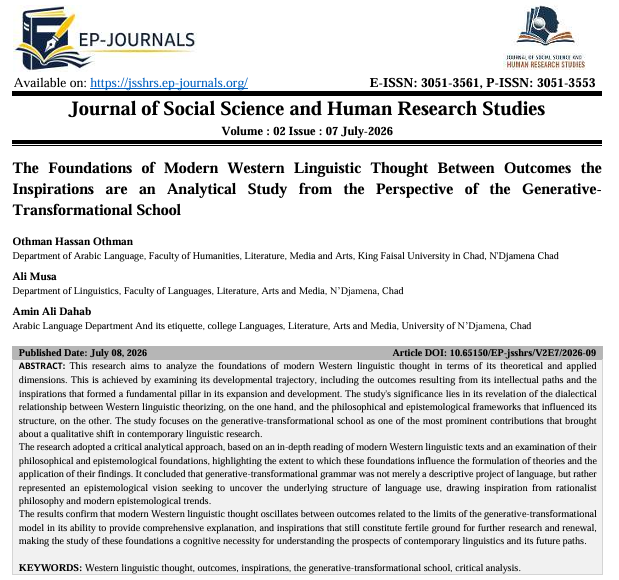
The Foundations of Modern Western Linguistic Thought Between Outcomes the Inspirations are an Analytical Study from the Perspective of the Generative-Transformational School
DOI:
https://doi.org/10.65150/EP-jsshrs/V2E7/2026-09Keywords:
Western linguistic thought, outcomes, inspirations, the generative-transformational school, critical analysis.Abstract
This research aims to analyze the foundations of modern Western linguistic thought in terms of its theoretical and applied dimensions. This is achieved by examining its developmental trajectory, including the outcomes resulting from its intellectual paths and the inspirations that formed a fundamental pillar in its expansion and development. The study's significance lies in its revelation of the dialectical relationship between Western linguistic theorizing, on the one hand, and the philosophical and epistemological frameworks that influenced its structure, on the other. The study focuses on the generative-transformational school as one of the most prominent contributions that brought about a qualitative shift in contemporary linguistic research.
The research adopted a critical analytical approach, based on an in-depth reading of modern Western linguistic texts and an examination of their philosophical and epistemological foundations, highlighting the extent to which these foundations influence the formulation of theories and the application of their findings. It concluded that generative-transformational grammar was not merely a descriptive project of language, but rather represented an epistemological vision seeking to uncover the underlying structure of language use, drawing inspiration from rationalist philosophy and modern epistemological trends.
The results confirm that modern Western linguistic thought oscillates between outcomes related to the limits of the generative-transformational model in its ability to provide comprehensive explanation, and inspirations that still constitute fertile ground for further research and renewal, making the study of these foundations a cognitive necessity for understanding the prospects of contemporary linguistics and its future paths.
References
1) Al-Masdi , Abd al-Salam . (1993). Linguistics and its epistemological foundations. Toubkal Publishing House.
2) Hassan, Tamam . (1994). The Arabic Language: Its Meaning and Structure. The world of books.
3) Al-Hanash , Muhammad . (2010). Modern Linguistic Theories: A Reading of Concepts and Applications. Dar Al-Tali'a.
Foreign References
1) Chomsky, Noam. (1965). Aspects of the Theory of Syntax. MIT Press.
2) Chomsky, Noam. (1980). Rules and Representations. Columbia University Press.
3) Ferdinand de Saussure. (1916). Cours de linguistique générale . Payot .
4) Fodor, Jerry. (1975). The Language of Thought. Harvard University Press.
5) Jackendoff, Ray. (1997). The Architecture of the Language Faculty. MIT Press.
Downloads
Published
Issue
Section
License
Copyright (c) 2026 Othman Hassan Othman, Ali Musa, Amin Ali Dahab (Author)

This work is licensed under a Creative Commons Attribution 4.0 International License.












