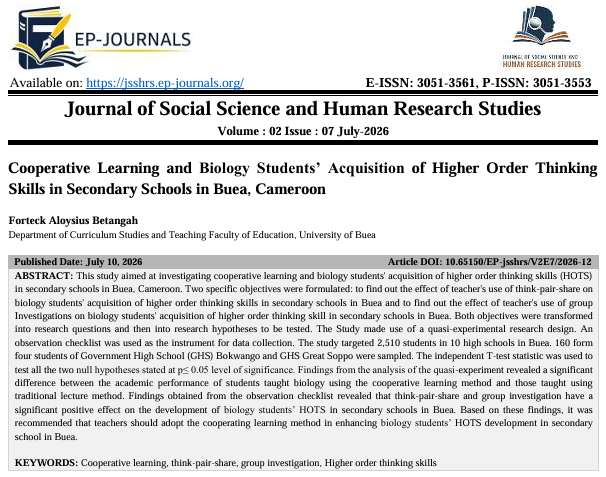
Cooperative Learning and Biology Students’ Acquisition of Higher Order Thinking Skills in Secondary Schools in Buea, Cameroon
DOI:
https://doi.org/10.65150/EP-jsshrs/V2E7/2026-12Keywords:
Cooperative learning, think-pair-share, group investigation, Higher order thinking skillsAbstract
This study aimed at investigating cooperative learning and biology students' acquisition of higher order thinking skills (HOTS) in secondary schools in Buea, Cameroon. Two specific objectives were formulated: to find out the effect of teacher's use of think-pair-share on biology students' acquisition of higher order thinking skills in secondary schools in Buea and to find out the effect of teacher's use of group Investigations on biology students' acquisition of higher order thinking skill in secondary schools in Buea. Both objectives were transformed into research questions and then into research hypotheses to be tested. The Study made use of a quasi-experimental research design. An observation checklist was used as the instrument for data collection. The study targeted 2,510 students in 10 high schools in Buea. 160 form four students of Government High School (GHS) Bokwango and GHS Great Soppo were sampled. The independent T-test statistic was used to test all the two null hypotheses stated at p≤ 0.05 level of significance. Findings from the analysis of the quasi-experiment revealed a significant difference between the academic performance of students taught biology using the cooperative learning method and those taught using traditional lecture method. Findings obtained from the observation checklist revealed that think-pair-share and group investigation have a significant positive effect on the development of biology students’ HOTS in secondary schools in Buea. Based on these findings, it was recommended that teachers should adopt the cooperating learning method in enhancing biology students’ HOTS development in secondary school in Buea.
References
1) Alkhatib, O.J. (2019). A framework of implementing higher-order thinking skills (problem-solving, critical thinking, creative thinking, and decision making) in engineering & humanities. Advances in science and engineering technology international conferences
2) Anderson, L.W., & Krathwohl, D.R. (2001). A taxonomy of learning, teaching, and assessing: a revision of bloom’s taxonomy of educational objectives. Longman.
3) Apriyanti, D., & Ayu, M. (2020). Think-pair-share: Engaging students in speaking activities in classroom. Journal of English Language Teaching and Learning
4) Bahri, A., Palennari, M., Hardianto, H., & Andi,M. (2021). Problem-based learning to develop students’ character in biology classroom. Asia-Pacific Forum on Science Learning and Teaching 20 (2).
5) Cooper, K.M., Schinske, J.N., & Tanner, K.D. (2021). Reconsidering the share of a think-pair-share: emerging limitations, alternatives, and opportunities for research. CBE- Life Sciences Education.
6) Deutsch. M (1962). Cooperation and Trust. Some Theoretical Notes. Nebraska Symposium on motivation. University of Nebraskar Press.
7) Felder, R.M & Brent, R. (2007). Cooperative learning. Active learning: Models from the analytical sciences
8) Healy, W.J., Taran, Z. & Betts, S.C. (2011). Sales course design using experiential learning principles and Bloom’s taxonomy. Journal of Instructional Pedagogies.
9) Johnson D. W. & Johnson R.T.(2018). Cooperative learning:the foundation for active learning. Active learning-Beyond the future,59-71.
10) Kemp V. (2010). Legal Services Research Centre
11) Komala. R., Lestari, D.P., & Ichsan, I.Z. (2020). Group investigation model in environmental learning: An effect for students’ higher order thinking skills. Universal Journal of Educational Research
12) Li, M.P. & Lam, B.H. (2013). Cooperative Learning. The Hong Kong Institiute of Education
13) McLoughlin, C. & Luca, J. (2000). Cognitive Engagement and Higher Order Thinking Through Computer Conferencing: We Know Why but Do We Know How? In A. Herrmann and M.M.
14) Primahesa, A., Sajidan, S., & Ramli, M. (2023). Improving higher order thinking skills in high school biology: A systematic review. Biosfer: Jurnal Pendidikan Biology.
15) Rofiah, E., Aminah, N. S., & Ekawati, E. Y. (2013). Penyusunan Instrumen Tes Kemampuan Berpikir Tingkat Tinggi Fisika pada Siswa SMP. Jurnal Pendidikan Fisika Universitas Sebelas
Maret,1(2).https://doi.org/https://jurnal.fkip.uns.ac.id/index.php/pfisika/article/view/2797.
16) Schwichow, M. Zimmerman, C., Croker, S., & Hartig, H. (2016). What students learn from hands-on activities. Journal of research in science teaching 53 (7). 980-1002.
17) Sharan, Y. (2015). Meaningful learning in the cooperative classroom. Taylor & Francis
18) Sumarni, S. (2016). Think pair share effect of understanding the concept and achievement. Proceeding of the International Conference on teacher Training and Education.Jurnal.uns.ac.id
19) Westheimer, J. & Kahne, J. (2004). What kind of citizen? The politics of education for democracy. American educational research journal.
Downloads
Published
Issue
Section
License
Copyright (c) 2026 Forteck Aloysius Betangah (Author)

This work is licensed under a Creative Commons Attribution 4.0 International License.












