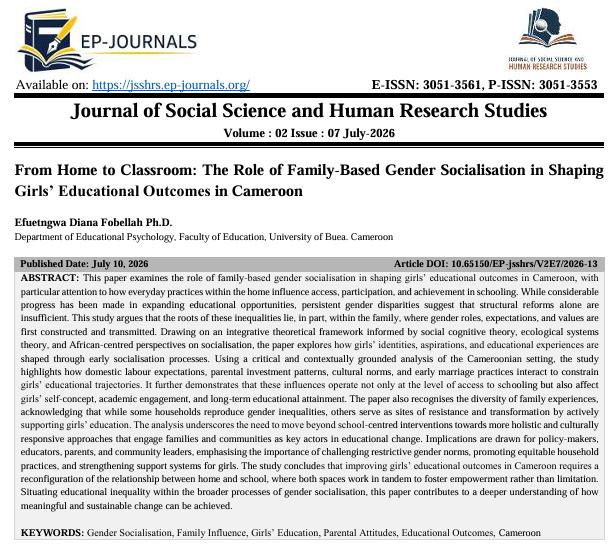
From Home to Classroom: The Role of Family-Based Gender Socialisation in Shaping Girls’ Educational Outcomes in Cameroon
DOI:
https://doi.org/10.65150/EP-jsshrs/V2E7/2026-13Keywords:
Gender Socialisation, Family Influence, Girls’ Education, Parental Attitudes, Educational Outcomes, CameroonAbstract
This paper examines the role of family-based gender socialisation in shaping girls’ educational outcomes in Cameroon, with particular attention to how everyday practices within the home influence access, participation, and achievement in schooling. While considerable progress has been made in expanding educational opportunities, persistent gender disparities suggest that structural reforms alone are insufficient. This study argues that the roots of these inequalities lie, in part, within the family, where gender roles, expectations, and values are first constructed and transmitted. Drawing on an integrative theoretical framework informed by social cognitive theory, ecological systems theory, and African-centred perspectives on socialisation, the paper explores how girls’ identities, aspirations, and educational experiences are shaped through early socialisation processes. Using a critical and contextually grounded analysis of the Cameroonian setting, the study highlights how domestic labour expectations, parental investment patterns, cultural norms, and early marriage practices interact to constrain girls’ educational trajectories. It further demonstrates that these influences operate not only at the level of access to schooling but also affect girls’ self-concept, academic engagement, and long-term educational attainment. The paper also recognises the diversity of family experiences, acknowledging that while some households reproduce gender inequalities, others serve as sites of resistance and transformation by actively supporting girls’ education. The analysis underscores the need to move beyond school-centred interventions towards more holistic and culturally responsive approaches that engage families and communities as key actors in educational change. Implications are drawn for policy-makers, educators, parents, and community leaders, emphasising the importance of challenging restrictive gender norms, promoting equitable household practices, and strengthening support systems for girls. The study concludes that improving girls’ educational outcomes in Cameroon requires a reconfiguration of the relationship between home and school, where both spaces work in tandem to foster empowerment rather than limitation. Situating educational inequality within the broader processes of gender socialisation, this paper contributes to a deeper understanding of how meaningful and sustainable change can be achieved.
References
1) Abah, I. A., Parh, A. E. K., & Tita, J. C. (2025). Disrupting gender stereotypes in STEM education in Cameroon: Case of Silicon Mountain Buea. Open Journal of Social Sciences, 13, 154–185.
2) African Union Library. (n.d.). Gender perceptions and schooling preferences in Cameroon.
3) Akwa Nadege, C. N. (2025). Gender and education: A case study of Cameroon. Humanity First Cameroon Plus.
4) Bandura, A. (1977). Social learning theory. Englewood Cliffs, NJ: Prentice Hall.
5) Bandura, A. (1986). Social foundations of thought and action: A social cognitive theory. Prentice-Hall.
6) Bicchieri, C., & Mercier, H. (2014). Norms and beliefs: How change occurs. Frontiers in Psychology, 5, 1–12.
https://doi.org/10.3389/fpsyg.2014.00290
7) Bronfenbrenner, U. (1979). The ecology of human development: Experiments by nature and design. Harvard University Press.
8) Bronfenbrenner, U. (n.d.). Ecological systems theory. In The SAGE encyclopedia of out-of-school learning. SAGE.
9) Brown, N. (2020). The impact of gender on education in Cameroon. Children of Cameroon.
10) Bussey, K., & Bandura, A. (1999). Social cognitive theory of gender development and differentiation. Psychological Review, 106(4), 676–713. https://doi.org/10.1037/0033-295X.106.4.676
11) Chisala, B. (2019). Family socialisation and gender roles in African contexts. African Journal of Educational Studies, 15(2), 45–61.
12) Chisamya, G., DeJaeghere, J., & MacKenzie, D. (2012). Gender and education for all: The impact of girls’ schooling and parental involvement in Sub-Saharan Africa. International Journal of Educational Development, 32(3), 381–391.
https://doi.org/10.1016/j.ijedudev.2011.09.004
13) Chuang, H. M. (2019). Socioeconomic influences on gendered educational outcomes: Evidence from African households. International Journal of Educational Development, 68, 44–52.
14) Davis-Kean, P. E. (2005). The influence of parent education and family income on child achievement: The indirect role of parental expectations and the home environment. Journal of Family Psychology, 19(2), 294–304. https://doi.org/10.1037/0893-3200.19.2.294
15) Delprato, M. (2023). Children and adolescents educational gender gaps across the life course in sub-Saharan Africa: On the role of mothers’ lack of empowerment as a barrier for girls’ educational performance. International Journal of Educational Development, 103,
102902. https://doi.org/10.1016/j.ijedudev.2023.102902
16) Eccles, J. S., & Harold, R. D. (1991). Gender differences in educational and occupational aspirations. Developmental Psychology, 27(2),
283–292. https://doi.org/10.1037/0012-1649.27.2.283
17) Eccles, J. S., & Harold, R. D. (1993). Parent-school involvement during the early adolescent years. Teachers College Record, 94(3), 568–587.
18) Eccles, J. S., & Wigfield, A. (2002). Motivational beliefs, values, and goals. Annual Review of Psychology, 53, 109–132. https://doi.org/10.1146/annurev.psych.53.100901.135153
19) Eccles, J. S., Adler, T. F., Futterman, R., Goff, S. B., Kaczala, C. M., Meece, J. L., & Midgley, C. (2013). Expectancies, values, and academic behaviors. In J. T. Spence (Ed.), Achievement and achievement motives (pp. 75–146). W. H. Freeman.
20) Fan, X., & Chen, M. (2001). Parental involvement and students’ academic achievement: A meta-analysis. Educational Psychology Review, 13(1), 1–22. https://doi.org/10.1023/A:1009048817385
21) Fonyuy, P. F. (2019). Indigenous knowledge systems and educational practices in Cameroon. University of Buea Press.
22) Fonyuy, P. F. (2020). Gender and education in Cameroon: Household influences and societal expectations. African Journal of Educational Studies, 11(2), 22–39.
23) Fonyuy, P. F. (2021). Gendered domestic responsibilities and educational outcomes in Cameroon. Journal of African Education, 10(1), 23–38.
24) Institut National de la Statistique. (2024). Women and men, girls and boys in Cameroon 2024.https://ins-cameroun.cm/wp content/uploads/2025/07/Factbook_Cameroon_EN_2025_01_17.pdf
25) Jacobs, J. E., Chhin, C., & Bleeker, M. (2005). Girls’ and boys’ self-perceptions of ability in mathematics and science: Gender differences in the relationship to career choice. Journal of Research in Science Teaching, 42(6), 513–537. https://doi.org/10.1002/tea.20064
26) Johannes, T. A. (2006). Household level social capital and children’s schooling decision in Cameroon: A gender analysis. Cornell University / SAGA.
27) Leach, F., Fiscian, V., Kadzamira, E., Lemani, E., & Machakanja, P. (2014). An investigation of the schooling experiences of girls in Africa: Evidence from six countries. Gender and Education, 26(2), 115–132. https://doi.org/10.1080/09540253.2014.888969
28) Leaper, C. (2015). Gendered socialization. In R. M. Lerner & M. E. Lamb (Eds.), Handbook of child psychology and developmental science (7th ed., Vol. 3, pp. 561–608). Hoboken, NJ: Wiley.
29) Leaper, C., & Brown, C. S. (2014). Parenting girls and boys. In K. L. Fingerman et al. (Eds.), Handbook of life-span development (pp. 433–466). Springer.
30) Levtov, R., van der Gaag, N., Greene, M., Kaufman, M., & Barker, G. (2015). State of the world’s fathers: A men’s survey. Promundo-US and Sonke Gender Justice.
31) Njogu, P., & Oduor, E. (2018). Parental influence on girls’ academic achievement in Kenya. International Journal of Education and Development, 8(3), 55–70.
32) Nsamenang, A. B. (2002). Adolescence in Sub-Saharan Africa: An image constructed from Africa’s triple inheritance. In B. B. Brown, R. Larson, & T. S. Saraswathi (Eds.), The world’s youth: Adolescence in eight regions of the globe (pp. 61–104). Cambridge University Press.
33) Okeke, C. (2018). Family influence on girls’ education in Nigeria: A socio-cultural perspective. African Educational Research Journal, 6(3), 145–156.
34) Okeke, C., & Nwankwo, L. (2020). Gender expectations and academic performance of Nigerian children. Journal of Gender Studies, 12(4), 77–93.
35) Research Guru. (2023). Cultural practices and their effect on the education of adolescent girls in Northwest Cameroon.
36) Tabi Johannes, A. (2006). Household level social capital and children’s schooling decision in Cameroon: A gender analysis. Cornell University / SAGA. https://www.saga.cornell.edu/saga/educconf/tabi.pdf
37) Tameko, J. D. (2025). Women’s empowerment and educational equity: Analysing gendered household education expenditures in Cameroon. African Journal of Economics and Agricultural Research, 12(2), 124–141.
38) Tchombe, T. P., & Fouda, J. M. (2020). Gender norms and schooling outcomes of girls in Cameroon. Journal of Education and Practice, 11(12), 72–84.
39) UNESCO. (2018). Gender disparities in education in Sub-Saharan Africa. (Referenced in related study).
40) UNESCO. (2021). Global education monitoring report 2021: Reimagining our futures together – A new social contract for education. UNESCO Publishing.
41) UNICEF. (2023). Child marriage country profile: Cameroon.
42) UNICEF. (2025). Manifesto of the girls of Cameroon for respect of their rights.
43) Wodon, Q., Male, C., Montenegro, C., & Nayihouba, A. (2018). Economic impacts of child marriage: Global synthesis report. World Bank. frican Journal of Educational Research, 25(2), 45–63.
44) World Bank. (2020). Cameroon secondary education and skills development project (Gender gap analysis annex).
Downloads
Published
Issue
Section
License
Copyright (c) 2026 Efuetngwa Diana Fobellah Ph.D. (Author)

This work is licensed under a Creative Commons Attribution 4.0 International License.












