Digital Leadership Practices of Principals and Access To E-Learning in Public Secondary Schools in Buea-CRM
DOI:
https://doi.org/10.65150/EP-jsshrs/V2E7/2026-15Keywords:
Digital Leadership, Principals, E-learning Access, Public Secondary Schools, Teacher Digital Competence, ICT Integration, Buea-CRM, Digital TransformationAbstract
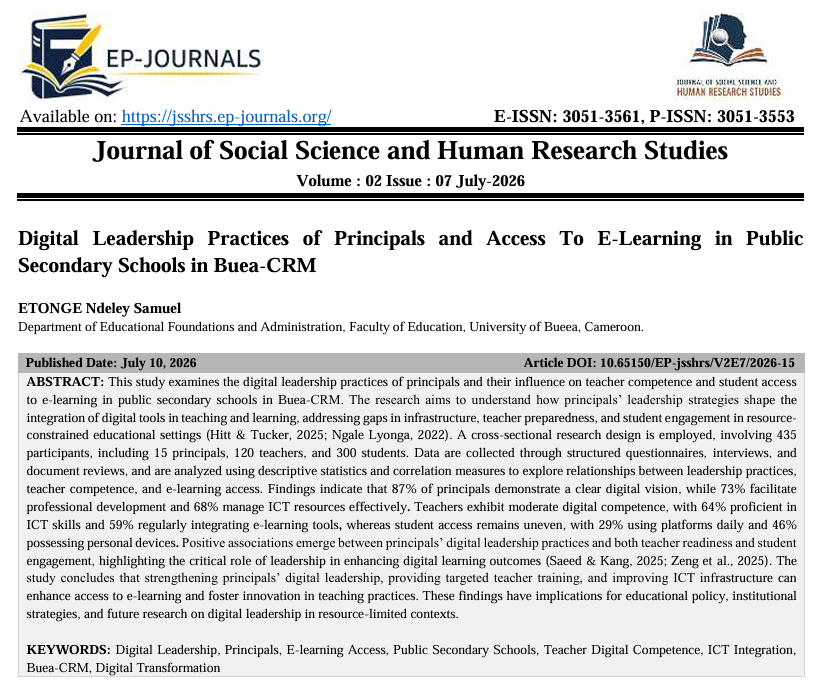
This study examines the digital leadership practices of principals and their influence on teacher competence and student access to e-learning in public secondary schools in Buea‑CRM. The research aims to understand how principals’ leadership strategies shape the integration of digital tools in teaching and learning, addressing gaps in infrastructure, teacher preparedness, and student engagement in resource-constrained educational settings (Hitt & Tucker, 2025; Ngale Lyonga, 2022). A cross-sectional research design is employed, involving 435 participants, including 15 principals, 120 teachers, and 300 students. Data are collected through structured questionnaires, interviews, and document reviews, and are analyzed using descriptive statistics and correlation measures to explore relationships between leadership practices, teacher competence, and e-learning access. Findings indicate that 87% of principals demonstrate a clear digital vision, while 73% facilitate professional development and 68% manage ICT resources effectively. Teachers exhibit moderate digital competence, with 64% proficient in ICT skills and 59% regularly integrating e-learning tools, whereas student access remains uneven, with 29% using platforms daily and 46% possessing personal devices. Positive associations emerge between principals’ digital leadership practices and both teacher readiness and student engagement, highlighting the critical role of leadership in enhancing digital learning outcomes (Saeed & Kang, 2025; Zeng et al., 2025). The study concludes that strengthening principals’ digital leadership, providing targeted teacher training, and improving ICT infrastructure can enhance access to e-learning and foster innovation in teaching practices. These findings have implications for educational policy, institutional strategies, and future research on digital leadership in resource-limited contexts.
References
1) Ahlquist, J. (2017). Digital student leadership development. New Directions for Student Leadership, 2017(153), 47 62.
2) Chamakiotis, P., & Panteli, N. (2011). Digital and e leadership research: Past, present and future directions. In [Author], Proceedings of the European Conference on Information Systems.
3) Dasruth, V. (2020). Digital leadership practices in South African schools. [Unpublished doctoral dissertation].
4) Darling Hammond, L., et al. (2020). Implications for digital leadership and innovation in education [Article].
5) Eickelmann, B., & Drossel, K. (2020). Digital leadership and school development. Research on Technology in Education.
6) Fullan, M. (2013). The new pedagogy: Students and teachers as learning partners. International Journal of Educational Reform.
7) Hitt, D., & Tucker, P. D. (2016). Towards a century of school leadership: Reinventing an academic discipline. Educational Administration Quarterly.
8) Hoddinghaus, B., et al. (2023). Digital leadership in organizational contexts: A systematic review.
9) International Society for Technology in Education. (2024). ISTE standards for educational leaders.
10) Kampylis, P., et al. (2015). DigCompOrg: A framework for improving schools’ digital capacity. European Commission.
11) Mhlanga, E., & Moloi, T. (2020). Digital learning in South African schools post COVID 19.
12) Ngale Lyonga, F. (2022). Leadership practices and education in Cameroon. International Journal of Education Policy and Leadership, 18(1), 1090508.
13) Navaridas Nalda, F., et al. (2020). Principal digital leadership: Vision, belief and technology adoption.
14) Pietsch, S., & Mah, D. (2025). School principals’ perspectives and digital leadership styles. Behavioral Sciences, 16(2), 165.
15) Reis Andersson, J. (2023). Leading the digitalisation process in K–12 schools: The school leaders’ perspective. Education and Information Technologies.
16) Raptis, N. (2025). Distributed leadership, new technologies and teachers’ digital competence in the post COVID era. European Journal of Education and Pedagogy.
17) Saeed, S., & Kang, J. (2025). Digital leadership and teachers’ technology integration in secondary schools. Journal of Education and e Learning Research.
18) Sallehin, S., Halim, L., & Onn, M. (2015). Principals’ digital leadership and digital era learning culture. Journal of Education and e Learning Studies.
19) Sheninger, E. (2019). Digital leadership: Changing paradigms for changing times. International Society for Technology in Education.
20) Tomte, C. (2013). Preparing school leaders for digital age learning environments.
21) Vanderlinde, R., & van Braak, J. (2010). The gap between policy and practice in ICT integration for school improvement. Educational Technology & Society.
22) Yuen, A. (2015). Challenges of digital leadership and digital divides in schools. Educational Administration Quarterly.
23) Yuliandari, I., et al. (2023). School leaders’ digital transformation perceptions and implementation.
24) Zeng, Y., et al. (2025). Principals’ digital leadership and teachers’ advanced technology integration. Education and Digital Competence Journal.
Downloads
Published
Issue
Section
License
Copyright (c) 2026 ETONGE Ndeley Samuel (Author)

This work is licensed under a Creative Commons Attribution 4.0 International License.












