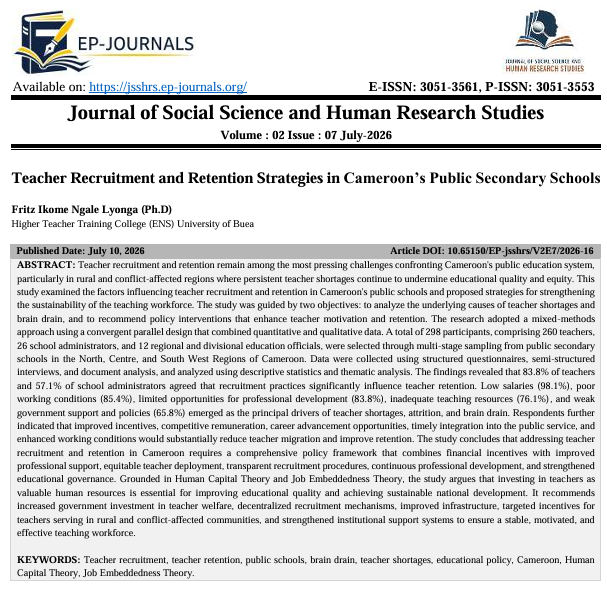
Teacher Recruitment and Retention Strategies in Cameroon’s Public Secondary Schools
DOI:
https://doi.org/10.65150/EP-jsshrs/V2E7/2026-16Keywords:
Teacher recruitment, teacher retention, public schools, brain drain, teacher shortages, educational policy, Cameroon, Human Capital Theory, Job Embeddedness Theory.Abstract
Teacher recruitment and retention remain among the most pressing challenges confronting Cameroon's public education system, particularly in rural and conflict-affected regions where persistent teacher shortages continue to undermine educational quality and equity. This study examined the factors influencing teacher recruitment and retention in Cameroon's public schools and proposed strategies for strengthening the sustainability of the teaching workforce. The study was guided by two objectives: to analyze the underlying causes of teacher shortages and brain drain, and to recommend policy interventions that enhance teacher motivation and retention. The research adopted a mixed-methods approach using a convergent parallel design that combined quantitative and qualitative data. A total of 298 participants, comprising 260 teachers, 26 school administrators, and 12 regional and divisional education officials, were selected through multi-stage sampling from public secondary schools in the North, Centre, and South West Regions of Cameroon. Data were collected using structured questionnaires, semi-structured interviews, and document analysis, and analyzed using descriptive statistics and thematic analysis. The findings revealed that 83.8% of teachers and 57.1% of school administrators agreed that recruitment practices significantly influence teacher retention. Low salaries (98.1%), poor working conditions (85.4%), limited opportunities for professional development (83.8%), inadequate teaching resources (76.1%), and weak government support and policies (65.8%) emerged as the principal drivers of teacher shortages, attrition, and brain drain. Respondents further indicated that improved incentives, competitive remuneration, career advancement opportunities, timely integration into the public service, and enhanced working conditions would substantially reduce teacher migration and improve retention. The study concludes that addressing teacher recruitment and retention in Cameroon requires a comprehensive policy framework that combines financial incentives with improved professional support, equitable teacher deployment, transparent recruitment procedures, continuous professional development, and strengthened educational governance. Grounded in Human Capital Theory and Job Embeddedness Theory, the study argues that investing in teachers as valuable human resources is essential for improving educational quality and achieving sustainable national development. It recommends increased government investment in teacher welfare, decentralized recruitment mechanisms, improved infrastructure, targeted incentives for teachers serving in rural and conflict-affected communities, and strengthened institutional support systems to ensure a stable, motivated, and effective teaching workforce.
References
1) Darling-Hammond, L. (2017). Teacher Education around the World: What Can We Learn from International Practice? European Journal of Teacher Education.
2) International Labour Organization (ILO). (2021). World Employment and Social Outlook.
3) OECD. (2020). Teachers and School Leaders as Lifelong Learners.
4) UNESCO. (2022). Reimagining Our Futures Together: A New Social Contract for Education.
5) UNESCO. (2023). Global Education Monitoring Report.
6) Armstrong, M. (2014). Armstrong’s Handbook of Human Resource Management Practice. Kogan Page.
7) Becker, G. S. (1964). Human Capital: A Theoretical and Empirical Analysis, with Special Reference to Education. University of Chicago Press.
8) Darling-Hammond, L. (2003). Keeping good teachers: Why it matters, what leaders can do. Educational Leadership.
9) Darling-Hammond, L. (2003). Keeping good teachers: Why it matters, what leaders can do. Educational Leadership, 60(8), 6-13.
10) Fonkeng, E. G., & Tamajong, E. L. (2009). Secondary School Administration and Principalship.
11) Fonkeng, E. G., & Tamajong, E. L. (2009). Secondary School Administration and Principalship. Yaoundé: Book House.
12) Fonkeng, G. E., & Tambe, A. F. (2019). Teacher attrition in Cameroon: Causes and implications for education quality. Journal of Educational Development, 12(3), 45-60.
13) Ingersoll, R. M. (2001). Teacher turnover and teacher shortages: An organizational analysis. American Educational Research Journal.
14) Ingersoll, R. M., & Smith, T. M. (2003). The wrong solution to the teacher shortage. Educational Leadership, 60(8), 30–33
15) Kyndt, E., Dochy, F., Michielsen, M., & Moeyaert, B. (2009). Employee retention: Organisational and personal perspectives. Vocations and Learning, 2(3), 195–215.
16) Mbua, F. N. (2003). Educational Administration: Theory and Practice. Design House.
17) Ngwana, T. A. (2011). The Implementation of Free Primary Education in Cameroon: Problems and Prospects. International Education Studies, 4(1), 87–97.
18) Njoh, H. A. (2019). Teacher Retention and Motivation in Cameroon’s Secondary Schools. University of Buea.
Tambo, L. I. (2012). Principles and Methods of Teaching: Applications in Cameroon Schools. ANUCAM.
19) UNESCO. (2022). Global Education Monitoring Report. Paris: UNESCO.
20) MINEDUB (2019). National Strategy for Teacher Deployment in Basic Education.
21) Mitchell, T. R., Holtom, B. C., Lee, T. W., Sablynski, C. J., & Erez, M. (2001). Why people stay: Using job embeddedness to predict voluntary turnover. Academy of Management Journal, 44(6), 1102–1121.
22) Ngimbous, J. (2019). Teacher Motivation and Retention in Cameroon’s Public Secondary Schools.
23) Ngimbous, J. (2019). Teacher Motivation and Retention in Cameroon’s Public Secondary Schools.
24) Ngome, C. K. (2003). Professionalism and Ethics in Education: The Challenge to Teacher Education in Cameroon. International Review of Education, 49(1–2), 133–152
25) Ngwana, T. A. (2011). The Implementation of Free Primary Education in Cameroon: Problems and Prospects. International Education Studies, 4(1), 87–97.
26) Ngwe, L. (2020). Challenges of teacher retention in rural Cameroon. International Journal of African Education, 8(2), 22-37.
27) Njoh, H. A. (2019). Teacher Retention and Motivation in Cameroon’s Secondary Schools. University of Buea.
28) Nkengbeza, D. (2021). Education in crisis: The impact of the Anglophone conflict on Cameroon’s schools. Yaoundé: CODESRIA.
29) Psacharopoulos, G., & Patrinos, H. A. (2018). Returns to investment in education: a decennial review of the global literature. Education Economics, 26(5), 445–458.
30) Tambo, L. I. (2012). Principles and Methods of Teaching: Applications in Cameroon Schools. ANUCAM.
31) Tambo, L. I. (2018). Education reforms and teacher management in Cameroon. Bamenda: Langaa RPCIG
32) Tchombe, T. M. (2000). Growth and expansion of education in Cameroon: Implications for teacher training.
33) Tchombe, T. M. (2000). Growth and expansion of education in Cameroon: Implications for teacher training. Yaoundé: UNESCO.
34) Tchombe, T. M. (2010). Structural Reforms in Teacher Education in Cameroon: The University of Buea Model. Journal of Educational Research and Development.
35) Transparency International Cameroon (2017). Education Sector Integrity Study Report.
36) UNESCO (2021). Global Education Monitoring Report – Central Africa Regional Review.
37) UNESCO. (2022). Global Education Monitoring Report. Paris: UNESCO.
38) UNESCO. (2022). Global Education Monitoring Report.
39) UNICEF. (2021). Cameroon Humanitarian Situation Report.
40) World Bank. (2021). Education Sector Analysis for Cameroon.
41) Ministry of Basic Education Cameroon. (2020). Annual Education Statistics Report.
42) World Bank (2020). Cameroon Human Capital Index Country Briefs.
43) World Bank (2022). Cameroon Education Sector Analysis.
44) World Bank (2022). Cameroon Education Sector Analysis: Priorities for Equitable and Efficient Learning.
Downloads
Published
Issue
Section
License
Copyright (c) 2026 Fritz Ikome Ngale Lyonga (Ph.D) (Author)

This work is licensed under a Creative Commons Attribution 4.0 International License.












