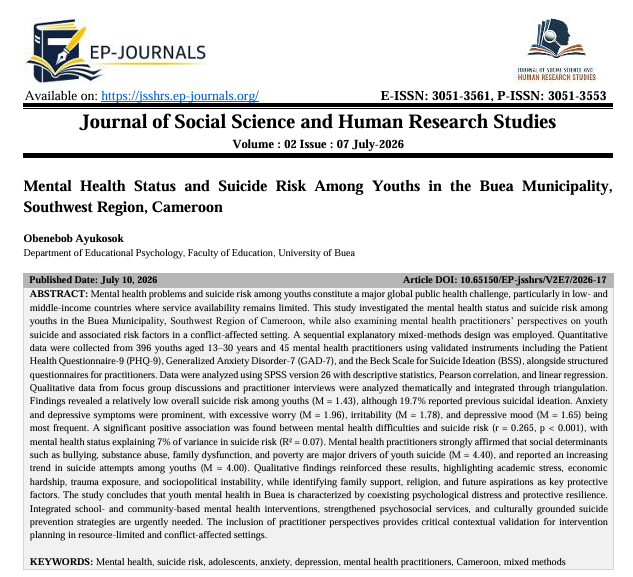
Mental Health Status and Suicide Risk Among Youths in the Buea Municipality, Southwest Region, Cameroon
DOI:
https://doi.org/10.65150/EP-jsshrs/V2E7/2026-17Keywords:
Mental health, suicide risk, adolescents, anxiety, depression, mental health practitioners, Cameroon, mixed methodsAbstract
Mental health problems and suicide risk among youths constitute a major global public health challenge, particularly in low- and middle-income countries where service availability remains limited. This study investigated the mental health status and suicide risk among youths in the Buea Municipality, Southwest Region of Cameroon, while also examining mental health practitioners’ perspectives on youth suicide and associated risk factors in a conflict-affected setting. A sequential explanatory mixed-methods design was employed. Quantitative data were collected from 396 youths aged 13–30 years and 45 mental health practitioners using validated instruments including the Patient Health Questionnaire-9 (PHQ-9), Generalized Anxiety Disorder-7 (GAD-7), and the Beck Scale for Suicide Ideation (BSS), alongside structured questionnaires for practitioners. Data were analyzed using SPSS version 26 with descriptive statistics, Pearson correlation, and linear regression. Qualitative data from focus group discussions and practitioner interviews were analyzed thematically and integrated through triangulation. Findings revealed a relatively low overall suicide risk among youths (M = 1.43), although 19.7% reported previous suicidal ideation. Anxiety and depressive symptoms were prominent, with excessive worry (M = 1.96), irritability (M = 1.78), and depressive mood (M = 1.65) being most frequent. A significant positive association was found between mental health difficulties and suicide risk (r = 0.265, p < 0.001), with mental health status explaining 7% of variance in suicide risk (R² = 0.07). Mental health practitioners strongly affirmed that social determinants such as bullying, substance abuse, family dysfunction, and poverty are major drivers of youth suicide (M = 4.40), and reported an increasing trend in suicide attempts among youths (M = 4.00). Qualitative findings reinforced these results, highlighting academic stress, economic hardship, trauma exposure, and sociopolitical instability, while identifying family support, religion, and future aspirations as key protective factors. The study concludes that youth mental health in Buea is characterized by coexisting psychological distress and protective resilience. Integrated school- and community-based mental health interventions, strengthened psychosocial services, and culturally grounded suicide prevention strategies are urgently needed. The inclusion of practitioner perspectives provides critical contextual validation for intervention planning in resource-limited and conflict-affected settings.
References
1) Atilola, O. (2024). Youth mental health in Africa: Emerging challenges and opportunities. Child and Adolescent Psychiatry and Mental Health, 18(1), 1–12.
2) Ayano, G., Solomon, M., & Tovmassian, K. (2020). Prevalence of suicidal ideation and associated factors among adolescents in sub-Saharan Africa: A systematic review. BMC Psychiatry, 20, 1–12.
3) Baxter, A. J., Scott, K. M., Ferrari, A. J., & Whiteford, H. A. (2023). Global prevalence of anxiety disorders among adolescents and young adults. The Lancet Psychiatry, 10(4), 287–299.
4) Beck, A. T., Rush, A. J., Shaw, B. F., & Emery, G. (1979). Cognitive therapy of depression. Guilford Press.
5) Bronfenbrenner, U. (1979). The ecology of human development: Experiments by nature and design. Harvard University Press.
6) Bronfenbrenner, U., & Morris, P. A. (2006). The bioecological model of human development. In R. M. Lerner (Ed.), Handbook of child psychology (6th ed.). Wiley.
7) Chu, C., Buchman-Schmitt, J. M., Stanley, I. H., et al. (2017). The interpersonal theory of suicide: A systematic review. Psychological Review, 124(4), 419–446.
8) Chu, C., Buchman-Schmitt, J. M., Stanley, I. H., et al. (2023). The interpersonal theory of suicide: A systematic review and meta-analysis update. Clinical Psychology Review, 103, 102338.
9) Cortina, M. A., Sodha, A., Fazel, M., & Ramchandani, P. G. (2012). Prevalence of child mental health disorders in sub-Saharan Africa: A systematic review. Archives of Disease in Childhood, 97(3), 239–244.
10) Erikson, E. H. (1968). Identity: Youth and crisis. Norton.
11) Franklin, J. C., Ribeiro, J. D., Fox, K. R., et al. (2017). Risk factors for suicidal thoughts and behaviors: A meta-analysis of 50 years of research. Psychological Bulletin, 143(2), 187–232.
12) Franklin, J. C., Ribeiro, J. D., Fox, K. R., et al. (2022). Risk factors for suicidal thoughts and behaviors: A meta-analysis of 50 years of research. Psychological Bulletin, 148(1–2), 1–35.
13) Hawton, K., Saunders, K. E. A., & O’Connor, R. C. (2012). Self-harm and suicide in adolescents. The Lancet, 379(9834), 2373–2382.
14) Joiner, T. E. (2005). Why people die by suicide. Harvard University Press.
15) Lim, K. S., Wong, C. H., McIntyre, R. S., et al. (2019). Global lifetime and 12-month prevalence of suicidal behavior: A systematic review and meta-analysis. The Lancet Psychiatry, 6(5), 365–378.
16) Liu, R. T., Walsh, R. F. L., & Sheehan, A. E. (2022). Protective factors against suicidal behavior in adolescents. Journal of Affective Disorders, 298, 1–12.
17) McLaughlin, K. A., Colich, N. L., Rodman, A. M., & Weissman, D. G. (2022). Mechanisms linking anxiety, depression and suicidal behavior. Annual Review of Clinical Psychology, 18, 321–348.
18) McLaughlin, K. A., Mennin, D. S., & Farach, F. J. (2012). The contributory role of anxiety in the development of depression. Journal of Abnormal Psychology, 121(2), 433–444.
19) Miranda-Mendizabal, A., Castellví, P., Parés-Badell, O., et al. (2019). Gender differences in suicidal behavior in adolescents: Systematic review and meta-analysis. PLoS ONE, 14(3), e0213766.
20) Musyimi, C. W., Mutiso, V. N., Ndetei, D. M., et al. (2022). Academic stress and depression among adolescents in low-resource settings. BMC Public Health, 22, 1–10.
21) Ngasa, S. N., Sama, C. B., Dzekem, B. S., et al. (2017). Prevalence and factors associated with depression among medical students in Cameroon. BMC Psychiatry, 17, 1–7.
22) Ngasa, S. N., Sama, C. B., Dzekem, B. S., et al. (2024). Anxiety and depression among adolescents in Sub-Saharan Africa: Current evidence and future directions. BMC Psychiatry, 24(1), 1–14.
23) O’Connor, R. C., & Kirtley, O. J. (2018). The integrated motivational–volitional model of suicidal behaviour. Philosophical Transactions of the Royal Society B, 373(1754), 20170268.
24) Patton, G. C., Sawyer, S. M., Santelli, J. S., et al. (2016). Our future: A Lancet commission on adolescent health and wellbeing. The Lancet, 387(10036), 2423–2478.
25) Quarshie, E. N.-B., Waterman, M. G., & House, A. O. (2021). Self-harm and suicidal behaviour among African youth: A systematic review. BMC Psychiatry, 21, 1–15.
26) Sankoh, O., Sevalie, S., & Weston, M. (2023). Adolescent mental health in Africa: Epidemiology and intervention priorities. Global Mental Health, 10, e45.
27) Turecki, G., Brent, D. A., Gunnell, D., et al. (2019). Suicide and suicide risk. Nature Reviews Disease Primers, 5, 74.
28) Turecki, G., Brent, D. A., Gunnell, D., et al. (2024). Suicide and suicide risk. Nature Reviews Disease Primers, 10(1), 1–23.
29) UNICEF. (2021). The state of the world’s children 2021: On my mind – Promoting, protecting and caring for children’s mental health. UNICEF.
30) UNICEF. (2024). The state of the world’s children 2024: Mental health and well-being of adolescents. UNICEF.
31) World Health Organization. (2021). Adolescent mental health. WHO.
32) World Health Organization. (2023). Suicide worldwide in 2023: Global health estimates. WHO.
33) World Health Organization. (2024). Suicide worldwide in 2024: Global health estimates. WHO.
Downloads
Published
Issue
Section
License
Copyright (c) 2026 Obenebob Ayukosok (Author)

This work is licensed under a Creative Commons Attribution 4.0 International License.












