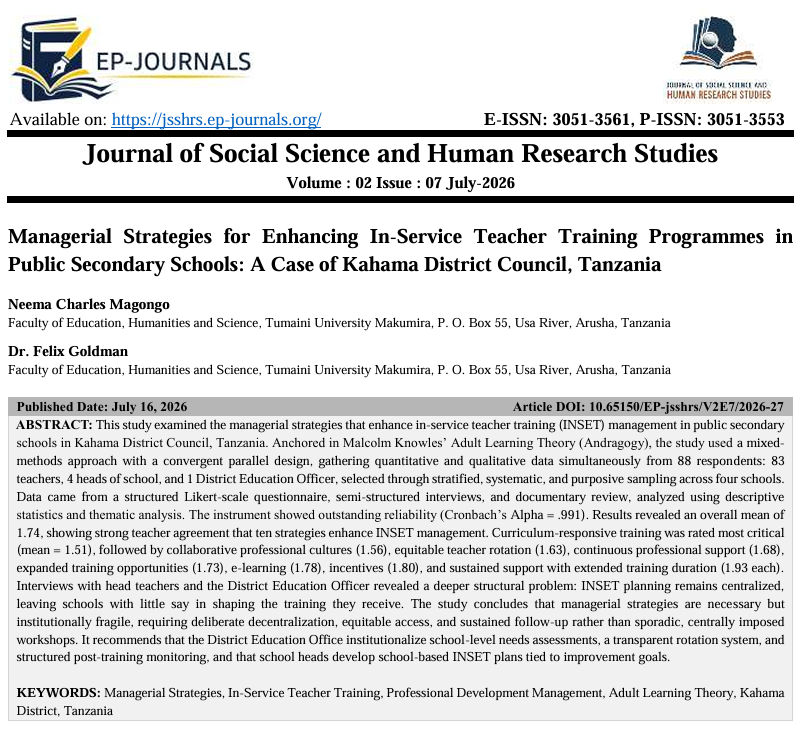
Managerial Strategies for Enhancing In-Service Teacher Training Programmes in Public Secondary Schools: A Case of Kahama District Council, Tanzania
DOI:
https://doi.org/10.65150/EP-jsshrs/V2E7/2026-27Keywords:
Managerial Strategies, In-Service Teacher Training, Professional Development Management, Adult Learning Theory, Kahama District, TanzaniaAbstract
This study examined the managerial strategies that enhance in-service teacher training (INSET) management in public secondary schools in Kahama District Council, Tanzania. Anchored in Malcolm Knowles’ Adult Learning Theory (Andragogy), the study used a mixed-methods approach with a convergent parallel design, gathering quantitative and qualitative data simultaneously from 88 respondents: 83 teachers, 4 heads of school, and 1 District Education Officer, selected through stratified, systematic, and purposive sampling across four schools. Data came from a structured Likert-scale questionnaire, semi-structured interviews, and documentary review, analyzed using descriptive statistics and thematic analysis. The instrument showed outstanding reliability (Cronbach’s Alpha = .991). Results revealed an overall mean of 1.74, showing strong teacher agreement that ten strategies enhance INSET management. Curriculum-responsive training was rated most critical (mean = 1.51), followed by collaborative professional cultures (1.56), equitable teacher rotation (1.63), continuous professional support (1.68), expanded training opportunities (1.73), e-learning (1.78), incentives (1.80), and sustained support with extended training duration (1.93 each). Interviews with head teachers and the District Education Officer revealed a deeper structural problem: INSET planning remains centralized, leaving schools with little say in shaping the training they receive. The study concludes that managerial strategies are necessary but institutionally fragile, requiring deliberate decentralization, equitable access, and sustained follow-up rather than sporadic, centrally imposed workshops. It recommends that the District Education Office institutionalize school-level needs assessments, a transparent rotation system, and structured post-training monitoring, and that school heads develop school-based INSET plans tied to improvement goals.
References
1) Allen, S. J., Rosch, D. M., & Riggio, R. E. (2022). Advancing leadership education and development: Integrating adult learning theory. Journal of Management Education, 46(2), 252-283. https://doi.org/10.1177/10525629211008645
2) Bang, N. C., & Takop, F. N. (2024). Situating in-service teacher training in reform community of developing holistic competence to engage practice. Forum for Education Studies, 2(4), 1621. https://doi.org/10.59400/fes.v2i4.1621
3) Boone, H. N., & Boone, D. A. (2012). Analyzing Likert data. Journal of Extension, 50(2), 1-5.
4) Braun, V., & Clarke, V. (2022). Thematic analysis: A practical guide. SAGE.
5) Bush, T. (2018). School leadership and management in South Africa. In T. Bush, L. Bell, & D. Middlewood (Eds.), Principles of educational leadership and management (2nd ed.). SAGE.
6) Creswell, J. W., & Plano Clark, V. L. (2023). Designing and conducting mixed methods research (4th ed.). SAGE.
7) Darling-Hammond, L., Hyler, M. E., & Gardner, M. (2022). Effective teacher professional development (2nd ed.). Learning Policy Institute.
8) Fulgence, K., & Chambua, R. (2025, June 17). Innovative teacher development is transforming classrooms in Tanzania. Global Partnership for Education Blog. https://www.globalpartnership.org/blog/innovative-teacher-development-transforming-classrooms-tanzania
9) Gao, Z., Hu, G., Akram, S., Ul Hassan, M., Shahzad, M. F., & Jan, S. A. (2025). Comparative analysis of managerial strategies for enhancing teacher motivation in public and private schools. Scientific Reports, 15, Article 6272. https://doi.org/10.1038/s41598-025-90900-9
10) Grover, N. (2023). Suggestive measures for the quality enhancement of in-service teacher training programmes. IJCRT, 11(1), 877-884.
11) Haule, G., & Otieno, M. (2025). The influence of in-service training on pedagogical practices of primary school teachers in Dodoma City, Tanzania. Journal of Research Innovation and Implications in Education, 9(3), 415-424. https://doi.org/10.59765/pfr53p9
12) Heriel, M. (2025). Effects of in-service teacher training on literacy and numeracy outcomes in Tunduru District, Tanzania. Tanzania Journal of Education Research, 12(1), 45-63.
13) Irielle, C. (2024). An exploration of the experiences of Nigerian adult learners utilizing smartphones and associated apps to access learning [Doctoral dissertation, Capella University]. ProQuest Dissertations & Theses.
14) Kahama District Education Office. (2023). Annual education report, 2022/2023. Kahama District Council.
15) Knowles, M. S. (1970). The modern practice of adult education: Andragogy versus pedagogy. Association Press.
16) Knowles, M. S., Holton, E. F., & Swanson, R. A. (2020). The adult learner (9th ed.). Routledge.
17) Komba, S. C. (2021). Continuous professional development for secondary school teachers in Tanzania: Practices and challenges. Journal of Education and Practice, 12(4), 33-42.
18) Komba, S. C., & Mwandanji, M. E. (2023). Challenges in the implementation of in-service teacher training programmes in Tanzanian secondary schools. Journal of Education and Practice, 14(2), 45-59. https://doi.org/10.7176/JEP/14-2-06
19) Livingston, M., & Cummings-Clay, D. (2023). Advancing adult learning using andragogic instructional practices. International Journal of Multidisciplinary Perspectives in Higher Education, 8(1), 29-53. https://doi.org/10.32674/jimphe.v8i1.3680
20) Mafumiko, F. M., & Kapinga, O. S. (2024). Workshop-based teacher development and its impact on classroom practice: A study of secondary schools in the Lake Zone, Tanzania. African Educational Research Journal, 12(1), 22-35.https://doi.org/10.30918/AERJ.121.24.003
21) Matorevhu, A. (2022). Teacher educators’ nature of understanding of adult learning theories application in pre-service teachers’ classes. Electronic Journal of Education, Social Economics and Technology, 3(1), 15-23. https://doi.org/10.33369/ejeset.v3i1.50
22) Mgwaya, M. (2022). Contribution of in-service training on teaching and learning performances of teachers in public secondary schools in Tanzania. GSJ, 10(10), 2600-2608.
23) Ndalichako, J. L. (2023). Assessment and learning outcomes in Sub-Saharan Africa. SAGE.
24) Pujari, A. (2023). Strategies for improving the quality of teacher education in the 21st century. International Journal of Teacher Education and Professional Development, 6(1), 1-15. https://doi.org/10.4018/IJTEPD.316394
25) Siregar, T. (2025). Mixed methods research approach. SSRN. https://doi.org/10.2139/ssrn.5837862
26) Tesfaye, A., & Mengistu, D. (2024). Reliability thresholds and instrument dependability in educational research: Evidence from secondary school studies in East Africa. International Journal of Educational Methodology, 10(3), 201-215.https://doi.org/10.12973/ijem.10.3.201
27) Uleanya, C., & Naicker, S. R. (2024). Future-fit and innovative school leadership in the African context: Lessons for sustainability in underdeveloped and developing countries. Leadership and Policy in Schools, 24(1). https://doi.org/10.1080/15700763.2024.2335618
28) UNESCO. (2022). Teacher policy development guide. UNESCO Publishing.
29) United Republic of Tanzania [URT]. (2023). Education Sector Development Plan 2021-2026. Ministry of Education, Science and Technology.
30) Westbrook, J., Durrani, N., Brown, R., Orr, D., Pryor, J., Boddy, J., & Salvi, F. (2021). Pedagogy, curriculum, teaching practices and teacher education in developing countries. Education Rigorous Literature Review, Department for International Development.
31) World Bank. (2022). Realizing the future of learning: From learning poverty to learning for everyone, everywhere. World Bank Group.
Downloads
Published
Issue
Section
License
Copyright (c) 2026 Neema Charles Magongo, Dr. Felix Goldman (Author)

This work is licensed under a Creative Commons Attribution 4.0 International License.