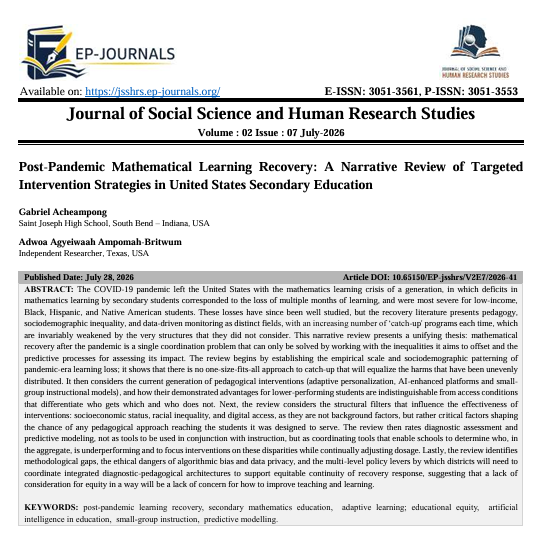
Post-Pandemic Mathematical Learning Recovery: A Narrative Review of Targeted Intervention Strategies in United States Secondary Education
DOI:
https://doi.org/10.65150/EP-jsshrs/V2E7/2026-41Keywords:
post-pandemic learning recovery, secondary mathematics education, adaptive learning, educational equity, artificial intelligence in education, small-group instruction, predictive modellingAbstract
The COVID-19 pandemic left the United States with the mathematics learning crisis of a generation, in which deficits in mathematics learning by secondary students corresponded to the loss of multiple months of learning, and were most severe for low-income, Black, Hispanic, and Native American students. These losses have since been well studied, but the recovery literature presents pedagogy, sociodemographic inequality, and data-driven monitoring as distinct fields, with an increasing number of ‘catch-up' programs each time, which are invariably weakened by the very structures that they did not consider. This narrative review presents a unifying thesis: mathematical recovery after the pandemic is a single coordination problem that can only be solved by working with the inequalities it aims to offset and the predictive processes for assessing its impact. The review begins by establishing the empirical scale and sociodemographic patterning of pandemic-era learning loss; it shows that there is no one-size-fits-all approach to catch-up that will equalize the harms that have been unevenly distributed. It then considers the current generation of pedagogical interventions (adaptive personalization, AI-enhanced platforms and small-group instructional models), and how their demonstrated advantages for lower-performing students are indistinguishable from access conditions that differentiate who gets which and who does not. Next, the review considers the structural filters that influence the effectiveness of interventions: socioeconomic status, racial inequality, and digital access, as they are not background factors, but rather critical factors shaping the chance of any pedagogical approach reaching the students it was designed to serve. The review then rates diagnostic assessment and predictive modeling, not as tools to be used in conjunction with instruction, but as coordinating tools that enable schools to determine who, in the aggregate, is underperforming and to focus interventions on these disparities while continually adjusting dosage. Lastly, the review identifies methodological gaps, the ethical dangers of algorithmic bias and data privacy, and the multi-level policy levers by which districts will need to coordinate integrated diagnostic-pedagogical architectures to support equitable continuity of recovery response, suggesting that a lack of consideration for equity in a way will be a lack of concern for how to improve teaching and learning.
References
1) A, A., Sanad Ammar. (2025a). ONLINE MATHEMATICS EDUCATION: A COMPREHENSIVE DECADE LONG REVIEW BETWEEN 2013 AND 2023. Zenodo (CERN European Organization for Nuclear Research). https://doi.org/10.5281/zenodo.17958733
2) A, A., Sanad Ammar. (2025b). ONLINE MATHEMATICS EDUCATION: A COMPREHENSIVE DECADE LONG REVIEW BETWEEN 2013 AND 2023. Zenodo (CERN European Organization for Nuclear Research). https://doi.org/10.5281/zenodo.17958732
3) Acquah, W. K., Bayah, D., Kessey, E. A., & Thompson, M. (2025). The impact of instructional strategies on promoting science, technology, engineering, and math education among K–12 in the United States. EPRA International Journal of Environmental Economics, Commerce and Educational Management, 12(2), 19.
4) AI-Driven Student Performance Prediction Models in EdTech. (2025). The International Journal for Research in Education, 14(10). https://doi.org/10.63345/ijre.v14.i10.3
5) AI-Driven Student Performance Prediction Models in EdTech. (2025). https://doi.org/10.63345/ijre.v14.i10.3
6) Akçay, A. O., & Çilingir, E. (2025). Sustaining Mathematics Education in the AI Era. https://doi.org/10.4018/979-8-3373-1998-8.ch009
7) Alam, A., & Mohanty, A. (2023). Cultural beliefs and equity in educational institutions: exploring the social and philosophical notions of ability groupings in teaching and learning of mathematics. International Journal of Adolescence and Youth, 28(1).
https://doi.org/10.1080/02673843.2023.2270662
8) AMIR, M., & ANSARI, A. (2026). Challenges related to Mathematics Education. International Journal For Multidisciplinary Research, 8(1). https://doi.org/10.36948/ijfmr.2026.v08i01.69466
9) Ansari, S., & Qamari, I. N. (2025). Artificial intelligence and students’ cognitive learning outcomes with bibliometric and content analysis for future research agenda. Discover Education, 4(1). https://doi.org/10.1007/s44217-025-00865-0
10) Arhimah, T., & Cudjoe-Mensah, Y. M. (2025). TECHNOLOGY-ASSISTED LEARNING AND EDUCATIONAL EQUITY: INVESTIGATING THE ROLE OF ADAPTIVE TOOLS IN CLOSING ACHIEVEMENT GAPS. EPRA International Journal of Environmental Economics Commerce and Educational Management, 18–23. https://doi.org/10.36713/epra22276
11) Asogwa, O. R., Seals, C., Tripp, L. O., & Nix, K. (2023). Mathematics Enrichment through Accelerated Learning to mitigate learning loss due to COVID-19 pandemic and distance learning. In IntechOpen eBooks. IntechOpen. https://doi.org/10.5772/intechopen.100226
12) Asogwa, O. R., Seals, C., Tripp, L. O., & Nix, K. (2023). Mathematics Enrichment through Accelerated Learning to mitigate learning loss due to COVID-19 pandemic and distance learning. https://doi.org/10.5772/intechopen.1002261
13) Ayanwale, M. A., Frimpong, E. K., Opesemowo, O. A. G., & Sanusi, I. T. (2024). Exploring Factors That Support Pre-service Teachers’ Engagement in Learning Artificial Intelligence. Journal for STEM Education Research. https://doi.org/10.1007/s41979-024-00121-4
14) Ayanwale, M. A., Molefi, R. R., & Oyeniran, S. (2024). Analyzing the evolution of machine learning integration in educational research: a bibliometric perspective. Discover Education, 3(1). https://doi.org/10.1007/s44217-024-00119-5
15) Bach, K. M., Reinhold, F., & Hofer, S. (2025). Unlocking math potential in students from lower SES backgrounds – using instructional scaffolds to improve performance. Npj Science of Learning, 10(1). https://doi.org/10.1038/s41539-025-00358-7
16) Bala, M. (2025a). Technology in Mathematics Education: Effects and Emerging Trends. Zenodo (CERN European Organization for Nuclear Research). https://doi.org/10.5281/zenodo.17559071
17) Bala, M. (2025b). Technology in Mathematics Education: Effects and Emerging Trends. Zenodo (CERN European Organization for Nuclear Research). https://doi.org/10.5281/zenodo.17559070
18) Betthäuser, B. A., Bach‐Mortensen, A., & Engzell, P. (2022). A systematic review and meta-analysis of the impact of the COVID-19 pandemic on learning [Review of A systematic review and meta-analysis of the impact of the COVID-19 pandemic on learning]. https://doi.org/10.35542/osf.io/d9m4h
19) Boaler, J., & Staples, M. (2008). Creating Mathematical Futures through an Equitable Teaching Approach: The Case of Railside School. Teachers College Record The Voice of Scholarship in Education, 110(3), 608–645. https://doi.org/10.1177/016146810811000302
20) Bowers, J., Anderson, M. J., & Beckhard, K. (2023). A Mathematics Educator Walks into a Physics Class: Identifying Math Skills in Students’ Physics Problem-Solving Practices. Journal for STEM Education Research. https://doi.org/10.1007/s41979-023-00105-w
21) Canonigo, A. M. (2024). Levering AI to enhance students’ conceptual understanding and confidence in mathematics. Journal of Computer Assisted Learning, 40(6), 3215–3229. https://doi.org/10.1111/jcal.13065
22) Canonigo, A. M. (2025). AI in Math Education: Shifting the Balance Toward Student Empowerment. In Frontiers in artificial intelligence and applications. https://doi.org/10.3233/faia250744
23) Carbonari, M. V., Davison, M., DeArmond, M., Dewey, D., Dizon-Ross, E., Goldhaber, D., Hashim, A. K., Kane, T. J., McEachin, A., Morton, E., Muroga, A., Patterson, T., & Staiger, D. O. (2024). The Impact and Implementation of Academic Interventions During COVID-19: Evidence from the Road to Recovery Project. Knowledge@UChicago (University of Chicago), 10. https://doi.org/10.1177/23328584241281286
24) Castle, S. D., Byrd, W. C., Koester, B. P., Pearson, M. I., Bonem, E., Caporale, N., Cwik, S., Denaro, K., Fiorini, S., Li, Y., Mead, C., Rypkema, H. A., Sweeder, R. D., Medinaceli, M. B. V., Whitcomb, K. M., Brownell, S. E., Levesque‐Bristol, C., Molinaro, M., Singh, C., … Matz, R. L. (2024). Systemic advantage has a meaningful relationship with grade outcomes in students’ early STEM courses at six research universities. International Journal of STEM Education, 11(1). https://doi.org/10.1186/s40594-024-00474-7
25) Castro, G. P. B., Chiappe, A., Rodriguez, D. F. B., & Sepúlveda, F. (2024). Harnessing AI for Education 4.0: Drivers of Personalized Learning. The Electronic Journal of E-Learning, 22(5), 1–14. https://doi.org/10.34190/ejel.22.5.3467
26) Castro, G. P. B., Chiappe, A., Rodríguez, D. F. B., & Sepúlveda, F. (2026). Artificial Intelligence and Learning Gaps: Evaluating the Effectiveness of Personalized Pathways. Applied Sciences, 16(3), 1302–1302. https://doi.org/10.3390/app16031302
27) Çevikbaş, M., & Kaiser, G. (2022). Can flipped classroom pedagogy offer promising perspectives for mathematics education on pandemic-related issues? A systematic literature review. ZDM, 55(1), 177–191. https://doi.org/10.1007/s11858-022-01388-w
28) Çevikbaş, M., & Kaiser, G. (2022). Can flipped classroom pedagogy offer promising perspectives for mathematics education on pandemic-related issues? A systematic literature review. https://doi.org/10.1007/s11858-022-01388-w
29) Chaudhry, M. A., & Kazim, E. (2021). Artificial Intelligence in Education (AIEd): a high-level academic and industry note 2021. AI and Ethics, 2(1), 157–165. https://doi.org/10.1007/s43681-021-00074-z
30) Chen, M. K. W. (2025). The Impact of AI-assisted Personalized Learning on Student Academic Achievement. US-China Education Review A, 15(6). https://doi.org/10.17265/2161-623x/2025.06.008
31) Chen, M. K. W. (2025). The Impact of AI-assisted Personalized Learning on Student Academic Achievement.
https://doi.org/10.17265/2161-623x/2025.06.008
32) Cohen, S. G., Yanai, J. V., & Dishon, G. (2024). Modeling Group Discourse with Epistemic Network Analysis: Unpacking Connections, Perspectives, and Individual Contributions. Journal of Science Education and Technology. https://doi.org/10.1007/s10956-024-10139-3
33) Costello, R. A., Salehi, S., Ballen, C. J., & Burkholder, E. (2023). Pathways of opportunity in STEM: comparative investigation of degree attainment across different demographic groups at a large research institution. International Journal of STEM Education, 10(1). https://doi.org/10.1186/s40594-023-00436-5
34) Dagunduro, A. O., Chikwe, C. F., Ajuwon, O. A., & Ediae, A. A. (2024). Adaptive Learning Models for Diverse Classrooms: Enhancing Educational Equity. International Journal of Applied Research in Social Sciences, 6(9), 2228–2240.https://doi.org/10.51594/ijarss.v6i9.1588
35) Daher, R. F. (2025). Integrating AI literacy into teacher education: a critical perspective paper.
36) Discover Artificial Intelligence, 5(1). https://doi.org/10.1007/s44163-025-00475-7
37) Dahlgren, M. (2024). Toward a Practical, Intellectually Honest, and Humanizing Conceptualization of Proof. Deep Blue (University of Michigan). https://doi.org/10.7302/23970
38) Daro, P., Mosher, F. A., & Corcoran, T. (2011). Learning Trajectories in Mathematics: A Foundation for Standards, Curriculum, Assessment, and Instruction. https://doi.org/10.12698/cpre.2011.rr68
39) DeBord, J. (2026). Factors Influencing Academic Recovery in Mathematics in Middle School Students After the COVID-19 Pandemic. https://doi.org/10.46409/sr.pcuc7001
40) Donnelly, R., & Patrinos, H. A. (2021). Learning loss during Covid-19: An early systematic review. Prospects, 51(4), 601–609.https://doi.org/10.1007/s11125-021-09582-6
41) Donnelly, R., & Patrinos, H. A. (2021). Learning loss during Covid-19: An early systematic review. https://doi.org/10.1007/s11125-021-09582-6
42) Dwivedi, D. N., Mahanty, G., & Dwivedi, V. nath. (2024). The Role of Predictive Analytics in Personalizing Education. https://doi.org/10.4018/979-8-3693-2169-0.ch003
43) Eden, C. A., Chisom, O. N., & Adeniyi, I. S. (2024b). Integrating AI in education: Opportunities, challenges, and ethical considerations. Magna Scientia Advanced Research and Reviews, 10(2), 6–13. https://doi.org/10.30574/msarr.2024.10.2.0039
44) Engelbrecht, J., Borba, M. C., & Kaiser, G. (2023). Will we ever teach mathematics again in the way we used to before the pandemic? ZDM, 55(1), 1–16. https://doi.org/10.1007/s11858-022-01460-5
45) Etheridge, D. M. (2026a). Mathematics in Crisis: Predictors of Achievement for Black and Latino High School Students Post COVID-19. Zenodo (CERN European Organization for Nuclear Research). https://doi.org/10.13140/rg.2.2.23161.12640
46) Etheridge, D. M. (2026b). Mathematics in Crisis: Predictors of Achievement for Black and Latino High School Students Post COVID-19. Digital Commons - NLU (National Louis University). https://digitalcommons.nl.edu/diss/952
47) Familoni, B. T., & Onyebuchi, N. C. (2024). ADVANCEMENTS AND CHALLENGES IN AI INTEGRATION FOR TECHNICAL LITERACY: A SYSTEMATIC REVIEW [Review of ADVANCEMENTS AND CHALLENGES IN AI INTEGRATION FOR TECHNICAL LITERACY: A SYSTEMATIC REVIEW]. Engineering Science & Technology Journal, 5(4), 1415–1430. Fair East Publishers. https://doi.org/10.51594/estj.v5i4.1042
48) Franks, B. A., & McGlamery, S. (2021). Effects of Teaching in a Summer STEM Camp on the Mathematics Teaching Self-efficacy of Highly Qualified Preservice Secondary Mathematics Teachers. Metropolitan Universities, 33(1), 45–67. https://doi.org/10.18060/25396
49) Gabriel, F., Kennedy, J., Marrone, R., & Leonard, S. N. (2025). Pragmatic AI in education and its role in mathematics learning and teaching. Npj Science of Learning, 10(1), 26–26. https://doi.org/10.1038/s41539-025-00315-4
50) Grawe, N. D. (2024). The International Crisis in Numeracy Education. Numeracy, 17(1). https://doi.org/10.5038/1936-4660.17.1.1460
51) Haileslassie, M. B., & Tegegne, H. R. (2025). Machine Learning for Early Intervention: A Quantitative Systematic Review of Predictive Models for Undergraduate Mathematics Performance. In Research Square. https://doi.org/10.21203/rs.3.rs-7845029/v1
52) Hannan, B., & Eynon, R. (2025). Widening the Digital Divide: The mediating role of Intelligent Tutoring Systems in the relationship between rurality, socioeducational advantage, and mathematics learning outcomes. ePrints Soton (University of Southampton), 233, 105312–105312. https://doi.org/10.1016/j.compedu.2025.105312
53) Henkel, O., Roberts, B., Jaffe, D., & Holt, L. E. (2025). Seeing the Big Picture: Evaluating Multimodal LLMs’ Ability to Interpret and Grade Handwritten Student Work. arXiv (Cornell University). https://doi.org/10.48550/arxiv.2510.05538
54) Huang, Z., Yang, Y., & Gülbahar, Y. (2025). Understanding the Interconnected Drivers of Mathematics Test Performance: A Longitudinal Study. https://doi.org/10.35542/osf.io/da8tf_v1
55) Huang, Z., Yang, Y., & Gülbahar, Y. (2025c). Understanding the Interconnected Drivers of Mathematics Test Performance: A Longitudinal Study. https://doi.org/10.35542/osf.io/da8tf_v4
56) Ifraheem, S., Rasheed, M., & Siddiqui, A. (2024). Transforming Education Through Artificial Intelligence: Personalization, Engagement and Predictive Analytics. Deleted Journal, 13(2), 250–266. https://doi.org/10.62345/jads.2024.13.2.22
57) Jamil, N. B., Rosli, R., Mahmud, M. S., & Hasim, S. M. (2025). Transformative teaching strategies for algebraic thinking: A systematic review of cognitive, pedagogical, and curricular advances [Review of Transformative teaching strategies for algebraic thinking: A systematic review of cognitive, pedagogical, and curricular advances]. Eurasia Journal of Mathematics Science and Technology Education, 21(10). Modestum Limited. https://doi.org/10.29333/ejmste/17250
58) Jita, T., Jita, L. C., & Omoniyi, A. A. (2025). Mathematics Education in the AI Era: Preparing Teachers for Evolving Classroom Demands. International Journal of Learning Teaching and Educational Research, 24(10), 417–454. https://doi.org/10.26803/ijlter.24.10.19
59) Jita, T., Jita, L. C., & Omoniyi, A. A. (2026). AI-Driven Innovations in Mathematics Education. In Advances in computational intelligence and robotics book series (pp. 241–286). IGI Global. https://doi.org/10.4018/979-8-2600-0101-1.ch009
60) Kanvaria, V. K., & Srivastava, T. (2025). Artificial Intelligence Tools in Mathematics Education: A Theoretical Inquiry into their Transformative Potential. Thiagarajar College of Preceptors Edu Spectra, 7(2), 29–37. https://doi.org/10.34293/eduspectra.v7i2.05
61) Khan, A. B. F., & Samad, S. R. A. (2024). Evaluating Online Learning Adaptability in Students Using Machine Learning-Based Techniques: A Novel Analytical Approach. Education Science and Management, 2(1), 25–34. https://doi.org/10.56578/esm020103
62) Khan, M., Thongnun, W., Zamani, M., Siripap, P., Channuwong, S., & Lertatthakornkit, T. (2025). Strategies For Reducing Educational Inequality In Primary Schools Using Adaptive Learning Technologies. International Journal of Environmental Sciences, 416–424. https://doi.org/10.64252/13f8wm17
63) Kitchen, R., Tabron, L. A., & Mestas, B. (2021). Moving Beyond Equal Access: Detracking a High School’s Mathematics Program. Eurasia Journal of Mathematics Science and Technology Education, 17(9). https://doi.org/10.29333/ejmste/11131
64) Kuhfeld, M., Robinson, G. de B., Isaacs, J., Postell, S., Lee, J., & Ottmar, E. (2025). High School Math Course-Taking: Shifts in Access and Achievement Post-COVID-19. AERA Open, 11. https://doi.org/10.1177/23328584251353514
65) Lee, H., & Brush, T. (2025). Reducing Academic Gaps Through AI: Personalized Learning Pathways in Mathematics. Proceedings., 3109–3111. https://doi.org/10.22318/icls2025.790236
66) Lee, J., & Albert, L. R. (2026). Socioeconomic differences in students’ help-seeking behaviors in mathematics within and beyond school contexts. Discover Education, 5(1). https://doi.org/10.1007/s44217-026-01295-2
67) Lee, J., & Paul, N. (2023). A Review of Pedagogical Approaches for Improved Engagement and Learning Outcomes in Mathematics [Review of A Review of Pedagogical Approaches for Improved Engagement and Learning Outcomes in Mathematics]. https://doi.org/10.47611/jsrhs.v12i3.5021
68) Lee, J., & Paul, N. (2023). A Review of Pedagogical Approaches for Improved Engagement and Learning Outcomes in Mathematics [Review of A Review of Pedagogical Approaches for Improved Engagement and Learning Outcomes in Mathematics]. https://doi.org/10.47611/jsrhs.v12i3.5021
69) Li, S., Zeng, C., Liu, H., Jia, J., Liang, M., Cha, Y., Lim, C. P., & Wu, X. (2025). A meta-analysis of AI-enabled personalized STEM education in schools. International Journal of STEM Education, 12(1). https://doi.org/10.1186/s40594-025-00566-y
70) Lodhi, S., & Roehrig, G. (2026). Beyond the Algorithm: A Critical Synthesis for Human-Centered AI in K-12 STEM Education. AI and Ethics, 6(2). https://doi.org/10.1007/s43681-026-00994-8
71) Luzano, J. F. (2025). New Frontier in Mathematics Education: A Review of Emerging Trends and Critical Issues on Artificial Intelligence. International Journal of Technology in Education, 8(1), 208–219. https://doi.org/10.46328/ijte.1028
72) Madaan, S., Sai, T. B. V., Mandal, R., Kar, A., Sharma, M., Selvakumar, P., & Manjunath, T. C. (2025). Math Instruction and AI. In Advances in computational intelligence and robotics book series (pp. 161–184). IGI Global.https://doi.org/10.4018/979-8-3693-7873-1.ch006
73) Mast, M. (2019). Are We at a Watershed Moment for the Quantitative Literacy Movement? Review of Shifting Context, Stable Core: Advancing Quantitative Literacy in Higher Education, by Luke Tunstall, Gizem Karaali, and Victor Piercey, eds. Numeracy, 11(1). https://doi.org/10.5038/1936-4660.12.2.14
74) Maulana, A., Idroes, G. M., Kemala, P., Maulydia, N. B., Sasmita, N. R., Tallei, T. E., Sofyan, H., & Rusyana, A. (2023). Leveraging Artificial Intelligence to Predict Student Performance: A Comparative Machine Learning Approach. Journal of Educational Management and Learning, 1(2), 64–70. https://doi.org/10.60084/jeml.v1i2.132
75) Mishra, Mr. S. (2024). Revolutionizing Education: The Impact of AI-Enhanced Teaching Strategies. International Journal for Research in Applied Science and Engineering Technology, 12(9), 9–32. https://doi.org/10.22214/ijraset.2024.64127
76) Mishra, S. (2024). Transformative Impact of AI on Education: Personalizing Learning and Addressing Challenges. International Journal for Research in Applied Science and Engineering Technology, 12(8), 1183–1189. https://doi.org/10.22214/ijraset.2024.63891
77) Mustafa, A. N. (2024). The future of mathematics education: Adaptive learning technologies and artificial intelligence. International Journal of Science and Research Archive, 12(1), 2594–2599. https://doi.org/10.30574/ijsra.2024.12.1.1134
78) Nabi, F., Vortia, W., & Shardey, E. (2025). Teacher Readiness for AI and Digital Tools in K-12 Classrooms: A Review of Professional Development Trends and Gaps. International Journal For Multidisciplinary Research, 7(5), 17.
79) Nancy, O., Stefania, D., & Andrew, L. L. H. (2024). A Benchmark for Math Misconceptions: Bridging Gaps in Middle School Algebra with AI-Supported Instruction. arXiv (Cornell University). https://doi.org/10.48550/arxiv.2412.03765
80) Nang, A. F. M., Maat, S. M., & Mahmud, M. S. (2024). Revolutionizing Education: Navigating the New Landscape Post-COVID-19: A Scoping Review [Review of Revolutionizing Education: Navigating the New Landscape Post-COVID-19: A Scoping Review]. International Journal of Educational Methodology, 19–33. Tayfun Yagar. https://doi.org/10.12973/ijem.10.1.819
81) Nguyen, A., Kremantzis, M. D., Essien, A., Petrounias, I., & Hosseini, S. (2024). Editorial: Enhancing Student Engagement Through Artificial Intelligence (AI): Understanding the Basics, Opportunities, and Challenges. Journal of University Teaching and Learning Practice, 21(6). https://doi.org/10.53761/caraaq92
82) Nopiah, Z. M., Mahat, A., Maat, S. M., & Razali, N. (2025). An Early Detection of Students Mathematical Competency in Engineering Mathematics Courses. Jurnal Kejuruteraan, 37(4), 1683–1689. https://doi.org/10.17576/jkukm-2025-37(4)-07
83) Otero, N., Druga, S., & Lan, A. (2024). A Benchmark for Math Misconceptions: Bridging Gaps in Middle School Algebra with AI-Supported Instruction. Research Square (Research Square). https://doi.org/10.21203/rs.3.rs-5306778/v1
84) Ouyang, F., Wu, M., Zheng, L., Zhang, L., & Jiao, P. (2023). Integration of artificial intelligence performance prediction and learning analytics to improve student learning in online engineering course. International Journal of Educational Technology in Higher Education, 20(1). https://doi.org/10.1186/s41239-022-00372-4
85) Park, S., Kim, S. Y., Zheng, X., & Lee, C. (2025b). Causal decomposition analysis with synergistic interventions: A triply robust machine-learning approach to addressing multiple dimensions of social disparities. Psychological Methods. https://doi.org/10.1037/met0000803
86) Patrinos, H. A., Gajderowicz, T., Jakubowski, M., Kennedy, A., Kjeldsen, C. C., & Strietholt, R. (2025). The Learning Crisis: Three Years after COVID-19. Research Square (Research Square). https://doi.org/10.21203/rs.3.rs-6566438/v1
87) Paul, J., & Jeyanthi, R. (2025). The Impact of AI-Assisted Personalized Learning on Student Achievement Gaps. International Journal of Education and Pedagogy (IJEP), 1(3), 88–88. https://doi.org/10.63090/ijep/3108.1800.0012
88) Polydoros, G., Antoniou, A.-S., & Polydoros, C. (2026). Inclusive AI-Mediated Mathematics Education for Students with Learning Difficulties: Reducing Math Anxiety in Digital and Smart-City Learning Ecosystems. Encyclopedia, 6(2), 39–39.
https://doi.org/10.3390/encyclopedia6020039
89) Polydoros, G., Galitskaya, V., Pergantis, P., Drigas, A., Antoniou, A., & Beazidou, E. (2025). Innovative AI-Driven Approaches to Mitigate Math Anxiety and Enhance Resilience Among Students with Persistently Low Performance in Mathematics. Psychology International, 7(2), 46–46. https://doi.org/10.3390/psycholint7020046
90) Redmond‐Sanogo, A., Burton, M., Ivy, J., & Maiorca, C. (2025). Generative AI in Mathematics, Science, and STEM Education: Research, Applications, and Emerging Themes. School Science and Mathematics, 126(1), 3–8. https://doi.org/10.1111/ssm.70002
91) Reimagining Education - The Role of E-learning, Creativity, and Technology in the Post-pandemic Era [Working Title]. (2023). In IntechOpen eBooks. IntechOpen. https://doi.org/10.5772/intechopen.110350
92) Remillard, J., Baker, J., Steele, M. D., Hoe, N. D., & Traynor, A. (2017). Universal Algebra I policy, access, and inequality: Findings from a national survey. Education Policy Analysis Archives, 25, 101–101. https://doi.org/10.14507/epaa.25.2970
93) Sharma, A., Naik, M., & Radhakrishnan, S. (2023). Personalized Learning Paths: Adapting Education with AI-Driven Curriculum. https://doi.org/10.52783/eel.v14i1.993
94) Spitzer, M., & Moeller, K. (2024). Performance increases in mathematics within an intelligent tutoring system during COVID-19 related school closures: a large-scale longitudinal evaluation. https://doi.org/10.1016/j.caeo.2024.100162
95) Tang, W.-C. (2025). Innovative Mathematics Pedagogy: Evidence-Based Strategies for Enhancing Student Learning. Journal of Integrative Education Studies, 1(1), 30–35. https://doi.org/10.64229/2q2ck886
96) Thomas, C. A., Berry, R. Q., & Sebastian, R. (2024). Examining the elements of culturally relevant pedagogy captured and missed in a measure of high-quality mathematics instruction. ZDM. https://doi.org/10.1007/s11858-024-01595-7
97) Thomas, D. R., & Larwin, K. H. (2023). A meta-analytic investigation of the impact of middle school STEM education: where are all the students of color? International Journal of STEM Education, 10(1). https://doi.org/10.1186/s40594-023-00425-8
98) Turkmenbayev, A., Abdykerimova, Е., Nurgozhayev, S., Karabassova, G., & Baigozhanova, D. (2025). The application of machine learning in predicting student performance in university engineering programs: a rapid review. Frontiers in Education, 10. https://doi.org/10.3389/feduc.2025.1562586
99) Villegas-Espinoza, A. E., & Necochea-Chamorro, J. I. (2025). Using Deep Learning in Student Performance Prediction: A Systematic Review [Review of Using Deep Learning in Student Performance Prediction: A Systematic Review]. TEM Journal, 2472–2482. UIKTEN. https://doi.org/10.18421/tem143-51
100) Vortia, W., & Djokoto, N. K. (2025). Learning Management Systems and e-Heutagogy: A Review of Their Impact on Self-Directed Learning in US Classrooms. Journal Of Humanities And Cultural Studies, 4(6), 22-29.
101) Walter, Y. (2024). Embracing the future of Artificial Intelligence in the classroom: the relevance of AI literacy, prompt engineering, and critical thinking in modern education. International Journal of Educational Technology in Higher Education, 21(1).
https://doi.org/10.1186/s41239-024-00448-3
102) Wei, X., Zhang, S., & Zhang, J. (2024). Identifying student profiles in a digital mental rotation task: insights from the 2017 NAEP math assessment. Frontiers in Education, 9. https://doi.org/10.3389/feduc.2024.1423602
103) Wronowski, M. L., Thornton, M., Razavi-Maleki, B., Witcher, A. W., & Duarte, B. J. (2022). Beyond Tracking: The Relationship of Opportunity to Learn and Diminished Math Outcomes for U.S. High School Students. https://doi.org/10.1177/01614681221113473
104) Yang, Y., Maeda, Y., & Gentry, M. (2024). The relationship between mathematics self-efficacy and mathematics achievement: multilevel analysis with NAEP 2019. Large-Scale Assessments in Education, 12(1). https://doi.org/10.1186/s40536-024-00204-z
105) Yue, M., Jong, M. S., & Ng, D. T. K. (2024). Understanding K–12 teachers’ technological pedagogical content knowledge readiness and attitudes toward artificial intelligence education. Education and Information Technologies, 29(15), 19505–19536.
https://doi.org/10.1007/s10639-024-12621-2
106) Yue, M., Mifdal, W., Zhang, Y., Suh, J., & Yao, Z. (2024). MathVC: An LLM-Simulated Multi-Character Virtual Classroom for Mathematics Education. arXiv (Cornell University). https://doi.org/10.48550/arxiv.2404.06711
107) Кosharna, N., Petryk, L., Dzhurylo, A., Rudnik, Y., & Sytnyk, O. М. (2025). Teaching Techniques to Cover Academic Gaps in Modern Conditions. International Journal on Culture History and Religion, 7, 48–64. https://doi.org/10.63931/ijchr.v7isi1.2.422
Downloads
Published
Issue
Section
License
Copyright (c) 2026 Gabriel Acheampong , Adwoa Agyeiwaah Ampomah Britwum (Author)

This work is licensed under a Creative Commons Attribution 4.0 International License.