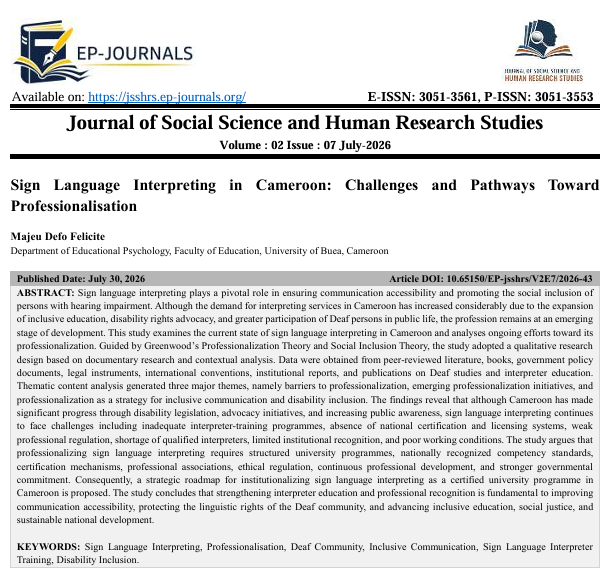
Sign Language Interpreting in Cameroon: Challenges and Pathways Toward Professionalisation
DOI:
https://doi.org/10.65150/EP-jsshrs/V2E7/2026-43Keywords:
Sign Language Interpreting, Professionalisation, Deaf Community, Inclusive Communication, Sign Language Interpreter Training, Disability Inclusion.Abstract
Sign language interpreting plays a pivotal role in ensuring communication accessibility and promoting the social inclusion of persons with hearing impairment. Although the demand for interpreting services in Cameroon has increased considerably due to the expansion of inclusive education, disability rights advocacy, and greater participation of Deaf persons in public life, the profession remains at an emerging stage of development. This study examines the current state of sign language interpreting in Cameroon and analyses ongoing efforts toward its professionalization. Guided by Greenwood’s Professionalization Theory and Social Inclusion Theory, the study adopted a qualitative research design based on documentary research and contextual analysis. Data were obtained from peer-reviewed literature, books, government policy documents, legal instruments, international conventions, institutional reports, and publications on Deaf studies and interpreter education. Thematic content analysis generated three major themes, namely barriers to professionalization, emerging professionalization initiatives, and professionalization as a strategy for inclusive communication and disability inclusion. The findings reveal that although Cameroon has made significant progress through disability legislation, advocacy initiatives, and increasing public awareness, sign language interpreting continues to face challenges including inadequate interpreter-training programmes, absence of national certification and licensing systems, weak professional regulation, shortage of qualified interpreters, limited institutional recognition, and poor working conditions. The study argues that professionalizing sign language interpreting requires structured university programmes, nationally recognized competency standards, certification mechanisms, professional associations, ethical regulation, continuous professional development, and stronger governmental commitment. Consequently, a strategic roadmap for institutionalizing sign language interpreting as a certified university programme in Cameroon is proposed. The study concludes that strengthening interpreter education and professional recognition is fundamental to improving communication accessibility, protecting the linguistic rights of the Deaf community, and advancing inclusive education, social justice, and sustainable national development.
References
1) Aarons, D., & Akach, P. (2002). Inclusion and the Deaf community. Journal of Deaf Studies and Deaf Education.
2) Baker-Shenk, C., & Cokely, D. (1980). American Sign Language: A teacher's resource text on grammar and culture. Gallaudet University Press.
3) Creswell, J. W., & Poth, C. N. (2018). Qualitative inquiry and research design: Choosing among five approaches (4th ed.). SAGE Publications.
4) Dean, R. K., & Pollard, R. Q. (2001). Application of demand-control theory to sign language interpreting: Implications for stress and interpreter training. Journal of Deaf Studies and Deaf Education, 6(2), 103–116.
5) Greenwood, E. (1957). Attributes of a profession. Social Work, 2(3), 45–55.
6) Humphrey, J., & Alcorn, B. (2007). So you want to be an interpreter? An introduction to sign language interpreting (4th ed.). H & H Publishing.
7) Lane, H., Hoffmeister, R., & Bahan, B. (1996). A journey into the Deaf-World. DawnSignPress.
8) Marschark, M., Peterson, R., & Winston, E. A. (Eds.). (2005). Sign language interpreting and interpreter education: Directions for research and practice. Oxford University Press.
9) Miles, M. (2001). Disability and deafness in Africa: A review of historical and contemporary issues.Disability & Society,16(7), 935–948.
10) Napier, J. (2002). Sign language interpreting: Linguistic coping strategies. Coleford Press.
11) Padden, C., & Humphries, T. (1988). Deaf in America: Voices from a culture. Harvard University Press.
12) Pöchhacker, F. (2004). Introducing interpreting studies. Routledge.
13) Registry of Interpreters for the Deaf. (2010). Code of professional conduct. Registry of Interpreters for the Deaf.
14) Republic of Cameroon. (2010). Law No. 2010/002 of 13 April 2010 relating to the protection and promotion of persons with disabilities. Government Printer.
15) Republic of Cameroon. (2018). Decree No. 2018/6233/PM of 26 July 2018 laying down the modalities for the application of Law No. 2010/002 relating to the protection and promotion of persons with disabilities. Government Printer.
16) Silver, H. (2015). The contexts of social inclusion (DESA Working Paper No. 144). United Nations Department of Economic and Social Affairs.
17) United Nations. (2006). Convention on the Rights of Persons with Disabilities. United Nations.
18) United Nations Educational, Scientific and Cultural Organization. (1994). The Salamanca Statement and Framework for Action on Special Needs Education. UNESCO.
19) United Nations Educational, Scientific and Cultural Organization. (2020). Global education monitoring report 2020: Inclusion and education – All means all. UNESCO.
20) Wilensky, H. L. (1964). The professionalization of everyone? American Journal of Sociology, 70(2), 137–158.
21) World Federation of the Deaf. (2018). Position paper on accessibility: Sign language interpreting and translation. World Federation of the Deaf.
22) World Health Organization. (2021). World report on hearing. World Health Organization.
Downloads
Published
Issue
Section
License
Copyright (c) 2026 Majeu Defo Felicite (Author)

This work is licensed under a Creative Commons Attribution 4.0 International License.