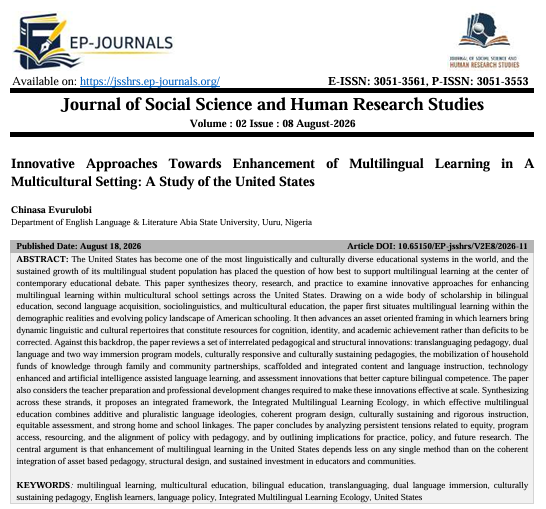
Innovative Approaches Towards Enhancement of Multilingual Learning in A Multicultural Setting: A Study of the United States
DOI:
https://doi.org/10.65150/EP-jsshrs/V2E8/2026-11Keywords:
multilingual learning, multicultural education, bilingual education, translanguaging, dual language immersion, culturally sustaining pedagogy, English learners, language policy, Integrated Multilingual Learning Ecology, United StatesAbstract
The United States has become one of the most linguistically and culturally diverse educational systems in the world, and the sustained growth of its multilingual student population has placed the question of how best to support multilingual learning at the center of contemporary educational debate. This paper synthesizes theory, research, and practice to examine innovative approaches for enhancing multilingual learning within multicultural school settings across the United States. Drawing on a wide body of scholarship in bilingual education, second language acquisition, sociolinguistics, and multicultural education, the paper first situates multilingual learning within the demographic realities and evolving policy landscape of American schooling. It then advances an asset oriented framing in which learners bring dynamic linguistic and cultural repertoires that constitute resources for cognition, identity, and academic achievement rather than deficits to be corrected. Against this backdrop, the paper reviews a set of interrelated pedagogical and structural innovations: translanguaging pedagogy, dual language and two way immersion program models, culturally responsive and culturally sustaining pedagogies, the mobilization of household funds of knowledge through family and community partnerships, scaffolded and integrated content and language instruction, technology enhanced and artificial intelligence assisted language learning, and assessment innovations that better capture bilingual competence. The paper also considers the teacher preparation and professional development changes required to make these innovations effective at scale. Synthesizing across these strands, it proposes an integrated framework, the Integrated Multilingual Learning Ecology, in which effective multilingual education combines additive and pluralistic language ideologies, coherent program design, culturally sustaining and rigorous instruction, equitable assessment, and strong home and school linkages. The paper concludes by analyzing persistent tensions related to equity, program access, resourcing, and the alignment of policy with pedagogy, and by outlining implications for practice, policy, and future research. The central argument is that enhancement of multilingual learning in the United States depends less on any single method than on the coherent integration of asset based pedagogy, structural design, and sustained investment in educators and communities.
References
1) Abedi, J. (2004). The No Child Left Behind Act and English language learners: Assessment and accountability issues. Educational Researcher, 33(1), 4–14.
2) Au, K. H. (1980). Participation structures in a reading lesson with Hawaiian children: Analysis of a culturally appropriate instructional event. Anthropology & Education Quarterly, 11(2), 91–115.
3) August, D., & Hakuta, K. (Eds.). (1997). Improving schooling for language-minority children: A research agenda. National Academy Press.
4) August, D., & Shanahan, T. (Eds.). (2006). Developing literacy in second-language learners: Report of the National Literacy Panel on Language-Minority Children and Youth. Lawrence Erlbaum.
5) Baker, C., & Wright, W. E. (2017). Foundations of bilingual education and bilingualism (6th ed.). Multilingual Matters.
6) Banks, J. A. (1993). Multicultural education: Historical development, dimensions, and practice. Review of Research in Education, 19, 3–49.
7) Banks, J. A., & Banks, C. A. M. (Eds.). (2019). Multicultural education: Issues and perspectives (10th ed.). Wiley.
8) Beeman, K., & Urow, C. (2013). Teaching for biliteracy: Strengthening bridges between languages. Caslon.
9) Bialystok, E. (2001). Bilingualism in development: Language, literacy, and cognition. Cambridge University Press.
10)Bialystok, E., Craik, F. I. M., & Luk, G. (2012). Bilingualism: Consequences for mind and brain. Trends in Cognitive Sciences,16(4), 240–250.
11) Blake, R. J. (2013). Brave new digital classroom: Technology and foreign language learning (2nd ed.). Georgetown University Press.
12) Boakye, K., Ofori, S. D., Ogbona, C. S., Yeboah, T. J., & Bobga, M. A. (2020). Integrating ICT and mathematical thinking: Exploring the effectiveness of digital tools in secondary mathematics instruction. IRE Journals, 4(4), 372–398. https://doi.org/10.64388/IREV4I4-1714179
13) Boakye, K., Ofori, S. D., Ogbona, C. S., Yeboah, T. J., & Bobga, M. A. (2021). Bridging the gap: A comparative study of mathematics curriculum reforms in Ghana and the United States. IRE Journals, 5(3), 429–450. https://doi.org/10.64388/IREV5I3-1714180
14) Bobga, M. A., Boakye, K., Ogbona, C. S., & Yeboah, T. J. (2018). Pedagogical strategies for teaching students with learning difficulties in resource-constrained schools. IRE Journals, 2(4), 173–194. https://doi.org/10.64388/IREV2I4-1714176
15) Bobga, M. A., Boakye, K., Ogbona, C. S., & Yeboah, T. J. (2025). Reforming teacher education curricula to address special learning needs: Lessons from U.S. and African institutions. International Journal of Advanced Multidisciplinary Research and Studies, 5(6), 2087–2103.
16) Callahan, R. M., & Gándara, P. C. (Eds.). (2014).The bilingual advantage:Language, literacy and the US labor market. Multilingual Matters.
17) Canagarajah, S. (2011). Codemeshing in academic writing: Identifying teachable strategies of translanguaging. The Modern Language Journal, 95(3), 401–417.
18) Collier, V. P. (1987). Age and rate of acquisition of second language for academic purposes. TESOL Quarterly, 21(4), 617–641.
19) Cook, V. (1992). Evidence for multicompetence. Language Learning, 42(4), 557–591.
20) Cook, V. (1999). Going beyond the native speaker in language teaching. TESOL Quarterly, 33(2), 185–209.
21) Crawford, J. (2004). Educating English learners: Language diversity in the classroom (5th ed.). Bilingual Educational Services.
22) Creese, A., & Blackledge, A. (2010). Translanguaging in the bilingual classroom: A pedagogy for learning and teaching? The Modern Language Journal, 94(1), 103–115.
23) Cummins, J. (1979). Linguistic interdependence and the educational development of bilingual children. Review of Educational Research, 49(2), 222–251.
24) Cummins, J. (1981). The role of primary language development in promoting educational success for language minority students. In California State Department of Education (Ed.), Schooling and language minority students: A theoretical framework (pp. 3–49). Evaluation, Dissemination and Assessment Center.
25) Cummins, J. (2000). Language, power, and pedagogy: Bilingual children in the crossfire. Multilingual Matters.
26) Cummins, J. (2007). Rethinking monolingual instructional strategies in multilingual classrooms. Canadian Journal of Applied Linguistics, 10(2), 221–240.
27) Cummins, J. (2008). BICS and CALP: Empirical and theoretical status of the distinction. In B. Street & N. H. Hornberger (Eds.), Encyclopedia of language and education (2nd ed., Vol. 2, pp. 71–83). Springer.
28) de Jong, E. J., & Harper, C. A. (2005). Preparing mainstream teachers for English-language learners: Is being a good teacher good enough? Teacher Education Quarterly, 32(2), 101–124.
29) Delgado-Gaitan, C. (2004). Involving Latino families in schools: Raising student achievement through home-school partnerships. Corwin Press.
30) Delpit, L. (2006). Other people’s children: Cultural conflict in the classroom (Rev. ed.). The New Press.
31) Dörnyei, Z. (2005). The psychology of the language learner: Individual differences in second language acquisition. Lawrence Erlbaum.
32) Dörnyei, Z., & Ushioda, E. (2011). Teaching and researching motivation (2nd ed.). Pearson.
33) Echevarría, J., Vogt, M., & Short, D. J. (2017). Making content comprehensible for English learners: The SIOP model (5th ed.). Pearson.
34) Ellis, R. (2008). The study of second language acquisition (2nd ed.). Oxford University Press.
35) Epstein, J. L. (2001). School, family, and community partnerships: Preparing educators and improving schools. Westview Press.
36) Escamilla, K., Hopewell, S., Butvilofsky, S., Sparrow, W., Soltero-González, L., Ruiz-Figueroa, O., & Escamilla, M. (2014). Biliteracy from the start: Literacy squared in action. Caslon.
37) Gándara, P., & Hopkins, M. (Eds.). (2010). Forbidden language: English learners and restrictive language policies. Teachers College Press.
38) García, O. (2009). Bilingual education in the 21st century: A global perspective. Wiley-Blackwell.
39) García, O., & Wei, L. (2014). Translanguaging: Language, bilingualism and education. Palgrave Macmillan.
40) García, O., Johnson, S. I., & Seltzer, K. (2017). The translanguaging classroom: Leveraging student bilingualism for learning. Caslon.
41) García, O., Kleifgen, J. A., & Falchi, L. (2008). From English language learners to emergent bilinguals (Equity Matters: Research Review No. 1). Campaign for Educational Equity, Teachers College, Columbia University.
42) Gardner, R. C. (1985). Social psychology and second language learning: The role of attitudes and motivation. Edward Arnold.
43) Gass, S. M., & Selinker, L. (2008). Second language acquisition: An introductory course (3rd ed.). Routledge.
44) Gay, G. (2018). Culturally responsive teaching: Theory, research, and practice (3rd ed.). Teachers College Press.
45) Genesee, F. (1994). Educating second language children: The whole child, the whole curriculum, the whole community. Cambridge University Press.
46) Genesee, F., Lindholm-Leary, K., Saunders, W. M., & Christian, D. (2006). Educating English language learners: A synthesis of research evidence. Cambridge University Press.
47) Gibbons, P. (2015). Scaffolding language, scaffolding learning: Teaching English language learners in the mainstream classroom (2nd ed.). Heinemann.
48) Godwin-Jones, R. (2011). Emerging technologies: Mobile apps for language learning. Language Learning & Technology, 15(2), 2–11.
49) Goldenberg, C. (2008). Teaching English language learners: What the research does and does not say. American Educator, 32(2), 8–23, 42–44.
50) Golonka, E. M., Bowles, A. R., Frank, V. M., Richardson, D. L., & Freynik, S. (2014). Technologies for foreign language learning: A review of technology types and their effectiveness. Computer Assisted Language Learning, 27(1), 70–105.
51) González, N., Moll, L. C., & Amanti, C. (Eds.). (2005). Funds of knowledge: Theorizing practices in households, communities, and classrooms. Lawrence Erlbaum.
52) Grosjean, F. (1989). Neurolinguists, beware! The bilingual is not two monolinguals in one person. Brain and Language, 36(1), 3–15.
53) Gutiérrez, K. D., & Rogoff, B. (2003). Cultural ways of learning: Individual traits or repertoires of practice. Educational Researcher, 32(5), 19–25.
54) Hakuta, K. (1986). Mirror of language: The debate on bilingualism. Basic Books.
55) Hornberger, N. H. (2003). Continua of biliteracy: An ecological framework for educational policy, research, and practice in multilingual settings. Multilingual Matters.
56) Hornberger, N. H., & Link, H. (2012). Translanguaging and transnational literacies in multilingual classrooms: A biliteracy lens. International Journal of Bilingual Education and Bilingualism, 15(3), 261–278.
57) Joseph, O. B., & Nwankwo, C. U. (2024). Professional development for STEM educators: Enhancing teaching effectiveness through continuous learning. International Journal of Applied Research in Social Sciences, 6(8), 1558–1574. https://doi.org/10.51594/ijarss.v6i8.1370
58) Joseph, O. B., & Uzondu, N. C. (2024a). Bridging the digital divide in STEM education: Strategies and best practices. Engineering Science & Technology Journal, 5(8), 2435–2453. https://doi.org/10.51594/estj.v5i8.1378
59) Joseph, O. B., & Uzondu, N. C. (2024b). Integrating AI and machine learning in STEM education: Challenges and opportunities. Computer Science & IT Research Journal, 5(8), 1732–1750. https://doi.org/10.51594/csitrj.v5i8.1379
60) Joseph, O. B., Onwuzulike, O. C., & Shitu, K. (2024). Digital transformation in education: Strategies for effective implementation. World Journal of Advanced Research and Reviews, 23(2), 2785–2799. https://doi.org/10.30574/wjarr.2024.23.2.2668
61) Krashen, S. D. (1982). Principles and practice in second language acquisition. Pergamon Press.
62) Krashen, S. D. (1985). The input hypothesis: Issues and implications. Longman.
63) Krashen, S. D., & Terrell, T. D. (1983). The natural approach: Language acquisition in the classroom. Pergamon Press.
64) Kroll, J. F., & Bialystok, E. (2013). Understanding the consequences of bilingualism for language processing and cognition. Journal of Cognitive Psychology, 25(5), 497–514.
65) Kukulska-Hulme, A., & Shield, L. (2008). An overview of mobile assisted language learning: From content delivery to supported collaboration and interaction. ReCALL, 20(3), 271–289.
66) Ladson-Billings, G. (1994). The dreamkeepers: Successful teachers of African American children. Jossey-Bass.
67) Ladson-Billings, G. (1995). Toward a theory of culturally relevant pedagogy. American Educational Research Journal, 32(3), 465–491.
68) Lantolf, J. P., & Thorne, S. L. (2006). Sociocultural theory and the genesis of second language development. Oxford University Press.
69) Lau v. Nichols, 414 U.S. 563 (1974).
70) Lee, C. D. (2007). Culture, literacy, and learning: Taking bloom in the midst of the whirlwind. Teachers College Press.
71) Lightbown, P. M., & Spada, N. (2013). How languages are learned (4th ed.). Oxford University Press.
72) Lilian, I. N., Liadi, K. O., & Yeboah, T. J. (2024). Multilingual ecofeminism and environmental justice: Rethinking gender, language, and ecology in global contexts. Journal of Humanities and Social Policy, 10(6), 195–222. https://doi.org/10.56201/jhsp.v10.no6.2024.pg195.222
73) Lilian, I. N., Liadi, K. O., & Yeboah, T. J. (2025a). Intersectionality, language, and identity: Multilingual perspectives on inclusion and social justice. IRE Journals, 8(9), 1761–1788. https://doi.org/10.64388/IREV8I9-1713695
74) Lilian, I. N., Liadi, K. O., & Yeboah, T. J. (2025b). Language and collaboration across the humanities and social sciences: Addressing global challenges through multidisciplinary dialogue. IRE Journals, 9(1), 2024–2050. https://doi.org/10.64388/IREV9I1-1713696
75) Lilian, I. N., Liadi, K. O., Yeboah, T. J., & Apelehin, A. A. (2020). Understanding cross-cultural communication: Identity, diversity, and global interaction. Gyanshauryam, International Scientific Refereed Research Journal, 3(4), 153–176. https://doi.org/10.32628/GISRRJ21352
76) Lindholm-Leary, K. J. (2001). Dual language education. Multilingual Matters.
77) Long, M. H. (1996). The role of the linguistic environment in second language acquisition. In W. C. Ritchie & T. K. Bhatia (Eds.), Handbook of second language acquisition (pp. 413–468). Academic Press.
78) Lucas, T., Villegas, A. M., & Freedson-Gonzalez, M. (2008). Linguistically responsive teacher education: Preparing classroom teachers to teach English language learners. Journal of Teacher Education, 59(4), 361–373.
79) Marian, V., & Shook, A. (2012). The cognitive benefits of being bilingual. Cerebrum, 2012, 13.
80) Menken, K. (2008). English learners left behind: Standardized testing as language policy. Multilingual Matters.
81) Moll, L. C., Amanti, C., Neff, D., & González, N. (1992). Funds of knowledge for teaching: Using a qualitative approach to connect homes and classrooms. Theory into Practice, 31(2), 132–141.
82) National Academies of Sciences, Engineering, and Medicine. (2017). Promoting the educational success of children and youth learning English: Promising futures. The National Academies Press.
83) National Center for Education Statistics. (2024). English learners in public schools (Condition of Education). U.S. Department of Education, Institute of Education Sciences.
84) Nieto, S. (2010). Language, culture, and teaching: Critical perspectives (2nd ed.). Routledge.
85) Nieto, S., & Bode, P. (2018). Affirming diversity: The sociopolitical context of multicultural education (7th ed.). Pearson.
86) Norton, B. (2013). Identity and language learning: Extending the conversation (2nd ed.). Multilingual Matters.
87) Ogbona, C. S., Yeboah, T. J., Bobga, M. A., & Boakye, K. (2020). Parental collaboration and student progress: Understanding home–school partnerships in special education. IRE Journals, 3(10), 552–573. https://doi.org/10.64388/IREV3I10-1714178
88) Otheguy, R., García, O., & Reid, W. (2015). Clarifying translanguaging and deconstructing named languages: A perspective from linguistics. Applied Linguistics Review, 6(3), 281–307.
89) Ovando, C. J., & Combs, M. C. (2018). Bilingual and ESL classrooms: Teaching in multicultural contexts (6th ed.). Rowman & Littlefield.
90) Paap, K. R., & Greenberg, Z. I. (2013). There is no coherent evidence for a bilingual advantage in executive processing. Cognitive Psychology, 66(2), 232–258.
91) Paris, D. (2012). Culturally sustaining pedagogy: A needed change in stance, terminology, and practice. Educational Researcher, 41(3), 93–97.
92) Paris, D., & Alim, H. S. (Eds.). (2017). Culturally sustaining pedagogies: Teaching and learning for justice in a changing world. Teachers College Press.
93) Poehner, M. E., & Lantolf, J. P. (2005). Dynamic assessment in the language classroom. Language Teaching Research, 9(3), 233–265.
94) Ruiz, R. (1984). Orientations in language planning. NABE Journal, 8(2), 15–34.
95) Seun, A., Ajayi, A., Bobga, M. A., Yeboah, T. J., Apelehin, A. A., Ofori, S. D., Elumilade, R. A., & Abutu, D. E. (2023). PearlAI and motivation paths: Advancing student engagement through AI-powered personalization in basic education. International Journal of Scientific Research in Science, Engineering and Technology, 10(4), 391–403. https://doi.org/10.32628/IJSRSET232532
96) Seun, A., Ajayi, A., Elumilade, R. A., Bobga, M. A., Yeboah, T. J., Ofori, S. D., Apelehin, A. A., & Abutu, D. E. (2024b). PearlAI: Hyperpersonalization and hyperlocalization as new AI affordances in basic education. International Journal of Scientific Research in Computer Science, Engineering and Information Technology, 10(6), 2553–2568. https://doi.org/10.32628/CSEIT25113574
97) Seun, A., Ajayi, A., Yeboah, T. J., Ofori, S. D., Elumilade, R. A., Apelehin, A. A., Abutu, D. E., & Bobga, M. A. (2024a). The PearlAI framework: Leveraging artificial intelligence to transform education in Africa. International Journal of Scientific Research in Computer Science, Engineering and Information Technology, 10(3), 1120–1132. https://doi.org/10.32628/CSEIT25113581
98) Shohamy, E. (2011). Assessing multilingual competencies: Adopting construct valid assessment policies. The Modern Language Journal, 95(3), 418–429.
99) Short, D. J., Fidelman, C. G., & Louguit, M. (2012). Developing academic language in English language learners through sheltered instruction. TESOL Quarterly, 46(2), 334–361.
100) Slavin, R. E., & Cheung, A. (2005). A synthesis of research on language of reading instruction for English language learners. Review of Educational Research, 75(2), 247–284.
101) Sleeter, C. E. (2012). Confronting the marginalization of culturally responsive pedagogy. Urban Education, 47(3), 562–584.
102) Snow, C. E., Burns, M. S., & Griffin, P. (Eds.). (1998). Preventing reading difficulties in young children. National Academy Press.
103) Snow, M. A., Met, M., & Genesee, F. (1989). A conceptual framework for the integration of language and content in second/foreign language instruction. TESOL Quarterly, 23(2), 201–217.
104) Solano-Flores, G., & Trumbull, E. (2003). Examining language in context: The need for new research and practice paradigms in the testing of English-language learners. Educational Researcher, 32(2), 3–13.
105) Steele, J. L., Slater, R. O., Zamarro, G., Miller, T., Li, J., Burkhauser, S., & Bacon, M. (2017). Effects of dual-language immersion programs on student achievement: Evidence from lottery data. American Educational Research Journal, 54(1S), 282S–306S.
106) Swain, M. (1985). Communicative competence: Some roles of comprehensible input and comprehensible output in its development. In S. Gass & C. Madden (Eds.), Input in second language acquisition (pp. 235–253). Newbury House.
107) Swain, M., & Lapkin, S. (2000). Task-based second language learning: The uses of the first language. Language Teaching Research, 4(3), 251–274.
108) Thomas, W. P., & Collier, V. P. (2002). A national study of school effectiveness for language minority students’ long-term academic achievement. Center for Research on Education, Diversity & Excellence.
109) Umansky, I. M., & Reardon, S. F. (2014). Reclassification patterns among Latino English learner students in bilingual, dual immersion, and English immersion classrooms. American Educational Research Journal, 51(5), 879–912.
110) Valdés, G. (1997). Dual-language immersion programs: A cautionary note concerning the education of language-minority students. Harvard Educational Review, 67(3), 391–429.
111) Valdés, G. (2001). Learning and not learning English: Latino students in American schools. Teachers College Press.
112) Valenzuela, A. (1999). Subtractive schooling: U.S.-Mexican youth and the politics of caring. State University of New York Press.
113) Villegas, A. M., & Lucas, T. (2002). Preparing culturally responsive teachers: Rethinking the curriculum. Journal of Teacher Education, 53(1), 20–32.
114) Vygotsky, L. S. (1978). Mind in society: The development of higher psychological processes. Harvard University Press.
115) Walqui, A. (2006). Scaffolding instruction for English language learners: A conceptual framework. International Journal of Bilingual Education and Bilingualism, 9(2), 159–180.
116) Warschauer, M. (2000). The changing global economy and the future of English teaching. TESOL Quarterly, 34(3), 511–535.
117) Warschauer, M., & Healey, D. (1998). Computers and language learning: An overview. Language Teaching, 31(2), 57–71.
118) Wei, L. (2018). Translanguaging as a practical theory of language. Applied Linguistics, 39(1), 9–30.
119) Wiley, T. G., & Wright, W. E. (2004). Against the undertow: Language-minority education policy and politics in the “age of accountability.” Educational Policy, 18(1), 142–168.
120) Wong Fillmore, L. (1991). When learning a second language means losing the first. Early Childhood Research Quarterly, 6(3), 323–346.
121) Wright, W. E. (2019). Foundations for teaching English language learners: Research, theory, policy, and practice (3rd ed.). Caslon.
122) Yeboah, T. J., Bobga, M. A., Boakye, K., & Ogbona, C. S. (2019). Professional development and teacher competence in managing exceptional learners: A Ghanaian perspective. IRE Journals, 2(12), 618–636. https://doi.org/10.64388/IREV2I12-1714177
123) Yeboah, T. J., Bobga, M. A., Boakye, K., & Ogbona, C. S. (2022). Data-driven teaching: Using student progress data to personalize learning in special education classrooms. Journal of Frontiers in Multidisciplinary Research, 3(2), 225–240.
https://doi.org/10.54660/.JFMR.2022.3.2.225-240
124) Yeboah, T. J., Bobga, M. A., Boakye, K., & Ogbona, C. S. (2024). Technology integration in special education: Enhancing student engagement and accessibility. International Journal of Advanced Multidisciplinary Research and Studies, 4(6), 2978–2993.
125) Yeboah, T. J., Bobga, M. A., Boakye, K., & Ogbona, C. S. (2025). Teacher resilience and retention in special education: Understanding the psychological factors behind burnout. International Journal of Advanced Multidisciplinary Research and Studies, 5(6), 2069–2086.
Downloads
Published
Issue
Section
License
Copyright (c) 2026 Chinasa Evurulobi (Author)

This work is licensed under a Creative Commons Attribution 4.0 International License.












