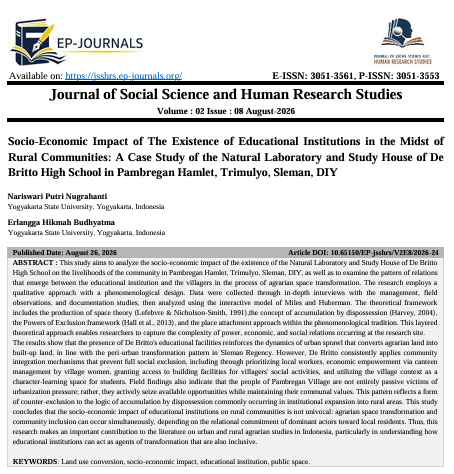
Socio-Economic Impact of The Existence of Educational Institutions in the Midst of Rural Communities: A Case Study of the Natural Laboratory and Study House of De Britto High School in Pambregan Hamlet, Trimulyo, Sleman, DIY
DOI:
https://doi.org/10.65150/EP-jsshrs/V2E8/2026-24Keywords:
Land use conversion, socio-economic impact, educational institution, public spaceAbstract
This study aims to analyze the socio-economic impact of the existence of the Natural Laboratory and Study House of De Britto High School on the livelihoods of the community in Pambregan Hamlet, Trimulyo, Sleman, DIY, as well as to examine the pattern of relations that emerge between the educational institution and the villagers in the process of agrarian space transformation. The research employs a qualitative approach with a phenomenological design. Data were collected through in-depth interviews with the management, field observations, and documentation studies, then analyzed using the interactive model of Miles and Huberman. The theoretical framework includes the production of space theory (Lefebvre & Nicholson-Smith, 1991),the concept of accumulation by dispossession (Harvey, 2004), the Powers of Exclusion framework (Hall et al., 2013), and the place attachment approach within the phenomenological tradition. This layered theoretical approach enables researchers to capture the complexity of power, economic, and social relations occurring at the research site.
The results show that the presence of De Britto's educational facilities reinforces the dynamics of urban sprawl that converts agrarian land into built-up land, in line with the peri-urban transformation pattern in Sleman Regency. However, De Britto consistently applies community integration mechanisms that prevent full social exclusion, including through prioritizing local workers, economic empowerment via canteen management by village women, granting access to building facilities for villagers' social activities, and utilizing the village context as a character-learning space for students. Field findings also indicate that the people of Pambregan Village are not entirely passive victims of urbanization pressure; rather, they actively seize available opportunities while maintaining their communal values. This pattern reflects a form of counter-exclusion to the logic of accumulation by dispossession commonly occurring in institutional expansion into rural areas. This study concludes that the socio-economic impact of educational institutions on rural communities is not univocal: agrarian space transformation and community inclusion can occur simultaneously, depending on the relational commitment of dominant actors toward local residents. Thus, this research makes an important contribution to the literature on urban and rural agrarian studies in Indonesia, particularly in understanding how educational institutions can act as agents of transformation that are also inclusive.
References
1) Alemu, G. M., & Kombe, W. (2025). Sprawling cities, shrinking farmland: urban expansion and smallholder farmers in Sub-Saharan Africa. In International Journal of Urban Sustainable Development (Vol. 17, Number 1, pp. 154–178). Taylor and Francis Ltd.
https://doi.org/10.1080/19463138.2025.2517014
2) Cahyani, N. P., Yunastiawan, A., Pramana, E., Ni’mah, N. M., Studi, P., Wilayah, P., & Kota, D. (2025). DINAMIKA SUB-URBANISASI DI KAWASAN PERKOTAAN YOGYAKARTA (STUDI KASUS: KAPANEWON KASIHAN DAN GAMPING). MATRA,6(2),12–23.
3) Carlisle, S., Baker, S., Bowditch, E., Constant, N., Finch, T., Minter, M., & Syder, A. (2026). Place attachment and attitudes to landscape change for tree planting and net zero. People and Nature. https://doi.org/10.1002/pan3.70287
4) Devi, M. K., Gorman, Y. H., & Hidayati, S. R. (2020). Spatial transformation in urban periphery: The case of Yogyakarta. IOP Conference
5) Series: Earth and Environmental Science, 592(1). https://doi.org/10.1088/1755-1315/592/1/012022
6) Ghorbanzadeh, S., & Nordberg, K. (2024). The multilocality of sense of place in ecosystem services discourse. Sustainability Science, 19(3), 989–1002. https://doi.org/10.1007/s11625-024-01464-y
7) Hall, Derek., Hirsch, Philip., & Li, Tania. (2013). Powers of exclusion: land dilemmas in Southeast Asia. University of Hawaiʻi Press.
8) Harvey, David. (2004). The new imperialism. Oxford University Press.
9) Lefebvre, H. (1991). The Production of Space. Oxford: Blackwell.
10) Miles, M. B., Huberman, A. M., & Saldaña, J. (2014). Qualitative Data Analysis: A Methods Sourcebook (3rd ed.). Thousand Oaks, CA: Sage Publications.
11) Ratnasari, Siscawati, M., & Soetjipto, A. W. (2020). Multi-Layered Exclusions of Women Heads of Household Over Land: Case Study on Ex-Plantation Concession Area in Nanggung Village, Nanggung Sub-District, Bogor Regency, West Java Province, Indonesia. Asian Women, 36(2), 97–120.
12) Sandi, F. A. T., & Sudaryono. (2024). Fenomenologi Transformasi Ruang Hidup Masyarakat Suku Duano di Pesisir Indragiri Hilir. Syntax Literate: Jurnal Ilmiah Indonesia, 9(2).
13) Sirait, M. T. (2015). Inclusion, exclusion and agrarian change: experiences of forest land redistribution in Indonesia. Journal of Peasant Studies.
14) Yusliana, Oka, I., & Pramana, A. Y. E. (2025). Membaca Dinamika Peri-Urban: Transformasi Spasial, Sosial, dan Ekonomi di Kawasan Perkotaan Yogyakarta: Studi Kasus Kabupaten Sleman. Jurnal Pratendidikan Geografi Undiksha, 13(3), 427–437.
Downloads
Published
Issue
Section
License
Copyright (c) 2026 Nariswari Putri Nugrahanti , Erlangga Hikmah Budhyatma (Author)

This work is licensed under a Creative Commons Attribution 4.0 International License.












