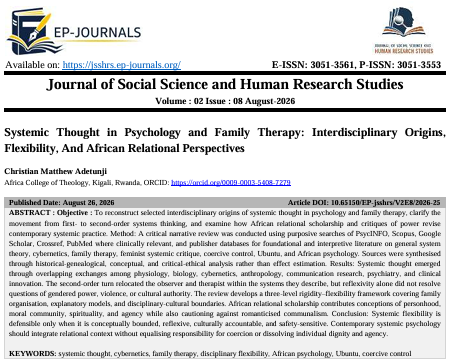
Systemic Thought in Psychology and Family Therapy: Interdisciplinary Origins, Flexibility, And African Relational Perspectives
DOI:
https://doi.org/10.65150/EP-jsshrs/V2E8/2026-25Keywords:
systemic thought, cybernetics, family therapy, disciplinary flexibility, African psychology, Ubuntu, coercive controlAbstract
Objective : To reconstruct selected interdisciplinary origins of systemic thought in psychology and family therapy, clarify the movement from first- to second-order systems thinking, and examine how African relational scholarship and critiques of power revise contemporary systemic practice. Method: A critical narrative review was conducted using purposive searches of PsycINFO, Scopus, Google Scholar, Crossref, PubMed where clinically relevant, and publisher databases for foundational and interpretive literature on general system theory, cybernetics, family therapy, feminist systemic critique, coercive control, Ubuntu, and African psychology. Sources were synthesised through historical-genealogical, conceptual, and critical-ethical analysis rather than effect estimation. Results: Systemic thought emerged through overlapping exchanges among physiology, biology, cybernetics, anthropology, communication research, psychiatry, and clinical innovation. The second-order turn relocated the observer and therapist within the systems they describe, but reflexivity alone did not resolve questions of gendered power, violence, or cultural authority. The review develops a three-level rigidity–flexibility framework covering family organisation, explanatory models, and disciplinary-cultural boundaries. African relational scholarship contributes conceptions of personhood, moral community, spirituality, and agency while also cautioning against romanticised communalism. Conclusion: Systemic flexibility is defensible only when it is conceptually bounded, reflexive, culturally accountable, and safety-sensitive. Contemporary systemic psychology should integrate relational context without equalising responsibility for coercion or dissolving individual dignity and agency.
References
1) Abraham, T. H. (2020). The Macy Conferences on cybernetics: Reinstantiating the mind. In Oxford Research Encyclopedia of Psychology. Oxford University Press. https://doi.org/10.1093/acrefore/9780190236557.013.541
2) Adams, G., Dobles, I., Gómez, L. H., Kurtiş, T., & Molina, L. E. (2015). Decolonizing psychological science: Introduction to the special thematic section. Journal of Social and Political Psychology, 3(1), 213–238. https://doi.org/10.5964/jspp.v3i1.564
3) Atkinson, B. J., & Heath, A. W. (1990). Further thoughts on second-order family therapy: This time it’s personal. Family Process, 29(2),145–155. https://doi.org/10.1111/j.1545-5300.1990.00145.x
4) Bateson, G., Jackson, D. D., Haley, J., & Weakland, J. (1956). Toward a theory of schizophrenia. Behavioral Science, 1(4), 251–264.https://doi.org/10.1002/bs.3830010402
5) Bayuo, J. (2025). Personhood and community: African philosophical perspectives. Nursing Philosophy, 26(4), Article e70052.https://doi.org/10.1111/nup.70052
6) Bowen, M. (1978). Family therapy in clinical practice. Jason Aronson.
7) Cannon, W. B. (1932). The wisdom of the body. W. W. Norton.
8) Capra, F., & Luisi, P. L. (2014). The systems view of life: A unifying vision. Cambridge University Press.
9) Goldenberg, I., Stanton, M., & Goldenberg, H. (2017). Family therapy: An overview (9th ed.). Cengage Learning.
10) Goldner, V. (1985). Feminism and family therapy. Family Process, 24(1), 31–47. https://doi.org/10.1111/j.1545-5300.1985.00031.x
11) Green, B. N., Johnson, C. D., & Adams, A. (2006). Writing narrative literature reviews for peer-reviewed journals: Secrets of the trade. Journal of Chiropractic Medicine, 5(3), 101–117. https://doi.org/10.1016/S0899-3467(07)60142-6
12) Gyekye, K. (1997). Tradition and modernity: Philosophical reflections on the African experience. Oxford University Press.
13) Haley, J. (1976). Problem-solving therapy. Jossey-Bass.
14) Hare-Mustin, R. T. (1978). A feminist approach to family therapy. Family Process, 17(2), 181–194.https://doi.org/10.1111/j.1545-5300.1978.00181.x
15) Hoffman, L. (1990). Constructing realities: An art of lenses. Family Process, 29(1), 1–12.https://doi.org/10.1111/j.1545-5300.1990.00001.x
16) Karakurt, G., Whiting, K., Van Esch, C., Bolen, S. D., & Calabrese, J. R. (2016). Couples therapy for intimate partner violence: A systematic review and meta-analysis. Journal of Marital and Family Therapy, 42(4), 567–583. https://doi.org/10.1111/jmft.12178
17) Lohmann, S., Cowlishaw, S., Ney, L., O’Donnell, M., & Felmingham, K. (2024). The trauma and mental health impacts of coercive control: A systematic review and meta-analysis. Trauma, Violence, & Abuse, 25(1), 630–647.https://doi.org/10.1177/15248380231162972
18) Maturana, H. R., & Varela, F. J. (1987). The tree of knowledge: The biological roots of human understanding. Shambhala.
19) Mead, M. (1968). Cybernetics of cybernetics. In H. von Foerster, J. D. White, L. J. Peterson, & J. K. Russell (Eds.), Purposive systems (pp. 1–11). Spartan Books.
20) Mbiti, J. S. (1969). African religions and philosophy. Heinemann.
21) Minuchin, S. (1974). Families and family therapy. Harvard University Press.
22) Mkhize, N. (2004). Psychology: An African perspective. In D. Hook, N. Mkhize, P. Kiguwa, & A. Collins (Eds.), Critical psychology (pp. 24–52). UCT Press.
23) Nichols, M. P., & Davis, S. D. (2020). Family therapy: Concepts and methods (12th ed.). Pearson.
24) Nsamenang, A. B. (2006). Human ontogenesis: An indigenous African view on development and intelligence. International Journal of Psychology, 41(4), 293–297. https://doi.org/10.1080/00207590544000077
25) Nwoye, A. (2004). The shattered microcosm: Imperatives for improved family therapy in Africa in the 21st century. Contemporary Family Therapy, 26(2), 143–164. https://doi.org/10.1023/B:COFT.0000031240.00980.88
26) Nwoye, A. (2015). What is African psychology the psychology of? Theory & Psychology, 25(1), 96–116.https://doi.org/10.1177/0959354314565116
27) Nwoye, A. (2017). An Africentric theory of human personhood. Psychology in Society, 54, 42–66.https://doi.org/10.17159/2309-8708/2017/n54a4
28) Page, M. J., McKenzie, J. E., Bossuyt, P. M., Boutron, I., Hoffmann, T. C., Mulrow, C. D., Shamseer, L., Tetzlaff, J. M., Akl, E. A., Brennan, S. E., Chou, R., Glanville, J., Grimshaw, J. M., Hróbjartsson, A., Lalu, M. M., Li, T., Loder, E. W., Mayo-Wilson, E., McDonald, S., … Moher, D. (2021). The PRISMA 2020 statement: An updated guideline for reporting systematic reviews. BMJ, 372, Article n71.
https://doi.org/10.1136/bmj.n71
29) Ramose, M. B. (1999). African philosophy through Ubuntu. Mond Books.
30) Ratele, K. (2017a). Four (African) psychologies. Theory & Psychology, 27(3), 313–327. https://doi.org/10.1177/0959354316684215
31) Ratele, K. (2017b). Frequently asked questions about African psychology. South African Journal of Psychology, 47(3), 273–279.https://doi.org/10.1177/0081246317703249
32) Satir, V., Banmen, J., Gerber, J., & Gomori, M. (1991). The Satir model: Family therapy and beyond. Science and Behavior Books.
33) Scott, B. (2004). Second-order cybernetics: An historical introduction. Kybernetes, 33(9/10), 1365–1378.https://doi.org/10.1108/03684920410556007
34) Snellingen, J. F., Carlin, P. E., & Vetere, A. (2024). Is it safe enough? An IPA study of how couple therapists make sense of their decision to either stop or continue with couple therapy when violence becomes the issue. Behavioral Sciences, 14(1), Article 37.https://doi.org/10.3390/bs14010037
35) Snyder, H. (2019). Literature review as a research methodology: An overview and guidelines. Journal of Business Research, 104, 333–339. https://doi.org/10.1016/j.jbusres.2019.07.039
36) Stark, E. (2007). Coercive control: How men entrap women in personal life. Oxford University Press.
37) Sukhera, J. (2022). Narrative reviews: Flexible, rigorous, and practical. Journal of Graduate Medical Education, 14(4), 414–417.https://doi.org/10.4300/JGME-D-22-00480.1
38) Umpleby, S. A., & Dent, E. B. (1999). The origins and purposes of several traditions in systems theory and cybernetics. Cybernetics and Systems, 30(2), 79–103. https://doi.org/10.1080/019697299125299
39) von Bertalanffy, L. (1968). General system theory: Foundations, development, applications. George Braziller.
40) von Foerster, H. (1981). Observing systems. Intersystems Publications.
41) Watzlawick, P., Beavin, J. H., & Jackson, D. D. (1967). Pragmatics of human communication: A study of interactional patterns, pathologies, and paradoxes. W. W. Norton.
42) Wiener, N. (1948). Cybernetics: Or control and communication in the animal and the machine. MIT Press.
Downloads
Published
Issue
Section
License
Copyright (c) 2026 Christian Matthew Adetunji (Author)

This work is licensed under a Creative Commons Attribution 4.0 International License.












