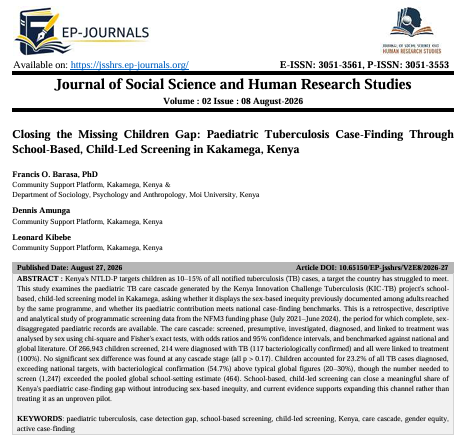
Closing the Missing Children Gap: Paediatric Tuberculosis Case-Finding Through School-Based, Child-Led Screening in Kakamega, Kenya
DOI:
https://doi.org/10.65150/EP-jsshrs/V2E8/2026-27Keywords:
paediatric tuberculosis, case detection gap, school-based screening, child-led screening, Kenya, care cascade, gender equity, active case-findingAbstract
Kenya's NTLD-P targets children as 10–15% of all notified tuberculosis (TB) cases, a target the country has struggled to meet. This study examines the paediatric TB care cascade generated by the Kenya Innovation Challenge Tuberculosis (KIC-TB) project's school-based, child-led screening model in Kakamega, asking whether it displays the sex-based inequity previously documented among adults reached by the same programme, and whether its paediatric contribution meets national case-finding benchmarks. This is a retrospective, descriptive and analytical study of programmatic screening data from the NFM3 funding phase (July 2021–June 2024), the period for which complete, sex-disaggregated paediatric records are available. The care cascade: screened, presumptive, investigated, diagnosed, and linked to treatment was analysed by sex using chi-square and Fisher's exact tests, with odds ratios and 95% confidence intervals, and benchmarked against national and global literature. Of 266,943 children screened, 214 were diagnosed with TB (117 bacteriologically confirmed) and all were linked to treatment (100%). No significant sex difference was found at any cascade stage (all p > 0.17). Children accounted for 23.2% of all TB cases diagnosed, exceeding national targets, with bacteriological confirmation (54.7%) above typical global figures (20–30%), though the number needed to screen (1,247) exceeded the pooled global school-setting estimate (464). School-based, child-led screening can close a meaningful share of Kenya's paediatric case-finding gap without introducing sex-based inequity, and current evidence supports expanding this channel rather than treating it as an unproven pilot.
References
1) Barasa, F. O. (2025). Gendered pathways in TB diagnosis: Insights from a school-based screening initiative in Kakamega County, Kenya. Iconic Research and Engineering Journals, 9(4), 911–921. https://www.irejournals.com/paper-details/1711412
2) Barasa, F., & Kibebe, L. (2025). Schools as surveillance hubs: Uncovering adult TB burden through child-led screening in Kakamega County, Kenya. GAS Journal of Arts Humanities and Social Sciences, 3(8). https://doi.org/10.5281/zenodo.16943385
3) Dorjee, K., Topgyal, S., Sood, R. K., Namdon, T., Kumar, R., Gyatso, U., Kalsang, J., Thinley, T., Dechen, T., Tsomo, T., Kalsang, T., Sadoff, R. C., Dorjee, S., Baksh, S., Yangkyi, T., Khachoe, T., Dolker, T., Wangmo, T., Lhadon, D., … Sadutshang, T. D. (2026).
Comprehensive tuberculosis screening and preventive treatment in schools and congregate settings of India (2017–2024): A prospective study. The Lancet Regional Health – Southeast Asia. https://doi.org/10.1016/j.lansea.2026.100725
4) Kakinda, M., Olum, R., Baluku, J. B., & Bongomin, F. (2024). Diagnostic accuracy of clinical diagnostic scoring systems for childhood tuberculosis: A systematic review and meta-analysis. Open Forum Infectious Diseases, 11(1), ofad624.https://doi.org/10.1093/ofid/ofad624
5) NLTD-P. (2023). Annual reports. National Tuberculosis, Leprosy and Lung Disease Program. https://nltp.co.ke/reports/annual-reports/
6) Robsky, K. O., Chaisson, L. H., Naufal, F., Delgado-Barroso, P., Alvarez-Manzo, H. S., Golub, J. E., Shapiro, A. E., & Salazar-Austin, N. (2023). Number needed to screen for tuberculosis disease among children: A systematic review. Pediatrics, 151(4), e2022059189. https://doi.org/10.1542/peds.2022-059189
7) Seddon, J. A., Jenkins, H. E., Liu, L., Cohen, T., Black, R. E., Vos, T., Becerra, M. C., Graham, S. M., Sismanidis, C., & Dodd, P. J. (2015). Counting children with tuberculosis: Why numbers matter. The International Journal of Tuberculosis and Lung Disease, 19(Suppl 1), S9–S16. https://doi.org/10.5588/ijtld.15.0471
8) World Health Organization. (2024). Global tuberculosis report 2024. https://www.who.int/teams/global-programme-on-tuberculosis-and-lung-health/tb-reports/global-tuberculosis-report-2024
Downloads
Published
Issue
Section
License
Copyright (c) 2026 Francis O. Barasa, PhD, Dennis Amunga , Leonard Kibebe (Author)

This work is licensed under a Creative Commons Attribution 4.0 International License.












