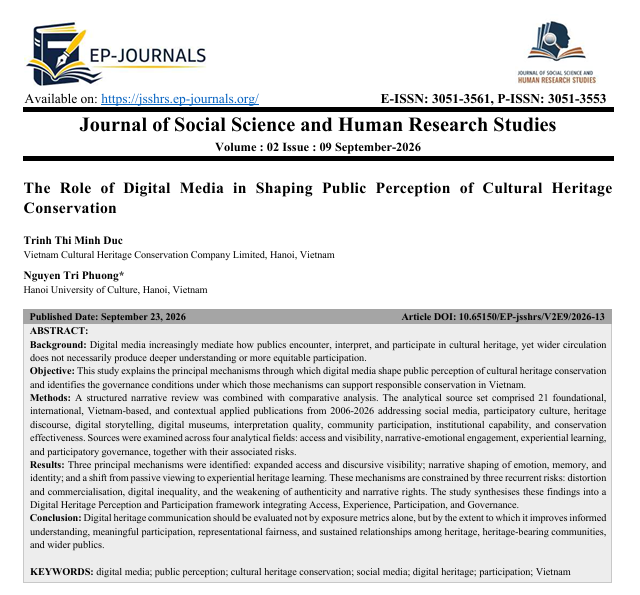
The Role of Digital Media in Shaping Public Perception of Cultural Heritage Conservation
DOI:
https://doi.org/10.65150/EP-jsshrs/V2E9/2026-13Keywords:
digital media, public perception, cultural heritage conservation, social media, digital heritage, participation, VietnamAbstract
Background: Digital media increasingly mediate how publics encounter, interpret, and participate in cultural heritage, yet wider circulation does not necessarily produce deeper understanding or more equitable participation.
Objective: This study explains the principal mechanisms through which digital media shape public perception of cultural heritage conservation and identifies the governance conditions under which those mechanisms can support responsible conservation in Vietnam.
Methods: A structured narrative review was combined with comparative analysis. The analytical source set comprised 21 foundational, international, Vietnam-based, and contextual applied publications from 2006-2026 addressing social media, participatory culture, heritage discourse, digital storytelling, digital museums, interpretation quality, community participation, institutional capability, and conservation effectiveness. Sources were examined across four analytical fields: access and visibility, narrative-emotional engagement, experiential learning, and participatory governance, together with their associated risks.
Results: Three principal mechanisms were identified: expanded access and discursive visibility; narrative shaping of emotion, memory, and identity; and a shift from passive viewing to experiential heritage learning. These mechanisms are constrained by three recurrent risks: distortion and commercialisation, digital inequality, and the weakening of authenticity and narrative rights. The study synthesises these findings into a Digital Heritage Perception and Participation framework integrating Access, Experience, Participation, and Governance.
Conclusion: Digital heritage communication should be evaluated not by exposure metrics alone, but by the extent to which it improves informed understanding, meaningful participation, representational fairness, and sustained relationships among heritage, heritage-bearing communities, and wider publics.
References
1) boyd, d., & Ellison, N. B. (2007). Social network sites: Definition, history, and scholarship. Journal of Computer-Mediated Communication, 13(1), 210-230. https://doi.org/10.1111/j.1083-6101.2007.00393.x
2) Bui, T. K. P. (2025). Cultural heritage and digital transformation: Mapping and preserving traditional art through technology (the case of Ca tru in Vinh Phuc). Journal of Science, Hanoi Open University, Special Issue 8A (November 2025), 509. https://doi.org/10.59266/houjs.2025.904
3) Cameron, F., & Kenderdine, S. (Eds.). (2007). Theorizing digital cultural heritage: A critical discourse. MIT Press.
4) Cao, H. (2025). Exploring the promotion of musical intangible cultural heritage under TikTok short videos. Scientific Reports, 15, Article 21772. https://doi.org/10.1038/s41598-025-09723-3
5) Giaccardi, E. (Ed.). (2012). Heritage and social media: Understanding heritage in a participatory culture. Routledge.
6) Ginzarly, M., Pereira Roders, A., & Teller, J. (2019). Mapping historic urban landscape values through social media. Journal of Cultural Heritage, 36, 1-11. https://doi.org/10.1016/j.culher.2018.10.002
7) Ha, D. H., Vu, V. T., & Pham, T. H. (2026). The impact of architectural heritage interpretation quality at the Imperial Citadel of Hue on responsible tourist behavior in sustainable tourism: The mediating role of personal norms. Heritage and Sustainable Development, 8(2), 43-58. https://doi.org/10.37868/hsd.v8i2.2035
8) He, B., Luo, Z., Chai, Z., & Tan, G. (2026). Narrative strategies in short videos for traditional craftsmanship in intangible cultural heritage: Empirical evidence from Douyin. Humanities and Social Sciences Communications, 13, Article 1240. https://doi.org/10.1057/s41599-026-07166-3
9) Hoang, V. (2017). Journalism and the conservation and promotion of cultural heritage value [Interview with Associate Professor Dr Do Van Tru]. World Heritage Online Magazine.
10) Hung, N. T. V., & Tuyen, V. V. (2026). The impact of tourism development dimensions on the effectiveness of conserving marine cultural heritage in Thanh Hoa Province, Vietnam. Geojournal of Tourism and Geosites, 67(3), 2133-2142. https://doi.org/10.30892/gtg.67326-1838
11) Jenkins, H. (2006). Convergence culture: Where old and new media collide. New York University Press.
12) Liang, X., Hua, N., Martin, J., Dellapiana, E., Coscia, C., & Zhang, Y. (2022). Social media as a medium to promote local perception expression in China's World Heritage sites. Land, 11(6), Article 841. https://doi.org/10.3390/land11060841
13) Liang, X., Lu, Y., & Martin, J. (2021). A review of the role of social media for cultural heritage sustainability. Sustainability, 13(3), Article 1055. https://doi.org/10.3390/su13031055
14) Nguyen, T. H. A., & Nguyen, Q. A. (2026). Preserving and promoting Vietnamese folk culture in the digital era: Opportunities and challenges from online platforms. Journal of Science, Hanoi Pedagogical University 2: Social Sciences and Humanities Series, 1(05), 236.
15) Pham, C. H., Pham, N. D., Duong, D. T., Hoang, A. C., & Tran, D. L. (2025). Leveraging the value of brocade weaving for the development of distinctive tourism in the northern mountainous region. Journal of Science and Technology - Nguyen Tat Thanh University, 8(S1), 424-428. https://doi.org/10.55401/sdxxf292
16) Smith, L. (2006). Uses of heritage. Routledge.
17) Tran, D. L. (2024a). Student entrepreneurship at Thanh Hoa University of Culture, Sports and Tourism: Current status, international experience, and proposed solutions for promotion. Vietnam Journal of Education, 24(Special Issue 13), 349-353. https://tcgd.tapchigiaoduc.edu.vn/index.php/tapchi/article/view/3475
18) Tran, D. L. (2024b). Improving the teaching quality of sewing and cutting techniques for students of fashion design at Thanh Hoa University of Culture, Sports and Tourism. Journal of Science, Thanh Hoa University of Culture, Sports and Tourism, (19), 117-126. https://doi.org/10.55988/2588-1264/186
19) Tran, T. T. T. (2025). Digital museums and online platforms: Applying graphic design to heritage reconstruction and communication. Journal of Science, Hanoi Open University, Special Issue 8A (November 2025), 498. https://doi.org/10.59266/houjs.2025.903
20) Vu, T. N. (2025). Applying digital technology to the digitisation and conservation of the Co Loa relic site. Journal of Science, Hanoi Open University, Special Issue 8A (November 2025), 434. https://doi.org/10.59266/houjs.2025.896
21) Dang, T. T. (2026). Transformation of graphic language in cultural heritage education in Ho Chi Minh City: From archiving to digital experience. Journal of Science, Hanoi Pedagogical University 2: Education Sciences Series, 2(05), 121.
Downloads
Published
Issue
Section
License
Copyright (c) 2026 Trinh Thi Minh Duc, Nguyen Tri Phuong (Author)

This work is licensed under a Creative Commons Attribution 4.0 International License.