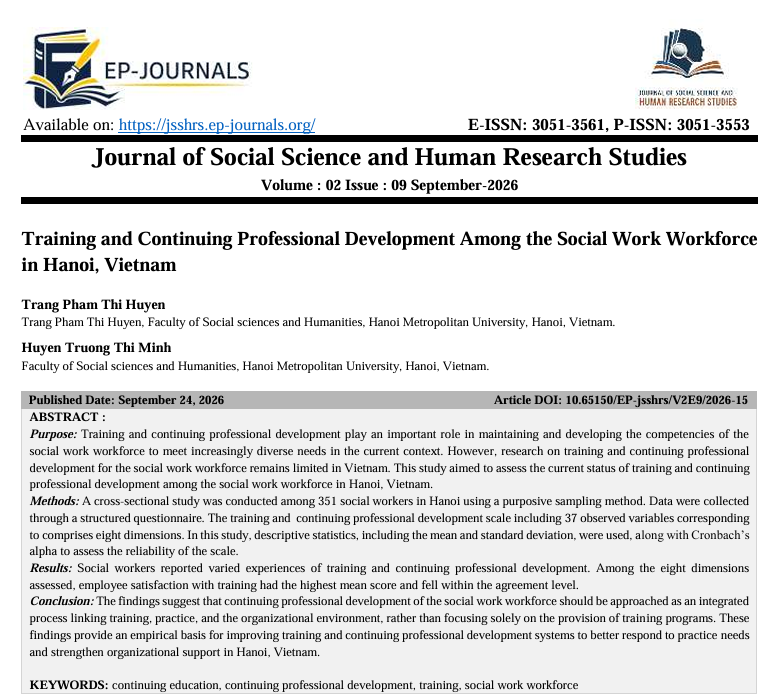
Training and Continuing Professional Development Among the Social Work Workforce in Hanoi, Vietnam
DOI:
https://doi.org/10.65150/EP-jsshrs/V2E9/2026-15Keywords:
continuing education, continuing professional development, training, social work workforceAbstract
Purpose: Training and continuing professional development play an important role in maintaining and developing the competencies of the social work workforce to meet increasingly diverse needs in the current context. However, research on training and continuing professional development for the social work workforce remains limited in Vietnam. This study aimed to assess the current status of training and continuing professional development among the social work workforce in Hanoi, Vietnam.
Methods: A cross-sectional study was conducted among 351 social workers in Hanoi using a purposive sampling method. Data were collected through a structured questionnaire. The training and continuing professional development scale including 37 observed variables corresponding to comprises eight dimensions. In this study, descriptive statistics, including the mean and standard deviation, were used, along with Cronbach’s alpha to assess the reliability of the scale.
Results: Social workers reported varied experiences of training and continuing professional development. Among the eight dimensions assessed, employee satisfaction with training had the highest mean score and fell within the agreement level.
Conclusion: The findings suggest that continuing professional development of the social work workforce should be approached as an integrated process linking training, practice, and the organizational environment, rather than focusing solely on the provision of training programs. These findings provide an empirical basis for improving training and continuing professional development systems to better respond to practice needs and strengthen organizational support in Hanoi, Vietnam.
References
1) Beltran, S., Yalim, A., Morris, A., & Taylor, L. (2023). Emerging social workers during COVID-19: Exploring perceived readiness and training needs. Journal of Social Work, 23(3), 428-442.
2) Bubb, S., & Earley, P. (2007). Leading and Managing Continuing Professional Development. London: Sage.
3) Brintzenhofeszoc, K., Belfiore, M. N., & Shields, J. J. (2019). Bringing SBIRT into the community: An evaluation of a continuing education training for social workers. Journal of Teaching in Social Work, 19(1-2), 124–138. https://doi.org/10.1080/1533256X.2019.1591797
4) Eltaiba, N., & Ndoye, A. (2018). The effectiveness of field education in social work education: A student perspective. Advances in Social Work and Welfare Education, 20(1), 170-184.
5) Filges, T., Torgerson, C., Gascoine, L., Dietrichson, J., Nielsen, C., & Viinholt, B. A. (2019). Effectiveness of continuing professional development training of welfare professionals on outcomes for children and young people: A systematic review. Campbell Systematic Reviews, 15(4). doi: 10.1002/cl2.1060.
6) Nguyễn Trung Hải. (2022). Nghiên cứu nguồn nhân lực công tác xã hội tại Việt Nam giai đoạn 2010-2020. Tạp chí Nguồn nhân lực và an sinh xã hội. Số 2, tháng 1, tr. 53-60.
7) Hall, M. N., Amodeo, M., Shaffer, H. J., & Bilt, J. V. (2000). Social workers employed in substance abuse treatment agencies: A training needs assessment. Social work, 45(2), 141-155.
8) Heyes, J., & Stuart, M. (1996). Does Training Matter? Employee Experiences and Attitudes. Human Resource Management Journal, 6(3), 7–21. https://doi.org/10.1111/j.1748-8583.1996.tb00409.x
9) Hughes, A. M., Zajac, S., Woods, A. L., & Salas, E. (2020). The role of work environment in training sustainment: A meta-analysis. Human factors, 62(1), 166-183.
10) Jordaan, L. C., & Geyer, S. (2025). “Didn’t they teach you that at university?” A scoping review of continuing professional development for enhancing work readiness of newly qualified social workers. Social Work Education,1-19.
11) Kirkpatrick, J. D., & Kirkpatrick, W. K. (2016). Kirkpatrick's four levels of training evaluation. Association for Talent Development.
12) Nguyễn Thị Thái Lan (2019). Nguồn nhân lực Công tác xã hội ở Việt Nam: Thực trạng và khuyến nghị. Tạp chí Khoa học Xã hội và Nhân văn (VNU Journal of Social Sciences and Humanities). 5, 6, 728–738.
13) McCulloch, T., Grant, S., Daly, M., Sen, R., & Ferguson, G. (2024). Embedding learning as a practice of value: Learning from the experiences of early career social workers in Scotland. The British Journal of Social Work, 54(7), 2977-2995.
14) Ministry of Health. (2026). Circular No. 29/2026/TT-BYT on social work practice and continuing social work knowledge updating [Thông tư số 29/2026/TT-BYT về thực hành công tác xã hội và cập nhật kiến thức công tác xã hội]
15) Mueller, C., & King, M. D. (2018). Beyond obligation: Social workers as lifelong learners. Journal of Educational Leadership in Action, 5(2), Article 7. https://doi.org/10.62608/2164-1102.1043.
16) National association of social workers (NASW). (2003). NASW Standards for Continuing Professional Education.
17) Nissen, L. B., Pendell, K. D., Jivanjee, P., & Goodluck, C. (2014). Lifelong learning in social work education: A review of the literature and implications for the future. Journal of Teaching in Social Work, 34(4), 384–400. https://doi.org/10.1080/08841233.2014.936577
18) Phillips, J. D., Goldsborough, E. J., Davis, T., Rondini-Zayas, J., Sanborn, R., Monahan, T., & Villagrana, K. M. (2026). Development and Application of the Training Needs Assessment for the Child Welfare Workforce (tna-Cww). Human Service Organizations: Management, Leadership & Governance, 50(2), 192–209.
19) Santos A., & Stuart M. (2003). Employee perceptions and their influence on training effectiveness. Human Resource Management Journal, 13(1), 27-45.
20) Schmidt, S. W. (2004). The Job Training and Job Satisfaction Survey Technical Manual. East Carolina University.
21) Shukla, A., Dash, S., & Kumar, A. (2024). Factors affecting transfer of online training: A systematic literature review and proposed taxonomy. Human Resource Development Quarterly, 35(3), 363–390.
22) Spirina, T., & Liakh, T. (2020). Social workers training in continuing education system. The Modern Higher Education Review, (4), 27–34. https://doi.org/10.28925/2518-7635.2019.4.3
23) Tran Thi Thanh Huong, Tran Tho Nhi, Vu Thu Thao, & Pham Tuong Van. (2024). Professional capacities of social workers in some hospitals in Hanoi in 2024. Vietnam Journal of Community Medicine, 65(6). https://doi.org/10.52163/yhc.v65i6.1709
24) Government of Vietnam. (2024). Decree No. 110/2024/ND-CP on social work [Chính phủ. (2024). Nghị định số 110/2024/NĐ-CP về công tác xã hội].
25) Wen, T., Yan, H., & Wu, F. (2025). Impact of professional education on the turnover intentions of Chinese social workers. China Journal of Social Work, 18(1), 53–71.
26) Zimmerman, S. L. (1978). Continuing social work education: Why do social workers participate in continuing education programs?. Journal of Education for Social Work, 14(2), 111-116.
Downloads
Published
Issue
Section
License
Copyright (c) 2026 Trang Pham Thi Huyen, Huyen Truong Thi Minh (Author)

This work is licensed under a Creative Commons Attribution 4.0 International License.