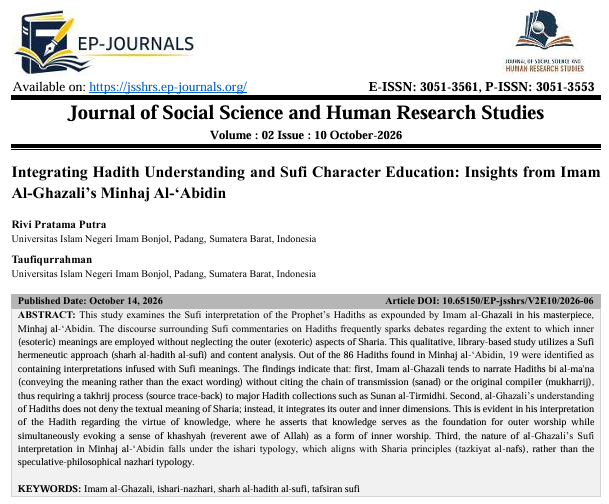
Integrating Hadith Understanding and Sufi Character Education: Insights from Imam Al-Ghazali’s Minhaj Al-‘Abidin
DOI:
https://doi.org/10.65150/EP-jsshrs/V2E10/2026-06Keywords:
Imam al-Ghazali, ishari-nazhari, sharh al-hadith al-sufi, tafsiran sufiAbstract
This study examines the Sufi interpretation of the Prophet’s Hadiths as expounded by Imam al-Ghazali in his masterpiece, Minhaj al-‘Abidin. The discourse surrounding Sufi commentaries on Hadiths frequently sparks debates regarding the extent to which inner (esoteric) meanings are employed without neglecting the outer (exoteric) aspects of Sharia. This qualitative, library-based study utilizes a Sufi hermeneutic approach (sharh al-hadith al-sufi) and content analysis. Out of the 86 Hadiths found in Minhaj al-‘Abidin, 19 were identified as containing interpretations infused with Sufi meanings. The findings indicate that: first, Imam al-Ghazali tends to narrate Hadiths bi al-ma'na (conveying the meaning rather than the exact wording) without citing the chain of transmission (sanad) or the original compiler (mukharrij), thus requiring a takhrij process (source trace-back) to major Hadith collections such as Sunan al-Tirmidhi. Second, al-Ghazali’s understanding of Hadiths does not deny the textual meaning of Sharia; instead, it integrates its outer and inner dimensions. This is evident in his interpretation of the Hadith regarding the virtue of knowledge, where he asserts that knowledge serves as the foundation for outer worship while simultaneously evoking a sense of khashyah (reverent awe of Allah) as a form of inner worship. Third, the nature of al-Ghazali’s Sufi interpretation in Minhaj al-‘Abidin falls under the ishari typology, which aligns with Sharia principles (tazkiyat al-nafs), rather than the speculative-philosophical nazhari typology.
References
1) Abdurrahman, U. (2015). Metodologi tafsir falsafi dan tafsir sufi. 'Adliya: Jurnal Hukum dan Kemanusiaan, 9(1), 1–20.
2) Afrizal. (2014). Metode penelitian kualitatif: Sebuah upaya mendukung penggunaan penelitian kualitatif dalam berbagai disiplin ilmu. Rajawali Press.
3) Al-Dhahabī, M. Ḥ. (2000). Al-Tafsīr wa al-mufassirūn (Vol. 2). Maktabah Wahbah.
4) Al-Ghazali, A. H. (2011). Ihya ‘Ulum al-Din (Terj. M. Jakfar). Darul Haq.
5) Al-Ghazali, A. H. (2013). Minhajul ’Abidin: Jalan para ahli ibadah (A. H. As-Sasaki, Trans.). Khatulistiwa. (Original work published ca. 1111)
6) Al-Qaththan, M. (2005). Pengantar studi ilmu Al-Qur'an (A. R. El-Mazani, Trans.). Pustaka Al-Kausar.
7) Arafat, A. T. (2017). Interaksi kaum sufi dengan ahli hadis: Melacak akar persinggungan tasawuf dan hadis. Journal of Islamic Studies and Humanities, 2(2), 129–155. https://doi.org/10.21580/jish.22.2520
8) Khairunnas, R. (2016). Rekonstruksi psikoterapi Islam. Cahaya Firdaus Publishing and Printing.
9) Khamid, A. (2018). Pentafsiran sufi terhadap teks al-Quran: Memahami analisis nazhari dan isyari. Jurnal Studi Ilmu-Ilmu Al-Qur'an dan Hadis, 19(1), 45–62.
10) Koenig, H. G., Al-Zaben, F., & VanderWeele, T. J. (2020). Religion and psychiatry: Recent developments in research. BJPsych Advances, 26(5), 262–272. https://doi.org/10.1192/bja.2019.81
11) Maisyaroh, M. (2019). Tasawuf sebagai dimensi batin ajaran Islam. At-Tafkir, 12(2), 141–151. https://doi.org/10.32505/at.v12i2.1243
12) Mashar, A. (2015). Tasawuf: Sejarah, madzhab, dan inti ajarannya. Al-A'raf: Jurnal Pemikiran Islam dan Filsafat, 12(1), 97–112. https://doi.org/10.22515/ajpif.v12i1.1186
13) Maslow, A. H. (1943). A theory of human motivation. Psychological Review, 50(4), 370–396. https://doi.org/10.1037/h0054346
14) Menegatti-Chequini, M. C., Maraldi, E. O., Peres, M. F. P., Leão, F. C., & Vallada, H. (2019). How psychiatrists think about religious and spiritual beliefs in clinical practice: Findings from a university hospital in São Paulo, Brazil. Brazilian Journal of Psychiatry, 41(1), 58–65. https://doi.org/10.1590/1516-4446-2017-2447
15) Miles, M. B., Huberman, A. M., & Saldana, J. (2014). Qualitative data analysis: A methods sourcebook(3rd ed.). SAGE Publications.
16) Muaz, A., & Darmawan, A. A. (2020). Psycho-sufistic therapy of underground sufism movement: A healing method against punk community in Jakarta. Teosofia: Indonesian Journal of Islamic Mysticism, 8(2), 115–128. https://doi.org/10.21580/tos.v8i2.5302
17) Rumi, J. (2004). The Masnavi: Book one (J. A. Mojaddedi, Trans.). Oxford University Press.
18) Said, M. (2014). Metodologi penafsiran sufistik: Perspektif Al-Gazali. Substantia: Jurnal Ilmu-Ilmu Usuluddin, 16(1), 45–60.
19) Saifuddin, A. (2020). Ethical code of Islamic psychotherapy in Indonesia. Buletin Psikologi, 28(1), 1–14.
https://doi.org/10.22146/buletinpsikologi.47661
20) Satria, O. (2021). Pentafsiran sufi terhadap hadis: Satu kajian tentang pemikiran Jalaluddin Rumi dalam kitab Fihi Mā Fīhi. Jurnal Usuluddin, 49(1), 75–98.
21) Suprayitno, M. A., & Santoso, A. (2020). The concept of Sufism from the perspective of Imam Nawawi: A study of Sufi Hadith interpretation in Arba’in an-Nawawiyyah. Indonesian Journal of Islamic Literature and Muslim Society, 5(2), 115–134.
22) Syafril, M. (2017). Pemikiran sufistik: Mengenal biografi intelektual Imam Al-Ghazali. Jurnal Syahadah, 5(2), 11–28.
23) Syukur, A. (2015). Mengenal corak tafsir Al-Qur’an. El-Furqania: Jurnal Ushuluddin dan Ilmu-Ilmu Keislaman, 1(1), 87–102. https://doi.org/10.54625/elfurqania.v1i01.877
24) Taufiqurrahman, T., et al. (2024). Exploring Jalaluddin Rumi's hermeneutic of love, patience and destiny in relation to the meaning of life. Jurnal Al-Tamaddun, 19(2), 101–114. https://doi.org/10.22452/JAT.vol19no2.8
Downloads
Published
Issue
Section
License
Copyright (c) 2026 Rivi Pratama Putra, Taufiqurrahman (Author)

This work is licensed under a Creative Commons Attribution 4.0 International License.












