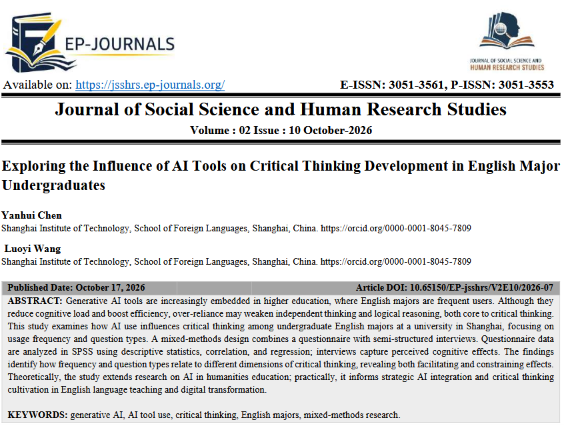
Exploring the Influence of AI Tools on Critical Thinking Development in English Major Undergraduates
DOI:
https://doi.org/10.65150/EP-jsshrs/V2E10/2026-07Keywords:
generative AI, AI tool use, critical thinking, English majors, mixed-methods researchAbstract
Generative AI tools are increasingly embedded in higher education, where English majors are frequent users. Although they reduce cognitive load and boost efficiency, over-reliance may weaken independent thinking and logical reasoning, both core to critical thinking. This study examines how AI use influences critical thinking among undergraduate English majors at a university in Shanghai, focusing on usage frequency and question types. A mixed-methods design combines a questionnaire with semi-structured interviews. Questionnaire data are analyzed in SPSS using descriptive statistics, correlation, and regression; interviews capture perceived cognitive effects. The findings identify how frequency and question types relate to different dimensions of critical thinking, revealing both facilitating and constraining effects. Theoretically, the study extends research on AI in humanities education; practically, it informs strategic AI integration and critical thinking cultivation in English language teaching and digital transformation.
References
1) Altamirano, S. F. S., Maquen-Niño, G. L. E., Roldán, C. M. G., Herrera, A. P., & Cárdenas, D. M. C. (2026). Generative artificial intelligence in higher education: A systematic review of perceptions, implementation and pedagogical transformation. Review of Education, 14, e70152. https://doi.org/10.1002/rev3.70152
2) Cai, Y. W., & Chen, Z. (2025). The double-edged sword: The impact of generative artificial intelligence on college students’ critical thinking. Journal of Huazhong Normal University (Humanities and Social Sciences), 64(6), 146-159.
https://doi.org/10.19992/j.cnki.1000-2456.2025.06.015
3) Ennis, R. H. (2015). Critical thinking: A streamlined conception. In M. Davies & R. Barnett (Eds.), The Palgrave handbook of critical thinking in higher education (pp. 31-47). Palgrave Macmillan. https://doi.org/10.1057/9781137378057_2
4) Facione, P. A. (1990). Critical thinking: A statement of expert consensus for purposes of educational assessment and instruction (The Delphi Report). California Academic Press.
5) Kohnke, L., Moorhouse, B. L., & Zou, D. (2023). ChatGPT for language teaching and learning. RELC Journal, 54(2),1–5.
6) Leng, J., Lu, H. H., & Dai, L. (2024). Empowering critical-thinking assessment with generative artificial intelligence: An applied experiment based on ChatGPT. Modern Distance Education Research, 36(6), 102-111.
7) Liu, F., & Dong, Y. (2025). Why is critical thinking increasingly important in the age of generative AI? Media in Foreign Language Instruction, 47(1), 3-10+113.
8) Liu, J., Sihes, A. J. B., & Lu, Y. (2025). How do generative artificial intelligence (AI) tools and large language models (LLMs) influence language learners’ critical thinking in EFL education? A systematic review. Smart Learning Environments, 12(48). https://doi.org/10.1186/s40561-025-00406-0
9) McDonald, N., Johri, A., Ali, A., & Collier, A. H. (2025). Generative artificial intelligence in higher education: Evidence from an analysis of institutional policies and guidelines.Computers in Human Behavior: Artificial Humans, 3, 100121.
https://doi.org/10.1016/j.chbah.2025.100121
10) Park, S., & Nan, X. (2026). Generative AI and misinformation: a scoping review of the role of generative AI in the generation, detection, mitigation, and impact of misinformation. AI & SOCIETY, 41, 1501-1515. https://doi.org/10.1007/s00146-025-02620-3
11) Qi, J., Xu, Y. R., Liu, J. A., & Xue, K. (2024). The impact of generative artificial intelligence tools on college students’ critical thinking and autonomous learning ability. e-Education Research, 45(12), 67-74. https://doi.org/10.13811/j.cnki.eer.2024.12.009
12) Sun, X., Liu, C., Li, P., & Cai, Z. (2026). Effects of Generative AI Tools On Students’ Critical Thinking: A Three-Level Meta-Analysis. Educational Psychology Review, 38(84). https://doi.org/10.1007/s10648-026-10180-1
13) Wen, Q. F., Wang, J. Q., Zhao, C. R., Liu, Y. P., & Wang, H. M. (2009). Developing a conceptual framework for assessing Chinese university students’ critical thinking skills. Foreign Language World, 30(1), 37-43.
14) Xu, L. (2024). AI-enhanced English writing instruction and students’ thinking development. Foreign Language World, (3), 58–65.
Downloads
Published
Issue
Section
License
Copyright (c) 2026 Yanhui Chen, Luoyi Wang (Author)

This work is licensed under a Creative Commons Attribution 4.0 International License.












