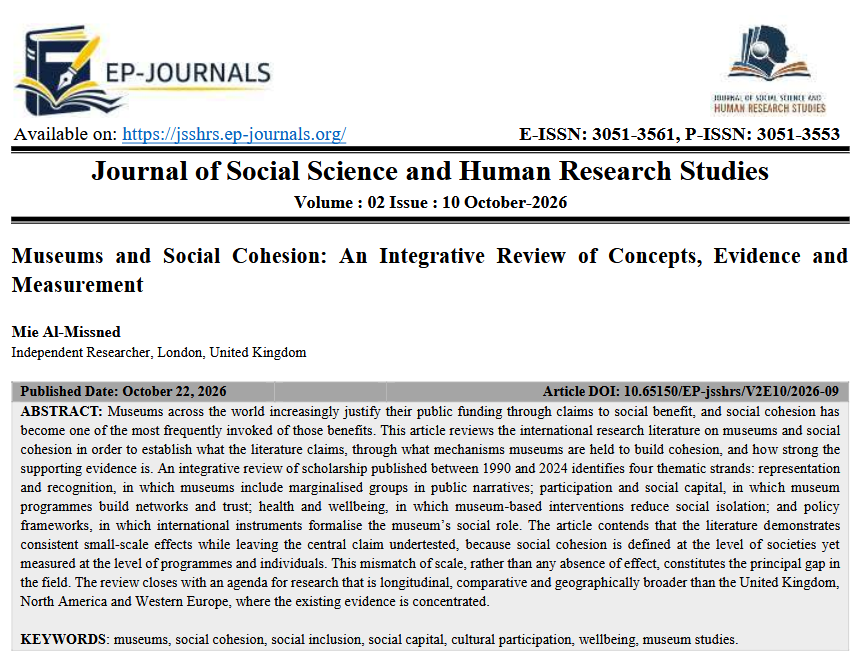
Museums and Social Cohesion: An Integrative Review of Concepts, Evidence and Measurement
DOI:
https://doi.org/10.65150/EP-jsshrs/V2E10/2026-09Keywords:
museums, social cohesion, social inclusion, social capital, cultural participation, wellbeing, museum studiesAbstract
Museums across the world increasingly justify their public funding through claims to social benefit, and social cohesion has become one of the most frequently invoked of those benefits. This article reviews the international research literature on museums and social cohesion in order to establish what the literature claims, through what mechanisms museums are held to build cohesion, and how strong the supporting evidence is. An integrative review of scholarship published between 1990 and 2024 identifies four thematic strands: representation and recognition, in which museums include marginalised groups in public narratives; participation and social capital, in which museum programmes build networks and trust; health and wellbeing, in which museum-based interventions reduce social isolation; and policy frameworks, in which international instruments formalise the museum’s social role. The article contends that the literature demonstrates consistent small-scale effects while leaving the central claim undertested, because social cohesion is defined at the level of societies yet measured at the level of programmes and individuals. This mismatch of scale, rather than any absence of effect, constitutes the principal gap in the field. The review closes with an agenda for research that is longitudinal, comparative and geographically broader than the United Kingdom, North America and Western Europe, where the existing evidence is concentrated.
References
1) Allport, G. W. (1954). The nature of prejudice. Addison-Wesley.
2) Belfiore, E. (2002). Art as a means of alleviating social exclusion: Does it really work? A critique of instrumental cultural policies and social impact studies in the UK. International Journal of Cultural Policy, 8(1), 91–106.
3) Belfiore, E., & Bennett, O. (2008). The social impact of the arts: An intellectual history. Palgrave Macmillan.
4) Bennett, T. (1995). The birth of the museum: History, theory, politics. Routledge.
5) Bourdieu, P., & Darbel, A. (1991). The love of art: European art museums and their public (C. Beattie & N. Merriman, Trans.). Polity Press. (Original work published 1969)
6) Braun, V., & Clarke, V. (2006). Using thematic analysis in psychology. Qualitative Research in Psychology, 3(2), 77–101. https://doi.org/10.1191/1478088706qp063oa
7) Chan, J., To, H.-P., & Chan, E. (2006). Reconsidering social cohesion: Developing a definition and analytical framework for empirical research. Social Indicators Research, 75(2), 273–302. https://doi.org/10.1007/s11205-005-2118-1
8) Chatterjee, H., & Noble, G. (2013). Museums, health and well-being. Ashgate.
9) Crooke, E. (2007). Museums and community: Ideas, issues and challenges. Routledge.
10) Falk, J. H., & Dierking, L. D. (2013). The museum experience revisited. Left Coast Press.
11) International Council of Museums. (2022). ICOM approves a new museum definition. ICOM.
12) Jeannotte, M. S. (2003). Singing alone? The contribution of cultural capital to social cohesion and sustainable communities. International Journal of Cultural Policy, 9(1), 35–49.
13) Matarasso, F. (1997). Use or ornament? The social impact of participation in the arts. Comedia.
14) OECD & ICOM. (2019). Culture and local development: Maximising the impact. A guide for local governments, communities and museums. OECD Publishing.
15) Putnam, R. D. (2000). Bowling alone: The collapse and revival of American community. Simon & Schuster.
16) Sandell, R. (1998). Museums as agents of social inclusion. Museum Management and Curatorship, 17(4), 401–418. https://doi.org/10.1080/09647779800401704
17) Sandell, R. (2003). Social inclusion, the museum and the dynamics of sectoral change. Museum and Society, 1(1), 45–62.
18) Silverman, L. H. (2010). The social work of museums. Routledge.
19) Simon, N. (2010). The participatory museum. Museum 2.0.
20) Thomson, L. J., Lockyer, B., Camic, P. M., & Chatterjee, H. J. (2018). Effects of a museum-based social prescription intervention on quantitative measures of psychological wellbeing in older adults. Perspectives in Public Health, 138(1), 28–38. https://doi.org/10.1177/1757913917737563
21) UNESCO. (2015). Recommendation concerning the protection and promotion of museums and collections, their diversity and their role in society. UNESCO.
22) UNESCO. (2021). Museums around the world in the face of COVID-19. UNESCO.
23) Vergo, P. (Ed.). (1989). The new museology. Reaktion Books.
Downloads
Published
Issue
Section
License
Copyright (c) 2026 Mie Al-Missned (Author)

This work is licensed under a Creative Commons Attribution 4.0 International License.