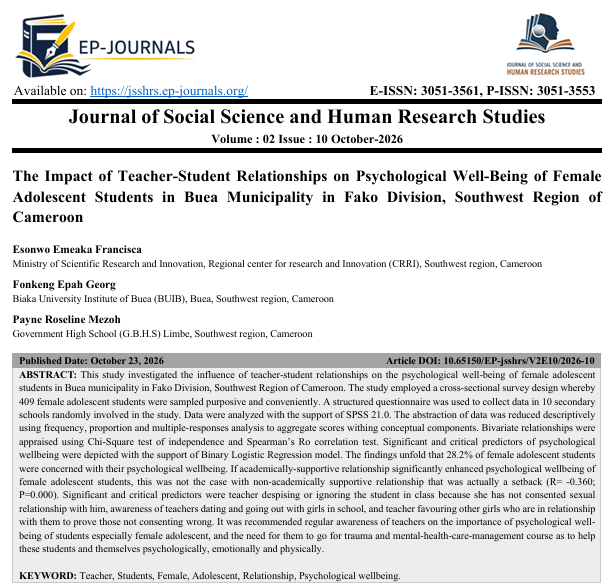
The Impact of Teacher-Student Relationships on Psychological Well-Being of Female Adolescent Students in Buea Municipality in Fako Division, Southwest Region of Cameroon
DOI:
https://doi.org/10.65150/EP-jsshrs/V2E10/2026-10Keywords:
Teacher, Students, Female, Adolescent, Relationship, Psychological wellbeing.Abstract
This study investigated the influence of teacher-student relationships on the psychological well-being of female adolescent students in Buea municipality in Fako Division, Southwest Region of Cameroon. The study employed a cross-sectional survey design whereby 409 female adolescent students were sampled purposive and conveniently. A structured questionnaire was used to collect data in 10 secondary schools randomly involved in the study. Data were analyzed with the support of SPSS 21.0. The abstraction of data was reduced descriptively using frequency, proportion and multiple-responses analysis to aggregate scores withing conceptual components. Bivariate relationships were appraised using Chi-Square test of independence and Spearman’s Ro correlation test. Significant and critical predictors of psychological wellbeing were depicted with the support of Binary Logistic Regression model. The findings unfold that 28.2% of female adolescent students were concerned with their psychological wellbeing. If academically-supportive relationship significantly enhanced psychological wellbeing of female adolescent students, this was not the case with non-academically supportive relationship that was actually a setback (R= -0.360; P=0.000). Significant and critical predictors were teacher despising or ignoring the student in class because she has not consented sexual relationship with him, awareness of teachers dating and going out with girls in school, and teacher favouring other girls who are in relationship with them to prove those not consenting wrong. It was recommended regular awareness of teachers on the importance of psychological well-being of students especially female adolescent, and the need for them to go for trauma and mental-health-care-management course as to help these students and themselves psychologically, emotionally and physically.
References
1) Bowlby, J. (1969). Attachment and loss: Vol. 1. Attachment. Basic Books.
2) Bronfenbrenner, U. (1979). The Ecology of Human Development: Experiments by Nature and Design. Cambridge, MA: Harvard University Press.
3) Burleson, B. R. (2003). Emotional support skills. In J. O. Greene & B. R. Burleson (Eds.), Handbook of communication and social interaction skills (pp. 551-594). Lawrence Erlbaum Associates
4) Cohen, B. E., Edmondson, D., & Kronish, I. M. (2015). State of the Art Review: Depression, Stress, Anxiety, and Cardiovascular Disease. American journal of hypertension, 28(11), 1295–1302. https://doi.org/10.1093/ajh/hpv047
5) Cornelius-White, J. (2007). Learner-centered teacher-student relationships are effective: A meta-analysis. Review of Educational Research, 77(1), 113–143. https://doi.org/10.3102/003465430298563
6) Cronbach, L. J. 1951. Coefficient alpha and the internal structure of tests. Psychometrika, 16:3, 297-334.
7) Cutrona, C. E. (1996). Social support in couples: Marriage as a resource in times of stress. Sage Publications.
8) Deci, E. L., & Ryan, R. M. (2000). The "what" and "why" of goal pursuit: Human needs and the self-determination of behavior. Psychological Inquiry, 11(4), 227-268.
9) Diener, E., Sapyta, J. J., & Suh, E. (2018). Subjective well-being is essential to well-being. Psychological Inquiry, 29(3), 125-138.
10) Erikson, E. H. (1968). Identity: Youth and crisis. Harvard University Press.
11) Fonkeng Epah, George; Tedjong, Romual (2017). Principals' leadership behaviour and teachers' organisational commitment: Case of some secondary schools in Mezam Division.
12) Gilligan, C. (2015). The listening guide: A new method for qualitative research. Qualitative Psychology, 2(1), 69-77.
13) Hamre, B. K., & Pianta, R. C. (2001). Early teacher-child relationships and the trajectory of children's school outcomes through eighth grade. Child Development, 72(2), 625-638.
14) Hankin, B. L., Abramson, L. Y., Moffitt, T. E., Silva, P. A., Mcgee, R., & Angell, K. E. (1998). Development of Depression from Preadolescence to Young Adulthood: Emerging Gender Differences in a 10-Year Longitudinal Study. Journal of Abnormal Psychology, 107, 128-140. https://doi.org/10.1037/0021-843X.107.1.128
15) Kerr, S. P., Kerr, W. R., & Xu, T. (2017). Personality Traits of Entrepreneurs: A Review of Recent Literature (Working Paper No. 24097). National Bureau of Economic Research.
16) https://doi.org/10.3386/w24097
17) Nana, C. (2018). Research Methods and Applied Statistics: Beginners and Advanced Learners (3rd Edition). Buea: GOOAHEAD.
18) Nana, C. (2025). Presentation of Statistical Outputs from Counting Approach: Shall Frequency Come Before Percentage? Published in International Journal of Trend in Scientific Research and Development (ijtsrd), ISSN: 2456 6470, Volume-9 | Issue-2, April 2025, pp.812-822, URL: www.ijtsrd.com/papers/ijtsrd78356.pdf
19) Olsson, C. A., McKenzie, J. L., & McGee, R. (2016). The adolescent pathway to health: Beyond risk behaviour. Journal of Adolescent Health, 58(4), 433-438.
20) Patton, G. C., Sawyer, S. M., Santelli, J. S., Ross, D. A., Afifi, R., Allen, N. B., ... & Viner, R. M. (2016). Our future: A Lancet commission on adolescent health and wellbeing. The Lancet, 387(10036), 2423-2478.
21) Pianta, R. C. (1999). Enhancing relationships between children and teachers. American Psychological Association.
22) Pianta, R. C., Hamre, B. K., & Allen, J. P. (2016). Teacher-student relationships and engagement: Conceptualizing, measuring, and improving the capacity of classroom interactions. In S. L. Christenson, A. L. Reschly, & C. Wylie (Eds.), Handbook of research on student engagement (pp. 365-386). Springer.
23) Quin D. (2017). Longitudinal and contextual associations between teacher–student relationships and student engagement: a systematic review. Rev. Educ. Res. 87, 345–387. doi: 10.3102/0034654316669434
24) Rimm-Kaufman, S. E., Baroody, A. E., Larsen, R. A., Curby, T. W., & Abry, T. (2015). To what extent do teacher-student interaction quality and student gender contribute to fifth-grade students' achievement? Journal of Educational Psychology, 107(1), 170-185. https://doi.org/(No DOI provided)
25) Roorda, D. L., Koomen, H. M. Y., Spilt, J. L., & Oort, F. J. (2011). The influence of affective teacher–student relationships on students’ school engagement and achievement: A meta-analytic approach. Review of Educational Research, 81(4), 493–529. https://doi.org/10.3102/0034654311421793
26) Ryff, C. D. (1989). Happiness is everything, or is it? Explorations on the meaning of psychological well-being. Journal of Personality and Social Psychology, 57(6), 1069-1081.
27) Ryff, C. D., & Keyes, C. L. M. (1995). The structure of psychological well-being revisited. Journal of Personality and Social Psychology, 69(4), 719-727.
28) Seligman, M. E. P. (2011). Flourish: A visionary new understanding of happiness and well-being. Simon and Schuster.
29) Shochet, I. M., Dadds, M. R., Ham, D., & Montague, R. (2006). School connectedness is an underemphasized parameter in adolescent mental health: Results of a community prediction study. Journal of Clinical Child & Adolescent Psychology, 35(2), 170-179.
30) Shochet, I. M., Dadds, M. R., Ham, D., & Montague, R. (2006). School connectedness is an underemphasized parameter in adolescent mental health: Results of a community prediction study. Journal of Clinical Child & Adolescent Psychology, 35(2), 170-179.
31) Slade, P. D. (1994). What is body image?Behaviour Research and Therapy, 32(5),497–502.https://doi.org/10.1016/0005-7967(94)90136-8
32) Slater, A., & Tiggemann, M. (2015). A comparative study of the impact of traditional and social media on body image concerns in young women. Journal of Youth and Adolescence, 44(1), 113-124. https://doi.org/(No DOI provided)
33) Suldo, S. M., Friedrich, A., & Michalowski, J. (2014). Increasing middle school students' life satisfaction: Efficacy of a positive psychology group intervention. Journal of Happiness Studies, 15(1), 19-42. https://doi.org/(No DOI provided
34) Sun, J., & Leithwood, K. (2017). How school leaders' leadership styles impact student achievement: A systematic review. Educational Administration Quarterly, 53(4), 557-590.
35) Taylor, S. E. (2011). Social Support: A Review. In H. S. Friedman (Ed.), The Oxford Handbook of Health Psychology (pp. 190-214). Oxford University Press. https://doi.org/10.1093/oxfordhb/9780195342819.013.0009
36) UNICEF (2021). Global Annual Results Reports 2021: Programme results achieved by contributions received from partners. https://www.unicef.org/reports/global-annual-results-2021.
37) Verschueren, K., & Koomen, H. M. (2012). Teacher-child relationships from an attachment perspective. Attachment & human development, 14(3), 205–211. https://doi.org/10.1080/14616734.2012.672260
38) World Health Organization. (2018). Adolescent mental health. Retrieved from https://www.who.int/news-room/fact-sheets/detail/adolescent-mental-health
39) World Health Organization. (2018, March 30). Mental health: Strengthening our response. https://www.who.int/news-room/fact-sheets/detail/mental-health-strengthening-our-response
40) Zelizer, Viviana A. 2011. Economic Lives: How Culture and Social Structure Matter. Princeton, NJ: Princeton University Press.
Downloads
Published
Issue
Section
License
Copyright (c) 2026 Esonwo Emeaka Francisca, Fonkeng Epah Georg, Payne Roseline Mezoh (Author)

This work is licensed under a Creative Commons Attribution 4.0 International License.