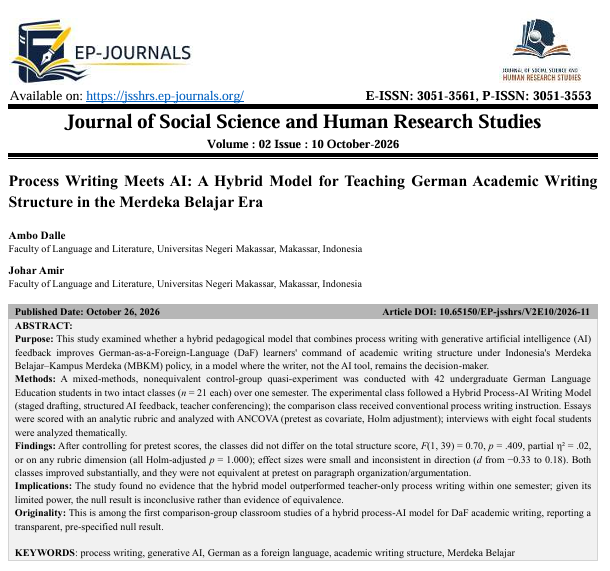
Process Writing Meets AI: A Hybrid Model for Teaching German Academic Writing Structure in the Merdeka Belajar Era
DOI:
https://doi.org/10.65150/EP-jsshrs/V2E10/2026-11Keywords:
process writing, generative AI, German as a foreign language, academic writing structure, Merdeka BelajarAbstract
Purpose: This study examined whether a hybrid pedagogical model that combines process writing with generative artificial intelligence (AI) feedback improves German-as-a-Foreign-Language (DaF) learners' command of academic writing structure under Indonesia's Merdeka Belajar–Kampus Merdeka (MBKM) policy, in a model where the writer, not the AI tool, remains the decision-maker.
Methods: A mixed-methods, nonequivalent control-group quasi-experiment was conducted with 42 undergraduate German Language Education students in two intact classes (n = 21 each) over one semester. The experimental class followed a Hybrid Process-AI Writing Model (staged drafting, structured AI feedback, teacher conferencing); the comparison class received conventional process writing instruction. Essays were scored with an analytic rubric and analyzed with ANCOVA (pretest as covariate, Holm adjustment); interviews with eight focal students were analyzed thematically.
Findings: After controlling for pretest scores, the classes did not differ on the total structure score, F(1, 39) = 0.70, p = .409, partial η² = .02, or on any rubric dimension (all Holm-adjusted p = 1.000); effect sizes were small and inconsistent in direction (d from −0.33 to 0.18). Both classes improved substantially, and they were not equivalent at pretest on paragraph organization/argumentation.
Implications: The study found no evidence that the hybrid model outperformed teacher-only process writing within one semester; given its limited power, the null result is inconclusive rather than evidence of equivalence.
Originality: This is among the first comparison-group classroom studies of a hybrid process-AI model for DaF academic writing, reporting a transparent, pre-specified null result.
References
1) Aiken, L. R. (1985). Three coefficients for analyzing the reliability and validity of ratings. Educational and Psychological Measurement, 45 (1), 131–142.
2) Braun, V., & Clarke, V. (2006). Using thematic analysis in psychology. Qualitative Research in Psychology, 3(2), 77–101. https://doi.org/10.1191/1478088706qp063oa
3) Carless, D., & Boud, D. (2018). The development of student feedback literacy: Enabling uptake of feedback. Assessment & Evaluation in Higher Education, 43(8), 1315–1325. https://doi.org/10.1080/02602938.2018.1463354
4) Clyne, M. (1987). Cultural differences in the organization of academic texts: English and German. Journal of Pragmatics, 11(2), 211–247.
5) Cohen, J. (1988). Statistical power analysis for the behavioral sciences (2nd ed.). Lawrence Erlbaum Associates.
6) Creswell, J. W., & Plano Clark, V. L. (2018). Designing and conducting mixed methods research (3rd ed.). SAGE Publications.
7) Deci, E. L., & Ryan, R. M. (2000). The "what" and "why" of goal pursuits: Human needs and the self-determination of behavior. Psychological Inquiry, 11(4), 227–268. https://doi.org/10.1207/S15327965PLI1104_01
8) Des Jarlais, D. C., Lyles, C., Crepaz, N., & the TREND Group. (2004). Improving the reporting quality of nonrandomized evaluations of behavioral and public health interventions: The TREND statement. American Journal of Public Health, 94(3), 361–366. https://doi.org/10.2105/AJPH.94.3.361
9) Elturki, E. (2026). AI-aware process writing pedagogy: Rethinking the process-based approach. TESOL Journal, 17(2), Article e70127. https://doi.org/10.1002/tesj.70127
10) Engeness, I., & Gamlem, S. M. (2025). Exploring AI-driven feedback as a cultural tool: A cultural-historical perspective on design of AI environments to support students' writing process. Integrative Psychological and Behavioral Science, 59(1), Article 23. https://doi.org/10.1007/s12124-025-09894-8
11) Escalante, J., Pack, A., & Barrett, A. (2023). AI-generated feedback on writing: Insights into efficacy and ENL student preference. International Journal of Educational Technology in Higher Education, 20, Article 57. https://doi.org/10.1186/s41239-023-00425-2
12) Flower, L., & Hayes, J. R. (1981). A cognitive process theory of writing. College Composition and Communication, 32(4), 365–387. https://doi.org/10.2307/356600
13) Hattie, J., & Timperley, H. (2007). The power of feedback. Review of Educational Research, 77(1), 81–112.
https://doi.org/10.3102/003465430298487
14) Holm, S. (1979). A simple sequentially rejective multiple test procedure. Scandinavian Journal of Statistics, 6(2), 65–70.
15) Hyland, K. (2003). Second language writing. Cambridge University Press.
16) Kaplan, R. B. (1966). Cultural thought patterns in inter-cultural education. Language Learning, 16(1–2), 1–20.
17) Kementerian Pendidikan dan Kebudayaan Republik Indonesia. (2020). Peraturan Menteri Pendidikan dan Kebudayaan Republik Indonesia Nomor 3 Tahun 2020 tentang Standar Nasional Pendidikan Tinggi [Regulation of the Minister of Education and Culture of the Republic of Indonesia Number 3 of 2020 on National Standards for Higher Education]. Kemendikbud.
18) Kementerian Pendidikan, Kebudayaan, Riset, dan Teknologi Republik Indonesia. (2023). Peraturan Menteri Pendidikan, Kebudayaan, Riset, dan Teknologi Republik Indonesia Nomor 53 Tahun 2023 tentang Penjaminan Mutu Pendidikan Tinggi [Regulation of the Minister of Education, Culture, Research, and Technology of the Republic of Indonesia Number 53 of 2023 on Quality Assurance in Higher Education]. Kemendikbudristek.
19) Steinhoff, T. (2007). Wissenschaftliche Textkompetenz: Sprachgebrauch und Schreibentwicklung in wissenschaftlichen Texten von Studenten und Experten. Max Niemeyer Verlag.
20) Strobl, C., Menke-Bazhutkina, I., Abel, N., & Michel, M. (2024). Adopting ChatGPT as a writing buddy in the advanced L2 writing class. Technology in Language Teaching & Learning, 6(1), Article 1168. https://doi.org/10.29140/tltl.v6n1.1168
21) Widodo, S., Iqbal, M., Setiawan, B., & Handayani, L. (2020). The implementation of Merdeka Belajar Kampus Merdeka (MBKM) in Indonesian higher education. Journal of Educational Science and Technology (EST), 6(2), 130–138.
22) Yusriadi, Y., Farida, U., & Misnawati, M. (2024). "Merdeka Belajar Kampus Merdeka" policies in Indonesia higher education institutions: New public policy reform. Al-Tanzim: Jurnal Manajemen Pendidikan Islam, 8(1), 344–360. https://doi.org/10.33650/al-tanzim.v8i1.7173
23) Zamel, V. (1983). The composing processes of advanced ESL students: Six case studies. TESOL Quarterly, 17(2), 165–187. https://doi.org/10.2307/3586647
24) Zhang, Z., Aubrey, S., Huang, X., & Chiu, T. K. F. (2025). The role of generative AI and hybrid feedback in improving L2 writing skills: A comparative study. Innovation in Language Learning and Teaching. Advance online publication. https://doi.org/10.1080/17501229.2025.2503890
Downloads
Published
Issue
Section
License
Copyright (c) 2026 Ambo Dalle (Author)

This work is licensed under a Creative Commons Attribution 4.0 International License.