The Psychology of Keyboard Warriors Through David J. Pollay’s Garbage Truck Theory
DOI:
https://doi.org/10.65150/EP-jsshrs/V2E8/2026-06Keywords:
Digital Aggression, Garbage Truck Theory, Keyboard Warriors, Moral Disengagement, Online DisinhibitionAbstract
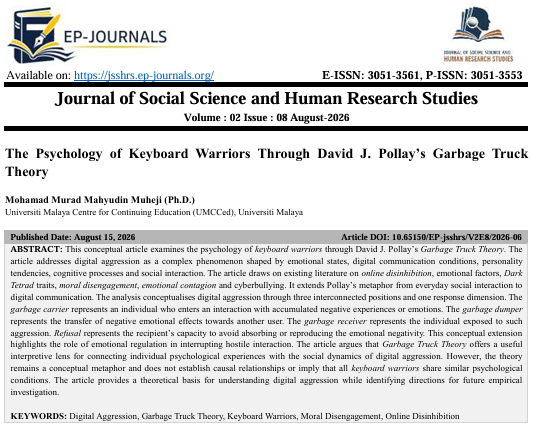
This conceptual article examines the psychology of keyboard warriors through David J. Pollay’s Garbage Truck Theory. The article addresses digital aggression as a complex phenomenon shaped by emotional states, digital communication conditions, personality tendencies, cognitive processes and social interaction. The article draws on existing literature on online disinhibition, emotional factors, Dark Tetrad traits, moral disengagement, emotional contagion and cyberbullying. It extends Pollay’s metaphor from everyday social interaction to digital communication. The analysis conceptualises digital aggression through three interconnected positions and one response dimension. The garbage carrier represents an individual who enters an interaction with accumulated negative experiences or emotions. The garbage dumper represents the transfer of negative emotional effects towards another user. The garbage receiver represents the individual exposed to such aggression. Refusal represents the recipient’s capacity to avoid absorbing or reproducing the emotional negativity. This conceptual extension highlights the role of emotional regulation in interrupting hostile interaction. The article argues that Garbage Truck Theory offers a useful interpretive lens for connecting individual psychological experiences with the social dynamics of digital aggression. However, the theory remains a conceptual metaphor and does not establish causal relationships or imply that all keyboard warriors share similar psychological conditions. The article provides a theoretical basis for understanding digital aggression while identifying directions for future empirical investigation.
References
1) Bandura, A. (1999). Moral disengagement in the perpetration of inhumanities. Personality and Social Psychology Review, 3(3), 193–209. https://doi.org/10.1207/S15327957PSPR0303_3
2) Bandura, A. (2002). Selective moral disengagement in the exercise of moral agency. Journal of Moral Education, 31(2), 101–119. https://doi.org/10.1080/0305724022014322
3) Buckels, E. E., Trapnell, P. D., & Paulhus, D. L. (2014). Trolls just want to have fun. Personality and Individual Differences, 67, 97–102. https://doi.org/10.1016/j.paid.2014.01.016
4) Cheng, J., Bernstein, M., Danescu-Niculescu-Mizil, C., & Leskovec, J. (2017). Anyone can become a troll: Causes of trolling behavior in online discussions. Proceedings of the 2017 ACM Conference on Computer Supported Cooperative Work and Social Computing, 1217–1230. https://doi.org/10.1145/2998181.2998213
5) Cheng, J., Danescu-Niculescu-Mizil, C., & Leskovec, J. (2015). Antisocial behavior in online discussion communities. Proceedings of the International AAAI Conference on Web and Social Media, 9(1), 61–70. https://doi.org/10.1609/icwsm.v9i1.14583
6) Council of Europe. (2001). Convention on cybercrime (Budapest Convention, ETS No. 185). https://www.coe.int/en/web/cybercrime/the-budapest-convention
7) Craker, N., & March, E. (2016). The dark side of Facebook®: The Dark Tetrad, negative social potency, and trolling behaviours. Personality and Individual Differences, 102, 79–84. https://doi.org/10.1016/j.paid.2016.06.043
8) Golf-Papez, M., & Veer, E. (2017). Don’t feed the trolling: Rethinking how online trolling is being defined and combated. Journal of Marketing Management, 33(15–16), 1336–1354. https://doi.org/10.1080/0267257X.2017.1383298
9) Hardaker, C. (2010). Trolling in asynchronous computer-mediated communication: From user discussions to academic definitions. Journal of Politeness Research, 6(2), 215–242. https://doi.org/10.1515/jplr.2010.011
10) Hatfield, E., Cacioppo, J. T., & Rapson, R. L. (1993). Emotional contagion. Current Directions in Psychological Science, 2(3), 96–99. https://doi.org/10.1111/1467-8721.ep10770953
11) Hatfield, E., Cacioppo, J. T., & Rapson, R. L. (1994). Emotional contagion. Cambridge University Press.
12) Hidalgo-Fuentes, S., González-Pérez, E., & Martínez-Álvarez, I. (2025). Relationship between online trolling and Dark Tetrad personality traits: A meta-analysis. Psicothema, 37(4), 29–41. https://doi.org/10.70478/psicothema.2025.37.26
13) Hu, Y., Bai, Y., Pan, Y., & Li, S. (2021). Cyberbullying victimization and depression among adolescents: A meta-analysis. Psychiatry Research, 305, 114198. https://doi.org/10.1016/j.psychres.2021.114198
14) Kowalski, R. M., Giumetti, G. W., Schroeder, A. N., & Lattanner, M. R. (2014). Bullying in the digital age: A critical review and meta-analysis of cyberbullying research among youth. Psychological Bulletin,140(4),1073–1137.https://doi.org/10.1037/a0035618
15) Lee, J., Choo, H., Zhang, Y., Cheung, H. S., Zhang, Q., & Ang, R. P. (2026). Cyberbullying victimization and mental health symptoms among children and adolescents: A meta-analysis of longitudinal studies. Trauma, Violence, & Abuse, 27(2), 391–406. https://doi.org/10.1177/15248380241313051
16) Lopes, B., & Yu, H. (2017). Who do you troll and why: An investigation into the nature of the online troll. Personality and Individual Differences, 112, 65–72. https://doi.org/10.1016/j.paid.2017.02.045
17) Mao, Y., Xu, T., & Kim, K. J. (2023). Motivations for proactive and reactive trolling on social media: Developing and validating a four-factor model. Social Media + Society, 9(4). https://doi.org/10.1177/20563051231203682
18) March, E. (2019). Psychopathy, sadism, empathy, and the motivation to cause harm: New evidence confirms malevolent nature of the Internet troll. Personality and Individual Differences, 141, 133–137. https://doi.org/10.1016/j.paid.2019.01.001
19) Ooi, K.-B., Lee, V.-H., Hew, J.-J., & Lin, B. (2019). Mobile social cyberbullying: Why are keyboard warriors raging? Journal of Computer Information Systems, 61(4), 371–382. https://doi.org/10.1080/08874417.2019.1679685
20) Phillips, W. (2015). This is why we can’t have nice things: Mapping the relationship between online trolling and mainstream culture. MIT Press.
21) Pollay, D. J. (2010). The law of the garbage truck: How to respond to people who dump on you, and how to stop dumping on others. Sterling Publishing.
22) Sest, N., & March, E. (2017). Constructing the cyber-troll: Psychopathy, sadism, and empathy. Personality and Individual Differences, 119, 69–72. https://doi.org/10.1016/j.paid.2017.06.038
23) Shachaf, P., & Hara, N. (2010). Beyond vandalism: Wikipedia trolls. Journal of Information Science, 36(3), 357–370. https://doi.org/10.1177/0165551510365390
24) Smith, P. K., Mahdavi, J., Carvalho, M., Fisher, S., Russell, S., & Tippett, N. (2008). Cyberbullying: Its nature and impact in secondary school pupils. Journal of Child Psychology and Psychiatry,49(4),376–385.https://doi.org/10.1111/j.1469-7610.2007.01846.x
25) Suler, J. (2004). The online disinhibition effect. CyberPsychology & Behavior,7(3),321–326. https://doi.org/10.1089/1094931041291295
26) Verbalyte, M., Keitel, C., & Howard, K. (2022). Online trolls: Unaffectionate psychopaths or just lonely outcasts and angry partisans? Politics and Governance, 10(4), 396–407. https://doi.org/10.17645/pag.v10i4.5790
27) Yang, Y., Tao, S., & Du, W. (2025). Game avatar to keyboard warriors: The relationship between online disinhibition, internet gaming disorder and cyberbullying. Acta Psychologica, 261, 105753. https://doi.org/10.1016/j.actpsy.2025.105753
Downloads
Published
Issue
Section
License
Copyright (c) 2026 Mohamad Murad Mahyudin Muheji (Ph.D.) (Author)

This work is licensed under a Creative Commons Attribution 4.0 International License.












