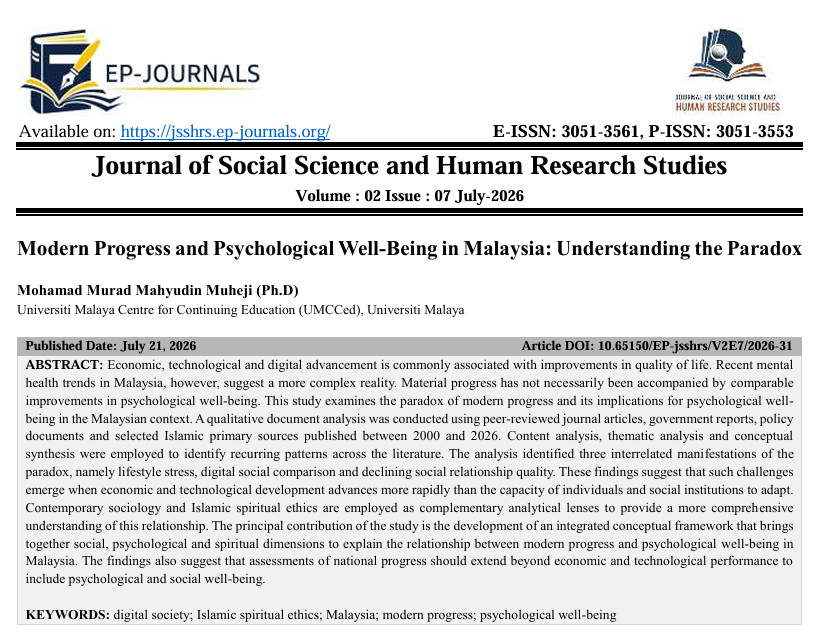
Modern Progress and Psychological Well-Being in Malaysia: Understanding the Paradox
DOI:
https://doi.org/10.65150/EP-jsshrs/V2E7/2026-31Keywords:
digital society, Islamic spiritual ethics, Malaysia, modern progress, psychological well-beingAbstract
Economic, technological and digital advancement is commonly associated with improvements in quality of life. Recent mental health trends in Malaysia, however, suggest a more complex reality. Material progress has not necessarily been accompanied by comparable improvements in psychological well-being. This study examines the paradox of modern progress and its implications for psychological well-being in the Malaysian context. A qualitative document analysis was conducted using peer-reviewed journal articles, government reports, policy documents and selected Islamic primary sources published between 2000 and 2026. Content analysis, thematic analysis and conceptual synthesis were employed to identify recurring patterns across the literature. The analysis identified three interrelated manifestations of the paradox, namely lifestyle stress, digital social comparison and declining social relationship quality. These findings suggest that such challenges emerge when economic and technological development advances more rapidly than the capacity of individuals and social institutions to adapt. Contemporary sociology and Islamic spiritual ethics are employed as complementary analytical lenses to provide a more comprehensive understanding of this relationship. The principal contribution of the study is the development of an integrated conceptual framework that brings together social, psychological and spiritual dimensions to explain the relationship between modern progress and psychological well-being in Malaysia. The findings also suggest that assessments of national progress should extend beyond economic and technological performance to include psychological and social well-being.
References
1) Abdullah, R. W., & Abd Samad, R. (2025). Global and Malaysian perspectives on mental health and digital interventions (2020–2025): A narrative review. International Journal of Research and Innovation in Social Science, 9(11), 7586–7591. https://doi.org/10.47772/IJRISS.2025.91100589
2) Ansari, S., Iqbal, N., Asif, R., Hashim, M., Farooqi, S. R., & Alimoradi, Z. (2024). Social media use and well-being: A systematic review and meta-analysis. Cyberpsychology, Behavior, and Social Networking, 27(10), 704–719.
3) Bauman, Z. (2000). Liquid modernity. Polity Press.
4) Beck, U. (1992). Risk society: Towards a new modernity. Sage.
5) Cacioppo, J. T., & Cacioppo, S. (2018). The growing problem of loneliness. The Lancet, 391(10119), 426.
6) Department of Statistics Malaysia. (2024). Statistics on causes of death, Malaysia.
7) Diener, E. (1984). Subjective well-being. Psychological Bulletin, 95(3), 542–575. https://doi.org/10.1037/0033-2909.95.3.542
8) Durkheim, É. (1951). Suicide: A study in sociology (J. A. Spaulding & G. Simpson, Trans.). Free Press. (Original work published 1897)
9) Giddens, A. (1991). Modernity and self-identity: Self and society in the late modern age. Polity Press.
10) Hasbie, S. N. R., Mahdi, A. K., Assim, M. I. S. A., & Taasim, S. I. (2024). Impak teknologi maklumat dan komunikasi terhadap kesihatan mental: Kajian literatur. Southeast Asia Psychology Journal, 12(1), 107–120. https://doi.org/10.51200/sapj.v12i1.5072
11) Helliwell, J. F., Layard, R., Sachs, J. D., De Neve, J. E., Aknin, L. B., & Wang, S. (Eds.). (2024). World Happiness Report 2024. Sustainable Development Solutions Network.
12) Holt-Lunstad, J. (2021). Loneliness and social isolation as risk factors for health outcomes. World Psychiatry, 20(1), 48–49.
13) Institut Kefahaman Islam Malaysia. (n.d.). Kesejahteraan mental dan spiritual: Agenda kritikal negara MADANI. https://www.ikim.gov.my/en/kesejahteraan-mental-dan-spiritual-agenda-kritikal-negara-madani/
14) Kassim, F., Mat Noor, N. A., & Yaacob, N. H. (2026). Kesunyian dalam peradaban moden. International Journal of Law, Government and Communication, 11(43), 244–263. https://doi.org/10.35631/IJLGC.1143016
15) Malaysian Communications and Multimedia Commission. (2024). Internet users survey 2024.
16) Malaysia Digital Economy Corporation. (2024). Malaysia digital economy report 2024
17) Maskun, R., Mat Khairi, S. M., Sulaiman, M. N. A., Aris, N. M., Omar, M. M., & Mohamed, M. N. (2025). Digital wellbeing among Generation Y in Malaysia: Implications, challenges, and the path forward. Asia Pacific Journal of Business, Humanities and Education, 10(1).
18) Ministry of Health Malaysia. (2023). National Health and Morbidity Survey 2023.
19) Ministry of Health Malaysia. (n.d.). Let's TALK Minda Sihat. https://www.moh.gov.my/program-inisiatif/lets-talk
20) Ministry of Health Malaysia. (2026). Talian HEAL 15555. https://jknselangor.moh.gov.my/htar/pengumuman-awam/661-talian-heal-15555
21) Muhamad, N. A., Maamor, N. H., Tengku Baharudin Shah, T. P. N., et al. (2026). Association between depression, anxiety and loneliness with internet addictions among public university students in Malaysia. BMJ Open, 16(1), e108315. https://doi.org/10.1136/bmjopen-2025-108315
22) Noradilah, N. M., & Mansor, A. T. (2009). Kesunyian dan kesejahteraan psikologi di kalangan pelajar universiti di Malaysia. Jurnal Psikologi Malaysia, 23, 27–30.
23) Norasid, S. N., & Ashaari, M. F. (2024). A systematic review of the impact of social media use on mental health in Malaysia. Al-Hikmah, 16(1). https://doi.org/10.17576/alhikmah.2024.161.513
24) Orben, A. (2020). The sisyphean cycle of technology panics. Perspectives on Psychological Science, 15(5), 1143–1157.
25) Organisation for Economic Co-operation and Development. (2024). How's life? 2024: Well-being and resilience in times of uncertainty.
26) Putnam, R. D. (2000). Bowling alone: The collapse and revival of American community. Simon & Schuster.
27) Ramadhan, R. N., Rampengan, D. D., Yumnanisha, D. A., et al. (2024). Impacts of digital social media detox for mental health: A systematic review and meta-analysis. Narra Journal, 4(2), e786. https://doi.org/10.52225/narra.v4i2.786
28) Razak, M. Y. A. (2022). Malaysia Happiness Index (MHI) Report 2021. Ministry of Housing and Local Government.
29) Ryff, C. D. (1989). Happiness is everything, or is it? Explorations on the meaning of psychological well-being. Journal of Personality and Social Psychology, 57(6), 1069–1081. https://doi.org/10.1037/0022-3514.57.6.1069
30) Surkalim, D. L., Luo, M., Eres, R., Gebel, K., van Buskirk, J., Bauman, A., & Ding, D. (2022). The prevalence of loneliness across 113 countries: Systematic review and meta-analysis. BMJ Global Health, 7(4), Article e008033. https://doi.org/10.1136/bmjgh-2021-008033
31) Turkle, S. (2011). Alone together: Why we expect more from technology and less from each other. Basic Books.
32) Twenge, J. M. (2020). Increases in depression, self-harm, and suicide among U.S. adolescents after 2012 and links to technology use: Possible mechanisms. Psychiatric Research and Clinical Practice, 2(1), 19–25.
33) Veenhoven, R. (2008). Healthy happiness: Effects of happiness on physical health and the consequences for preventive health care. Journal of Happiness Studies, 9(3), 449–469. https://doi.org/10.1007/s10902-006-9042-1
34) World Health Organization. (2022). World mental health report: Transforming mental health for all.
Downloads
Published
Issue
Section
License
Copyright (c) 2026 Mohamad Murad Mahyudin Muheji (Ph.D) (Author)

This work is licensed under a Creative Commons Attribution 4.0 International License.