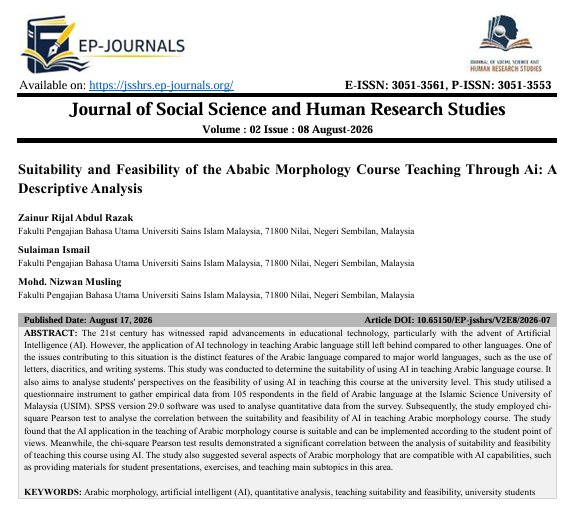
Suitability and Feasibility of the Arabic Morphology Course Teaching Through AI: A Descriptive Analysis
DOI:
https://doi.org/10.65150/EP-jsshrs/V2E8/2026-07Keywords:
Arabic morphology, artificial intelligent (AI), quantitative analysis, teaching suitability and feasibility, university studentsAbstract
The 21st century has witnessed rapid advancements in educational technology, particularly with the advent of Artificial Intelligence (AI). However, the application of AI technology in teaching Arabic language still left behind compared to other languages. One of the issues contributing to this situation is the distinct features of the Arabic language compared to major world languages, such as the use of letters, diacritics, and writing systems. This study was conducted to determine the suitability of using AI in teaching Arabic language course. It also aims to analyse students' perspectives on the feasibility of using AI in teaching this course at the university level. This study utilised a questionnaire instrument to gather empirical data from 105 respondents in the field of Arabic language at the Islamic Science University of Malaysia (USIM). SPSS version 29.0 software was used to analyse quantitative data from the survey. Subsequently, the study employed chi-square Pearson test to analyse the correlation between the suitability and feasibility of AI in teaching Arabic morphology course. The study found that the AI application in the teaching of Arabic morphology course is suitable and can be implemented according to the student point of views. Meanwhile, the chi-square Pearson test results demonstrated a significant correlation between the analysis of suitability and feasibility of teaching this course using AI. The study also suggested several aspects of Arabic morphology that are compatible with AI capabilities, such as providing materials for student presentations, exercises, and teaching main subtopics in this area.
References
1) Abdul Ghani, N. (2019). Al-zaka al-istinacie wa taclim al-lughah al-cArabiyah: Nahwa manassah taclimiyah mutakamilah. Riyadh: Markaz al-Malik Abdullah.
2) Aisyah Almukarromah. (2018). Al-taraduf wa al-musytarak al-lafzi fi al-Lughah al-Arabiyah. Jurnal Lisanudhad, 5(1), 91-105.
3) Al-Mahdi, M. (2021). Al-Ta’lim wa tahaddiyat al-mustaqbal fi dhauie falsafat al-zaka al-istina’ie. Journal of Technology for Teaching and Learning, 2(5), 97-140.
4) Al-Sa’id, M, Raghib, M. & Abd Al-Ghani, N. (2019). Al-‘Arabiyah wa al-zaka al-istina’ie. Riyadh: Markaz al-Malik Abdullah.
5) Al-‘Usaily, A.A. (2023). Al-Mu’jam al-mausu’ie li mustalahat al-lisaniyat al-tatbiqiyyah. Vol. 1. Riyadh: Majma’ Malik Salman al-‘Alami li al-Lughah al-Arabiyah.
6) Alam, A. (2021). Possibilities and Apprehensions in the landscape of artificial intelligence in education. Proceeding of the International Conference Computational Intelligence and Computing Applications (ICCICA 2021). http://dx.doi.org/10.1109/ICCICA52458.2021.9697272
7) Alwashilah, A.Chaedar. 1986. Linguistik: Suatu Pengantar. Bandung: Angkasa.
8) Annisa, A., Fidel, C, & Bouchaib, B. (2022). Artificial intelligence for Arabic lesson: Will it help teachers?. Al-Hijr: Journal of Adulearn World, 1(1), 1-8.
9) Ayah, S. A. (2023). Mustaqbal al-lughah al-Arabiyah fi ‘asri al-zaka al-istina’ie. Proceeding of ICON-POSSTAL Conference 2023. Universits Negeri Malang.
10) Badariah Duai & Nurfaradilla Mohd Nasri. (2021). Pendekatan pembelajaran berbantukan teknologi daro perspektif murid terpinggir sewaktu pandemik Covid-19. Jurnal Penyelidikan Sains Sosial, 4(10), 134-147.
11) Dignum, V. (2021). The role and challenges of education for responsible AI. London Review of Education, 19(1), 1-11.
12) European Comission. (2020). White paper on artificial intelligence. A European approach to excellence and trust. Accessed on 13th Mei 2024 from hrome-extension://efaidnbmnnnibpcajpcglclefindmkaj/https://eurlex.europa.eu/legalcontent/EN/TXT/PDF/?uri=CELEX:52020DC0065
13) Jahanzaib Shabbir & Tarique Anwer. (2015). Artificial Intelligence and its role in near future. Journal of Latex Class Files,14(8), 1-11.
14) Islamiyah, S., Syuhadak, S. & Insyirah, S. (2023). ChatGPT as a new frontier in Arabic education technology. Al-Arabi: Journal of Teaching Arabic as a Foreign Language, 7(1), 83-105.
15) Khalatia, M. M. & Romanyb, T.A.H. (2020). Artificial intelligence development and challenges (Arabic language as a model). International Journal of Innovation, Creativity and Change, 13(5), 916-926.
16) Latifah Muflihah. (2023). Al-Zaka al-istina’ie fi khidmah ta’lim al-lughah al-‘Arabiyah li ghair al-natiqin biha: tahaddiyat tuwajihuha wa afaq mubassyirah. Proceeding of ICON-POSSTAL Conference 2023. Universits Negeri Malang.
17) Lorena Manaj Sadiku. (2015). The important of four skills reading, speaking, writing and listening in a lesson hour. European Journal or Language dan Literature Studies, 1(1), 29-31.
18) Mohd. Zaini Sejo. (2012). Penekanan ilmu morfologi dalam buku teks bahasa Arab Kurikulum Baru Sekolah Menengah. Proceeding of National Conference on Arabic Language Teaching and Learning (PKEBAR’12). Accessed on 17th Mei 2024 from
file:///C:/Users/Acer/Downloads/Ilmu%20Nahu%20dan%20morfologi%20arab.pdf
19) Muhammad Afiq Mahazi & Hakim Zainal. (2018). Asas pembentukan kata dalam morfologi Arab. Ulum Islamiyyah, 25, 55-63.
20) Muhammad Rehan Anwar & Herdi Aziz Ahyarudin. (2022). AI-powered Arabic language education in the era of society 5.0. Journal of IAIC Transactions on Sustainable Digital Innovation, 5(1), 50-57.
21) Neisser, G. Boodoo, T. J. Bouchard, A. W. Boykin, N. Brody, S. J. Ceci, D. F. Halpern, J. C. Loehlin, R. Perloff, R. J. Sternberg. (1996). Intelligence: Knowns and unknowns. American psychologist, 51(2), 77.
22) Ni Luh Putu Ning Septyarini Putri Astawa & Putu Trisna Hady Permana. (2020). Media pembelajaran dengan kecerdasan buatan dalam pembelajaran bahasa Inggeris generasi-Z. Jurnal Sains Sosio Humaniora, 4(2), 756-767.
23) Noradilah Aziz & Lai Wei Sieng. (2019). Impak pendidikan berasaskan teknologi terhadap peningkatan prestasi pelajar di UKM. Jurnal Personalia Pelajar, 22(1), 69-75.
24) Norazlin Mohd Rusdin & Siti Rahaimah Ali. (2019). Amalan dan cabaran pelaksanaan pembelajaran Abd ke-21. Proceeding of the International Conference on Islamic Civilization and Technology Management, UniSZA.
25) Osman, K. (2023). Proceeding of ICON-POSSTAL Conference 2023. Application of artificial intelligence in Arabic linguistics: Challenges and strategies. Proceeding of ICON-POSSTAL Conference 2023. Universitas Negeri Malang.
26) Ramadani, F. S. & Baroroh, R. U. (2020). Strategies and methods of learning Arabic vocabulary. Ijaz Arabi: Journal of Arabic Learning, 3(2), 291-312.
27) Saeful Fitriana, B. (2023). Ta’sir al-zaka’ al-isthinai’e fi taclim al-lughah al-‘Arabiyah. Proceeding of International Conference for Postgraduate Student in Teaching Arabic Language, Literature and Linguistics, November 25th, 2023. Diakses pada 6 Mei 2024 dari https://prosiding.arab-um.com/index.php/ICON-POSTALL/article/view/1407.
28) Salbihana Samsudin, Syed Shahrul Zarizi, Halif Md Saleh & Ahmad Shukri Ahmad. (2023). Pengetahuan bakal guru tentang AI dalam pendidikan. Colloqium of Research, Management and Leadership & Innovation Competition 2023. IPG Campus of Sultan Mizan, Terengganu, Malaysia.
29) Siti Rahmah Borham, Saipolbarin Ramli & Mohammad Taufiq Abdul Ghani. (2022). Integration concept of artificial intelligence in the design of E-Muhadathah Kit for non-Arabic speakers. Journal of ICT in Education, 9(3), 1-10. https://doi.org/10.37134/jictie.vol9. sp.1.1.2022
30) Tirgul, C.S. & Naik, M.R. (2016). Artificial intelligence and robotics. International Journal of advanced research in computer engineering and technology, 5(6), 1787-1793.
31) Wong. T.Y & Bressler, N.M. (2016). Artificial intelligence with deep learning technology looks into diabetic retinopathy screening. Jama, 316(22), 2366-2367.
32) Vinciarelli, A., Esposito, A., Andre, A., Bonin, F., Chetouani, M., Cohn, J.F., Cristani, M., Fuhrmann, M., Gilmartin, M. & Hammal, Z. (2015). Open challenges in modelling, analysis and synthesis of human behaviour in human-human and human-machine interactions. Cognitive Computation, 7(4), 397-413.
33) Virginia Dignum. 2021. The role and challenges of education for responsible AI. London Review of Education, 19(1), 1-11.
34) Yuslina Mohamed, Zainur Rijal Abdul Razak, Sulaiman Ismail, Mohamed Hj Ibrahim, Wan Azura Wan Ahmad & Zulkipli Md Isa. (2023). Chatgpt-AI in teaching Arabic for specific purposes from the Arabic expert’s perspective. Al-Qanatir: International Journal Islamic Studies, 32(2), 213-225.
35) Zhu, Y., Mottaghi, R., Kolve, E., Lim, J.A., Gupta, L., Fei Fei, & Farhadi, A. (2017). Target-driven visial nagivation in indoor scenes using deep reinforcement learning. Dalam Robotics and Automation (ICRA). Proceeding of the IEEE International Conference 2017, 3357-3364.
Downloads
Published
Issue
Section
License
Copyright (c) 2026 Zainur Rijal Abdul Razak, Sulaiman Ismail, Mohd. Nizwan Musling (Author)

This work is licensed under a Creative Commons Attribution 4.0 International License.












