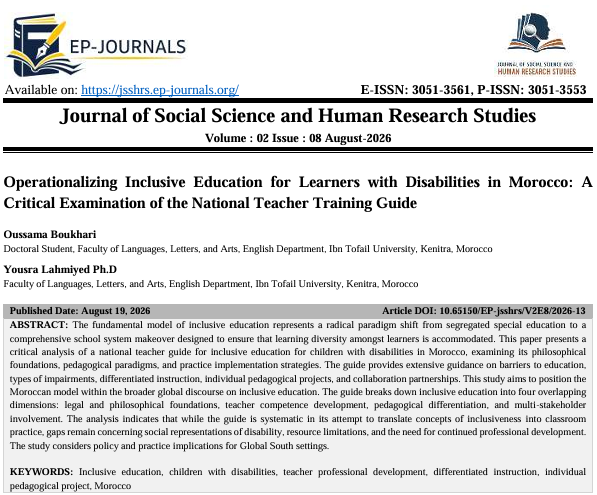
Operationalizing Inclusive Education for Learners with Disabilities in Morocco: A Critical Examination of the National Teacher Training Guide
DOI:
https://doi.org/10.65150/EP-jsshrs/V2E8/2026-13Keywords:
Inclusive education, children with disabilities, teacher professional development, differentiated instruction, individual pedagogical project, MoroccoAbstract
The fundamental model of inclusive education represents a radical paradigm shift from segregated special education to a comprehensive school system makeover designed to ensure that learning diversity amongst learners is accommodated. This paper presents a critical analysis of a national teacher guide for inclusive education for children with disabilities in Morocco, examining its philosophical foundations, pedagogical paradigms, and practice implementation strategies. The guide provides extensive guidance on barriers to education, types of impairments, differentiated instruction, individual pedagogical projects, and collaboration partnerships. This study aims to position the Moroccan model within the broader global discourse on inclusive education. The guide breaks down inclusive education into four overlapping dimensions: legal and philosophical foundations, teacher competence development, pedagogical differentiation, and multi-stakeholder involvement. The analysis indicates that while the guide is systematic in its attempt to translate concepts of inclusiveness into classroom practice, gaps remain concerning social representations of disability, resource limitations, and the need for continued professional development. The study considers policy and practice implications for Global South settings.
References
1) Agence européenne pour le développement de l'éducation pour les besoins éducatifs particuliers. (2012). La formation des enseignants pour l'éducation inclusive : Profil des enseignants inclusifs. Agence européenne pour le développement de l'éducation pour les besoins éducatifs particuliers.
2) Alborno, N. E., & Gaad, E. (2014). Index for inclusion: A framework for school review in the United Arab Emirates. British Journal of Special Education, 41(3), 231-248.
3) Booth, T., & Ainscow, M. (2002). Guide de l'éducation inclusive : Développer les apprentissages et la participation dans l'école. Centre pour l'Étude de l'Éducation Inclusive.
4) Boukhari, O., & Lahmiyed, Y. (2026-a). From Policy to Practice: Transformative Leadership for Inclusive Education of Children with Disabilities in Moroccan Schools. Journal of Social Science and Human Research Studies, 2(08), 1494-1498. https://doi.org/10.65150/EP-jsshrs/V2E8/2026-12.
5) Boukhari, O., & Lahmiyed, Y. (2026-b). The Legal and Legislative Frameworks for Persons with Disabilities in Morocco: A Critical Analysis of International Commitments and National Implementation. Journal of Social Science and Human Research Studies, 2(08), 1517-1521. https://doi.org/10.65150/EP-jsshrs/V2E8/2026-15.
6) Bowen, G. A. (2009). Document analysis as a qualitative research method. Qualitative Research Journal, 9(2), 27-40.
7) Braun, V., & Clarke, V. (2006). Using thematic analysis in psychology. Qualitative Research in Psychology, 3(2), 77-101.
8) Diop, I. (2012). Handicap et représentations sociales en Afrique occidentale. Le Français aujourd'hui, 177(2), 19-27.
9) Handicap International, & Ministère de l'Éducation Nationale et de l'Alphabétisation (Burkina Faso). (2012). Manuel de formation des enseignants en éducation inclusive. Handicap International.
10) Khochen, M., & Radford, J. (2012). Attitudes of teachers and headteachers towards inclusion in Lebanon. International Journal of Inclusive Education, 16(2), 139-153.
11) Ministère de l'Éducation Nationale, de la Formation Professionnelle, de l'Enseignement Supérieur et de la Recherche Scientifique, Direction des Curricula. (2017). Al-Handasa Al-Manhajiya Li-Fa'idat Al-Atfal Fi Wad'iyat I'aqa: Al-Itar Al-Marja'i [Curricular engineering for children with disabilities: A reference framework]. Rabat, Morocco.
12) Ministère de l'Éducation Nationale, de la Formation Professionnelle, de l'Enseignement Supérieur et de la Recherche Scientifique, Direction des Curricula. (2019). L'éducation inclusive au profit des enfants en situation de handicap : Guide pour les enseignants. Royaume du Maroc.
13) Organisation des Nations Unies. (2006). Convention relative aux droits des personnes handicapées. Nations Unies.
14) UNESCO. (2017). Un guide pour assurer l'inclusion et l'équité dans l'éducation. UNESCO.
Downloads
Published
Issue
Section
License
Copyright (c) 2026 Oussama Boukhari, Yousra Lahmiyed Ph.D (Author)

This work is licensed under a Creative Commons Attribution 4.0 International License.












