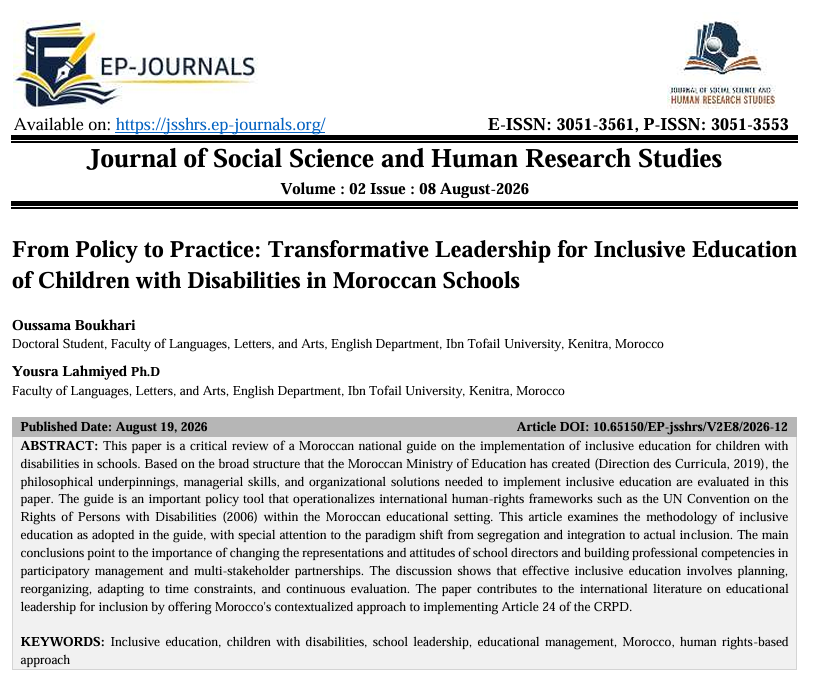
From Policy to Practice: Transformative Leadership for Inclusive Education of Children with Disabilities in Moroccan Schools
DOI:
https://doi.org/10.65150/EP-jsshrs/V2E8/2026-12Keywords:
Inclusive education, children with disabilities, school leadership, educational management, Morocco, human rights-based approachAbstract
This paper is a critical review of a Moroccan national guide on the implementation of inclusive education for children with disabilities in schools. Based on the broad structure that the Moroccan Ministry of Education has created (Direction des Curricula, 2019), the philosophical underpinnings, managerial skills, and organizational solutions needed to implement inclusive education are evaluated in this paper. The guide is an important policy tool that operationalizes international human-rights frameworks such as the UN Convention on the Rights of Persons with Disabilities (2006) within the Moroccan educational setting. This article examines the methodology of inclusive education as adopted in the guide, with special attention to the paradigm shift from segregation and integration to actual inclusion. The main conclusions point to the importance of changing the representations and attitudes of school directors and building professional competencies in participatory management and multi-stakeholder partnerships. The discussion shows that effective inclusive education involves planning, reorganizing, adapting to time constraints, and continuous evaluation. The paper contributes to the international literature on educational leadership for inclusion by offering Morocco's contextualized approach to implementing Article 24 of the CRPD.
References
1) Ainscow, M. (2005). Developing inclusive education systems: What are the levers for change? Journal of Educational Change, 6(2), 109-124.
2) Artiles, A. J., Kozleski, E. B., Dorn, S., & Christensen, C. (2006). Learning in inclusive education research: Re-mediating theory and methods with a transformative agenda. Review of Research in Education, 30(1), 65-108.
3) Avramidis, E., & Norwich, B. (2002). Teachers' attitudes towards integration/inclusion: A review of the literature. European Journal of Special Needs Education, 17(2), 129-147.
4) Boukhari, O., & Lahmiyed, Y. (2026-a). Operationalizing Inclusive Education for Learners with Disabilities in Morocco: A Critical Examination of the National Teacher Training Guide. Journal of Social Science and Human Research Studies, 2(08), 1499-1504. https://doi.org/10.65150/EP-jsshrs/V2E8/2026-13.
5) Boukhari, O., & Lahmiyed, Y. (2026-b). The Legal and Legislative Frameworks for Persons with Disabilities in Morocco: A Critical Analysis of International Commitments and National Implementation. Journal of Social Science and Human Research Studies, 2(08), 1517-1521. https://doi.org/10.65150/EP-jsshrs/V2E8/2026-15.
6) Bowen, G. A. (2009). Document analysis as a qualitative research method. Qualitative Research Journal, 9(2), 27-40.
7) Direction des Curricula. (2019). L'éducation inclusive au profit des enfants en situation de handicap: Guide pour les directeurs des établissements scolaires. Ministère de l'Éducation Nationale, de la Formation Professionnelle, de l'Enseignement Supérieur et de la Recherche Scientifique, Royaume du Maroc.
8) Florian, L., & Black-Hawkins, K. (2011). Exploring inclusive pedagogy. British Educational Research Journal, 37(5), 813-828.
9) Fullan, M. (2015). The new meaning of educational change (5th ed.). Teachers College Press.
10) Hoppey, D., & McLeskey, J. (2013). A case study of principal leadership in an effective inclusive school. The Journal of Special Education, 46(4), 245-256.
11) Moscovici, S. (1988). Notes towards a description of social representations. European Journal of Social Psychology, 18(3), 211-250.
12) Oliver, M. (1996). Understanding disability: From theory to practice. Macmillan.
13) Riehl, C. J. (2000). The principal's role in creating inclusive schools for diverse students: A review of normative, empirical, and critical literature on the practice of educational administration. Review of Educational Research, 70(1), 55-81.
14) Spillane, J. P. (2006). Distributed leadership. Jossey-Bass.
15) UNESCO. (2009). Policy guidelines on inclusion in education. UNESCO.
16) UNESCO. (2017). A guide for ensuring inclusion and equity in education. UNESCO.
17) United Nations. (2006). Convention on the Rights of Persons with Disabilities. United Nations.
18) Vygotsky, L. S. (1978). Mind in society: The development of higher psychological processes. Harvard University Press.
19) Waitoller, F. R., & Artiles, A. J. (2013). A decade of professional development research for inclusive education: A critical review and notes for a research program. Review of Educational Research, 83(3), 319-356.
Downloads
Published
Issue
Section
License
Copyright (c) 2026 Oussama Boukhari, Yousra Lahmiyed Ph.D (Author)

This work is licensed under a Creative Commons Attribution 4.0 International License.












