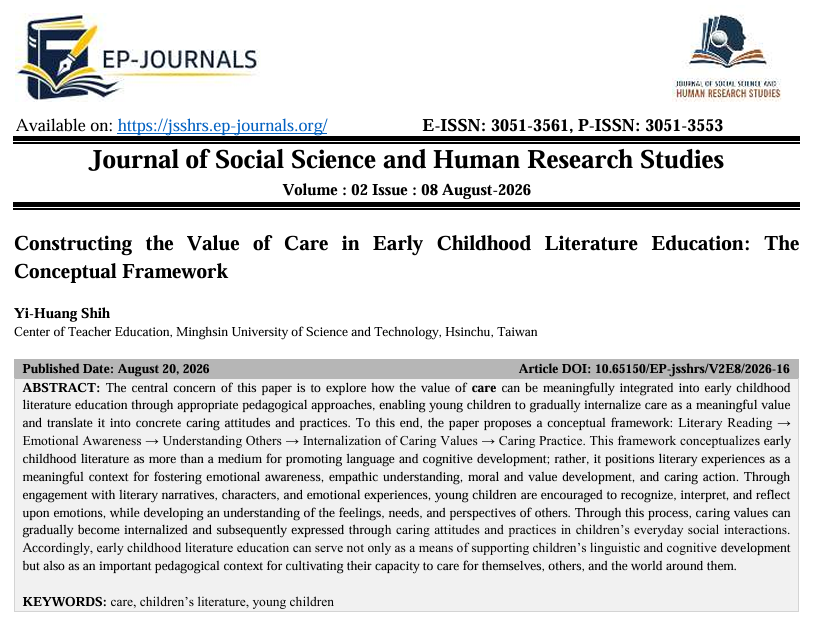
Constructing the Value of Care in Early Childhood Literature Education: The Conceptual Framework
DOI:
https://doi.org/10.65150/EP-jsshrs/V2E8/2026-16Keywords:
care, children’s literature, young childrenAbstract
The central concern of this paper is to explore how the value of care can be meaningfully integrated into early childhood literature education through appropriate pedagogical approaches, enabling young children to gradually internalize care as a meaningful value and translate it into concrete caring attitudes and practices. To this end, the paper proposes a conceptual framework: Literary Reading → Emotional Awareness → Understanding Others → Internalization of Caring Values → Caring Practice. This framework conceptualizes early childhood literature as more than a medium for promoting language and cognitive development; rather, it positions literary experiences as a meaningful context for fostering emotional awareness, empathic understanding, moral and value development, and caring action. Through engagement with literary narratives, characters, and emotional experiences, young children are encouraged to recognize, interpret, and reflect upon emotions, while developing an understanding of the feelings, needs, and perspectives of others. Through this process, caring values can gradually become internalized and subsequently expressed through caring attitudes and practices in children’s everyday social interactions. Accordingly, early childhood literature education can serve not only as a means of supporting children’s linguistic and cognitive development but also as an important pedagogical context for cultivating their capacity to care for themselves, others, and the world around them.
References
1) Dewey, J. (1934). Art as experience. Minton, Balch & Company.
2) Djikic, M., Oatley, K., & Carland, C. (2012). Genre or artistic merit? The effect of literature on personality. Scientific Study of Literature, 2(1), 62–84. https://doi.org/10.1075/ssol.2.1.06dji
3) Keen, S. (2007). Empathy and the novel. Oxford University Press. https://doi.org/10.1093/acprof:oso/9780195175769.001.0001
4) Kucirkova N (2019) How Could Children’s Storybooks Promote Empathy? A Conceptual Framework Based on Developmental Psychology and Literary Theory. Front. Psychol. 10:121. doi: 10.3389/fpsyg.2019.00121
5) Lee, F. J. (2005). Respect and care as the core of character education in schools. National Education Journal, 159, 172–185.
6) Mar, R. A., Oatley, K., Hirsh, J., de la Paz, J., & Peterson, J. B. (2006). Bookworms versus nerds: Exposure to fiction versus non-fiction, divergent associations with social ability, and the simulation of fictional social worlds. Journal of Research in Personality, 40(5), 694–712. https://doi.org/10.1016/j.jrp.2005.08.002
7) Mar, R. A., Oatley, K., & Peterson, J. B. (2009). Exploring the link between reading fiction and empathy: Ruling out individual differences and examining outcomes. Communications, 34(4), 407–428. https://doi.org/10.1515/COMM.2009.025
8) Mele, C., Russo-Spena, T., Di Bernardo, I., & Gherardi, S. (2025). Affect-Based Well-Being in Caring Practices with Companion Robots. Journal of Service Research, 0(0).
9) Miall, D. S., & Kuiken, D. (1999). What is literariness? Three components of literary reading. Discourse Processes, 28(2), 121–138. https://doi.org/10.1080/01638539909545076
10) Noddings, N. (2013). Caring: A relational approach to ethics and moral education (2nd ed.). University of California Press.
11) Nikolajeva, M. (2014). Reading for learning: Cognitive approaches to children's literature. John Benjamins.
12) Noddings, N. (1986). Caring: A feminine approach to ethics and moral education. University of California Press.
13) Noddings, N. (2002). Starting at home: Caring and social policy. University of California Press.
14) Oatley, K. (2016). Fiction: Simulation of social worlds. Trends in Cognitive Sciences, 20(8), 618–628. https://doi.org/10.1016/j.tics.2016.06.002
15) Sipe, L. R. (2008). Storytime: Young children's literary understanding in the classroom. Teachers College Press.
16) Shih, Y. H. (2024). Children’s literature: A review. International Journal of Latest Research in Humanities and Social Science, 7 (11), 42-46.
17) Shih, Y. H. (2025). Multicultural literature for children: Applications of stories. RA Journal of Applied Research, 11(09), 807–810. https://doi.org/10.47191/rajar/v11i9.06
18) Shih, Y. H. (2026a). A dialogue between children’s literature and place-based education: Curriculum development in Taiwanese preschools. Journal of Social Science and Human Research Studies, 2(08), 1423-1426. https://doi.org/10.65150/EP-jsshrs/V2E8/2026-03
19) Shih, Y. H. (2026b). Fostering learning motivation among young children in Taiwan: A curriculum design perspective. Social Science and Human Research Bulletin, 3(3), 228-236.
20) Shih, Y. H. (2026c). School-based curriculum development in Taiwanese preschools: Reflections on meaning and development strategies. Social Science and Human Research Bulletin, 3(1), 47-51.
21) Shih, Y. H., & Kao, S. C. (2025). Child-centred teaching for children’s literature: The case of “Miss Rumphius”. RA Journal of Applied Research, 11(06), 461–465. https://doi.org/10.47191/rajar/v11i6.04
22) Shih, Y. H., & Kao, S. C. (2026). Life-oriented children’s literature: Its meaning, core content, and educational implications. Social Science and Human Research Bulletin, 3(7), 714-717.
23) Tu, W. M. (1985). Confucian thought: Selfhood as creative transformation. State University of New York Press.
24) UNESCO. (2021). Reimagining our futures together: A new social contract for education. UNESCO.
25) Vygotsky, L. S. (1978). Mind in society: The development of higher psychological processes. Harvard University Press.
Downloads
Published
Issue
Section
License
Copyright (c) 2026 Yi-Huang Shih (Author)

This work is licensed under a Creative Commons Attribution 4.0 International License.












