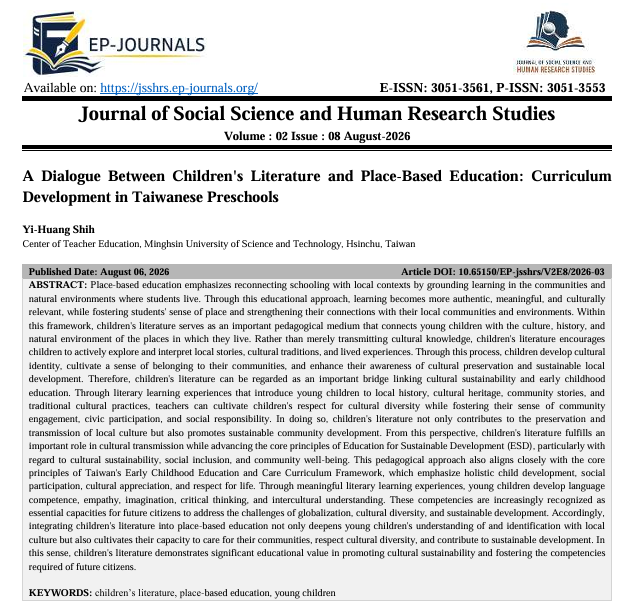
A Dialogue Between Children's Literature and Place-Based Education: Curriculum Development in Taiwanese Preschools
DOI:
https://doi.org/10.65150/EP-jsshrs/V2E8/2026-03Keywords:
children’s literature, place-based education, young childrenAbstract
Place-based education emphasizes reconnecting schooling with local contexts by grounding learning in the communities and natural environments where students live. Through this educational approach, learning becomes more authentic, meaningful, and culturally relevant, while fostering students' sense of place and strengthening their connections with their local communities and environments. Within this framework, children's literature serves as an important pedagogical medium that connects young children with the culture, history, and natural environment of the places in which they live. Rather than merely transmitting cultural knowledge, children's literature encourages children to actively explore and interpret local stories, cultural traditions, and lived experiences. Through this process, children develop cultural identity, cultivate a sense of belonging to their communities, and enhance their awareness of cultural preservation and sustainable local development. Therefore, children's literature can be regarded as an important bridge linking cultural sustainability and early childhood education. Through literary learning experiences that introduce young children to local history, cultural heritage, community stories, and traditional cultural practices, teachers can cultivate children's respect for cultural diversity while fostering their sense of community engagement, civic participation, and social responsibility. In doing so, children's literature not only contributes to the preservation and transmission of local culture but also promotes sustainable community development. From this perspective, children's literature fulfills an important role in cultural transmission while advancing the core principles of Education for Sustainable Development (ESD), particularly with regard to cultural sustainability, social inclusion, and community well-being. This pedagogical approach also aligns closely with the core principles of Taiwan's Early Childhood Education and Care Curriculum Framework, which emphasize holistic child development, social participation, cultural appreciation, and respect for life. Through meaningful literary learning experiences, young children develop language competence, empathy, imagination, critical thinking, and intercultural understanding. These competencies are increasingly recognized as essential capacities for future citizens to address the challenges of globalization, cultural diversity, and sustainable development. Accordingly, integrating children's literature into place-based education not only deepens young children's understanding of and identification with local culture but also cultivates their capacity to care for their communities, respect cultural diversity, and contribute to sustainable development. In this sense, children's literature demonstrates significant educational value in promoting cultural sustainability and fostering the competencies required of future citizens.
References
1) Banks, J. A. (2015). Cultural diversity and education: Foundations, curriculum, and teaching. New York: Routledge.
2) Bishop, R. S (1990) Mirrors, Windows, and Sliding Glass Doors. Perspectives: A Review Journal of the Cooperative Services for Children's Literature. 6(3), ix-xi.
3) Bruner, J. (1996). The culture of education. Harvard University Press.
4) Butzow, C. M., & Butzow, J. W. (1989). Science through children's literature: An integrated approach (through children's literature) . Englewood, CO: Teacher Ideas Press.
5) Butzow, C. M., & Butzow, J. W. (1999). Exploring the environment through children's literature. Englewood, CO: Teacher Ideas Press.
6) Chen, M. K., & Shih, Y. H. (2025). The role of higher education in sustainable national development: Reflections froman international perspective. Edelweiss Applied Science and Technology, 9(4), 1343–1351. https://doi.org/10.55214/25768484.v9i4.6262
7) Dewey, J. (1938). Experience and education. Macmillan.
8) Gay, G. (2018). Culturally responsive teaching: Theory, research, and practice (3rd ed.). New York: Teachers College Press.
9) Cajete, G. (1994). Look to the mountain: An ecology of indigenous education. Kivaki Press.
10) Ministry of Education (2017). The early childhood education and care curriculum framework. Taipei: Ministry of Education.
11) Nikolajeva, M. (2014). Reading for Learning: Cognitive Approaches to Children's Literature. Amsterdam: John Benjamins.
12) Piaget, J. (1952). The origins of intelligence in children. International Universities Press.
13) Piaget, J. (1972). The psychology of the child. Basic Books.
14) Shavit, Z. (1986). Poetics of children's literature. University of Georgia Press
15) Shih, Y. H. (2022). Designing culturally responsive education strategies to cultivate young children’s cultural identities: A case study of the development of a preschool local culture curriculum. Children, 9(12), 1789. https://doi.org/10.3390/children9121789 en/global-citizenship-peace-education/recommendation
16) Shih, Y. H. (2024a). An analysis on the benefits of incorporating cultural relevance in curriculum development. International Journal of Latest Research in Humanities and Social Science, 7(9), 4-7.
17) Shih, Y. H. (2024b). Culturally responsive curriculum: A systematic overview. Edelweiss Applied Science and Technology, 8(6), 6917–6925. https://doi.org/10.55214/25768484.v8i6.3493
18) Shih, Y. H. (2024c). An analysis on the benefits of incorporating cultural relevance in curriculum development. International Journal of Latest Research in Humanities and Social Science, 7(9), 4-7.
19) Shih, Y. H. (2024d). The local culture curriculum development in Taiwan’s elementary schools:Perspectives derived from Gregory A. Smith’s concept of place-based education. International Journal of Latest Research in Humanities and Social Science, 7(9), 82-86.
20) Sipe, L. R. (2007). Storytime: Young Children's Literary Understanding in the Classroom. Teachers College Press.
21) Smith, G. A. (2002). Place-based education: Learning to be where we are. Phi Delta Kappan, 83 (8), 584-594.
https://doi.org/10.1177/003172170208300806
22) Smith, G. A., & Sobel, D. (2010). Place- and community-based education in schools. New York :Routledge.
23) Smith, G. A., & Williams, D. R. (Eds.). (1999). Ecological education in action: On weaving education, culture, and the environment. Albany, NY: State University of New York Press.
24) Sobel, D. (2004). Place-based education: Connecting classrooms and communities. Orion Society.
25) UNESCO. (2026). Global citizenship and peace education. https://www.unesco.org/
26) UNESCO. (2020). Education for sustainable development: A roadmap. UNESCO.
27) UNESCO. (2023). Greening education partnership: Getting every learner climate-ready. UNESCO.
28) Vygotsky, L. S. (1978). Mind in society: The development of higher psychological processes. Harvard University Press.
29) Wang, R. J., & Shih, Y. H. (2022). Improving the quality of teacher education for sustainable development of Taiwan's education system: A systematic review on the research issues of teacher education after the implementation of 12-year national basic education. Front. Psychol. 13:921839. doi: 10.3389/fpsyg.2022.921839
30) Wang, R. J., & Shih, Y. H. (2023). What are universities pursuing? A review of the Quacquarelli Symonds world university rankings of Taiwanese universities (2021–2023). Front. Educ. 8:1185817. doi: 10.3389/feduc.2023.1185817
Downloads
Published
Issue
Section
License
Copyright (c) 2026 Yi-Huang Shih (Author)

This work is licensed under a Creative Commons Attribution 4.0 International License.