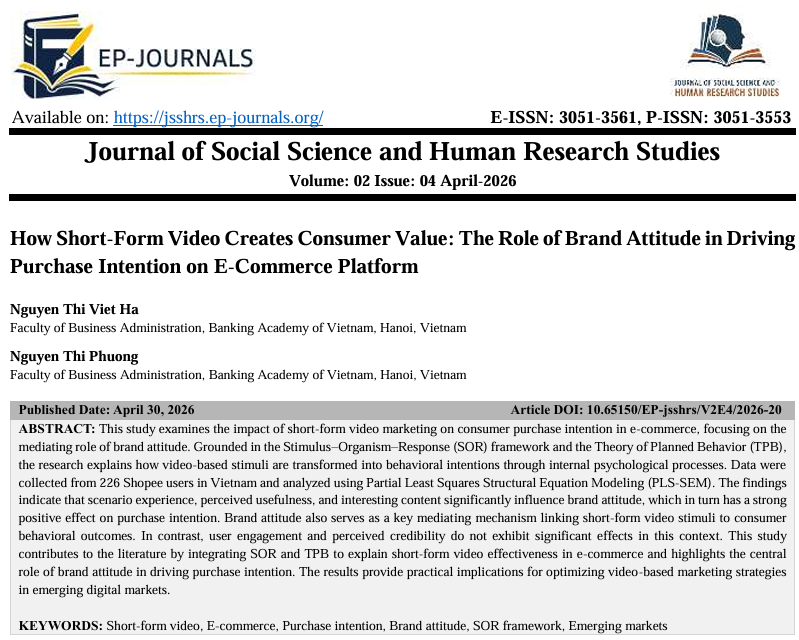
How Short-Form Video Creates Consumer Value: The Role of Brand Attitude in Driving Purchase Intention on E-Commerce Platform
DOI:
https://doi.org/10.65150/EP-jsshrs/V2E4/2026-20Keywords:
Short-form video, E-commerce, Purchase intention, Brand attitude, SOR framework, Emerging marketsAbstract
This study examines the impact of short-form video marketing on consumer purchase intention in e-commerce, focusing on the mediating role of brand attitude. Grounded in the Stimulus–Organism–Response (SOR) framework and the Theory of Planned Behavior (TPB), the research explains how video-based stimuli are transformed into behavioral intentions through internal psychological processes. Data were collected from 226 Shopee users in Vietnam and analyzed using Partial Least Squares Structural Equation Modeling (PLS-SEM). The findings indicate that scenario experience, perceived usefulness, and interesting content significantly influence brand attitude, which in turn has a strong positive effect on purchase intention. Brand attitude also serves as a key mediating mechanism linking short-form video stimuli to consumer behavioral outcomes. In contrast, user engagement and perceived credibility do not exhibit significant effects in this context. This study contributes to the literature by integrating SOR and TPB to explain short-form video effectiveness in e-commerce and highlights the central role of brand attitude in driving purchase intention. The results provide practical implications for optimizing video-based marketing strategies in emerging digital markets.
References
1) Ajzen, I. (1991). The theory of planned behavior. Organizational Behavior and Human Decision Processes, 50(2), 179–211.
https://doi.org/10.1016/0749-5978(91)90020-t
2) Bagozzi, R. P., & Yi, Y. (1988). On the evaluation of structural equation models. Journal of the Academy of Marketing Science, 16(1), 74–94.
3) Black, W. C., Babin, B. J., Anderson, R. E., & Tatham, R. L. (2005). Multivariate Data Analysis (6th ed.). Pearson.
4) Chin, W.W. (1998) The Partial Least Squares Approach to Structural Equation Modeling. Modern Methods for Business Research, 2, 295-336.
5) Davis, F. D. (1989). Perceived usefulness, perceived ease of use, and Journ acceptance of information technology. MIS Quarterly,13(3), 319-340.
6) Ducoffe, R. H. (1996). Advertising Value and Advertising on the Web. Journal of Advertising Research, 36, 21-35.
7) Fornell, C., & Larcker, D. F. (1981). Evaluating structural equation models with unobservable variables and measurement error. Journal of Marketing Research, 18(1), 39–50.
8) Goldsmith, R. E., & Horowitz, D. (2006). Measuring motivations for online opinion seeking. Journal of Interactive Advertising, 6(2), 3–14.
9) Hair, J. F., Black, W. C., Babin, B. J., & Anderson, R. E. (2014). Multivariate Data Analysis (7th ed.). Pearson.
10) Hair, J. F., Howard, M. C., & Nitzl, C. (2020). Assessing measurement model quality in PLS-SEM. Organizational Research Methods, 23(3), 1–24.
11) Hair, J. F., Hult, G. T. M., Ringle, C. M., & Sarstedt, M. (2017). A Primer on Partial Least Squares Structural Equation Modeling (PLS-SEM). Sage.
12) Hair, J. F., Risher, J. J., Sarstedt, M., & Ringle, C. M. (2019). When to use and how to report the results of PLS-SEM. Journal of the Academy of Marketing Science, 47(1), 2–31.
13) Henseler, J., Ringle, C. M., & Sinkovics, R. R. (2009). The use of partial least squares path modeling in international marketing. Advances in International Marketing, 20, 277–319.
14) Hewei T (2022) Factors affecting clothing purchase intention in mobile short video app: Mediation of perceived value and immersion experience. PLoS ONE 17(9): e0273968. https:// doi.org/10.1371/journal.pone.0273968
15) Hock, M., & Christian M. Ringle (2010). Strategic networks in the software industry: An empirical analysis of the value continuum.
16) Hussain, S., Song, X., & Niu, B. (2022). Consumers' motivational involvement in eWOM for information adoption: The mediating role of organizational motives. Journal of Retailing and Consumer Services, 64, 102742.
17) Kim, J. H., & Jang, S. S. (2014). A scenario-based experiment and a field study: A comparative examination for service failure and recovery. International Journal of Hospitality Management,41(August),125-132.
18) Le, H. T. T. (2024). From AI recommendations to purchase intention: Exploring consumer psychology in the Vietnamese e-commerce market.
19) Liu, G. F., Gao, P. C., Li, Y. C., & Zhang, Z. P. (2019). Research on the influence of social media short video marketing on consumer brand attitude. International Conference on Social Science and Higher Education, 433-438.
20) Liu, Q., & Wang, Z. (2023). The effect of short video content marketing on consumer purchase intention: sellersOctober 2023, Frontiers in Business Economics and Management 11(3):1-5, DOI:10.54097/fbem.v11i3.12934
21) Luo, X., Zhang, J., Wang, Y., & Li, H. (2025). The impact of short-form video content on consumer purchase intention: The mediating role of trust. Scientific Reports, 15, Article 94994. https://doi.org/10.1038/s41598-025-94994-z
22) McQuail, D. (2010). McQuail's mass communication theory. Thousand Oaks, CA:Sage Publications.
23) Mehrabian, A., & Russell, J. A. (1974). An approach to environmental psychology. Washington, WA: The MIT Press.
24) Meng, F., Wang, Y., & Chen, X. (2024). How short-form video marketing influences consumer behavior: Evidence from e-commerce platforms. Journal of Business Research, 183, 114874. https://doi.org/10.1016/j.jbusres.2024.114874
25) Mir, I. A., & your Rehman, K. (2013). Factors affecting consumer attitudes and intentions toward user-generated product content on YouTube. Management & Marketing,8(4),637-654.
26) Mir, I., & Zaheer, A. (2012). Verification of social impact theory claims in social media context. Journal of Internet Banking and Commerce,17(1), 1-15.
27) Ngo, T. T. A., Quach, P., Nguyen, T. V., Nguyen, A. D., & Nguyen, T. M. N. (2023). Short video marketing factors influencing the purchase intention of Generation Z in Vietnam. Innovative Marketing, 19(3), 34–50. https://doi.org/10.21511/im.19(3).2023.04
28) Nguyen, H. T. (2024). A study on the use of digital marketing tools and strategies in Vietnamese businesses. Industry and Trade Journal
29) Nguyen, T. M. H., Nguyen, H. T. T., & Tran, Q. N. (2023).The influence of TikTok content on Generation Z’s purchase intention in Vietnam. UEF Journal of Business and Economics, 8(5), 45–60.
30) Nunnally, J. C., & Bernstein, I. H. (1994). Psychometric Theory (3rd ed.). McGraw-Hill.
31) Pavlou, P. A., & Fygenson, M. (2006). Understanding and predicting electronic commerce adoption: An extension of the theory of planned behavior. MIS Quarterly, 30(1), 115-143.
32) Ringle, C. M., Wende, S., & Becker, J. M. (2017). SmartPLS 3. SmartPLS GmbH.
33) Sarstedt, M., Ringle, C. M., & Hair, J. F. (2022). Partial Least Squares Structural Equation Modeling. Journal of the Academy of Marketing Science.
34) Shen, Y., Li, X., & Guo, L. (2024). Understanding consumer responses to short-form video marketing: An SOR perspective. Humanities and Social Sciences Communications, 11, 2808. https://doi.org/10.1057/s41599-024-02808-w
35) Spears, N., & Singh, S. N. (2004). Measuring attitude toward the brand and purchase intentions. Journal of Current Issues & Research in Advertising, 26(2), 53-66.
36) Sun, Y., Shao, X., Li, X., Guo, Y., & Nie, K. (2019). How live streaming influences purchase intentions in social commerce: An IT affordance perspective. Electronic Commerce Research and Applications, 37, 100886.
https://doi.org/10.1016/j.elerap.2019.100886
37) Thao, H. T. P., & Hai, T. N. H. (2024). The impact of short video marketing on the intention to buy fashion goods online of Generation Y and Z. JOURNAL OF SCIENCE OF THE OPEN UNIVERSITY OF HO CHI MINH CITY - ECONOMICS AND BUSINESS ADMINISTRATION, 19(10), 22–36. https://doi.org/10.46223/hcmcoujs.econ.vi.19.10.3073.2024.
38) Wang, Y., & Sun, S. (2010). Examining the role of beliefs and attitudes in online advertising: A comparison between the USA and Romania. Journal of Current Issues & Research in Advertising, 32(1), 87–107.
39) Wu, T., & Su, Y. (2025).How does short-form video marketing influence consumers’ purchase intention? The roles of emotional resonance, perceived value, and trust. Environment and Social Psychology, 10(11). https://doi.org/10.59429/esp.v10i11.4196
40) Yüksel, H. F. (2016). Factors affecting purchase intention in YouTube videos. The Journal of Knowledge Economy & Knowledge Management,11(2), 33-47.
Downloads
Published
Issue
Section
License
Copyright (c) 2026 Nguyen Thi Viet Ha, Nguyen Thi Phuong (Author)

This work is licensed under a Creative Commons Attribution 4.0 International License.