Effectiveness of Visual Content on Social Media Marketing
DOI:
https://doi.org/10.65150/EP-jsshrs/V2E3/2026-04Keywords:
customer response index, digital promotion, social media marketing, visual content, InstagramAbstract
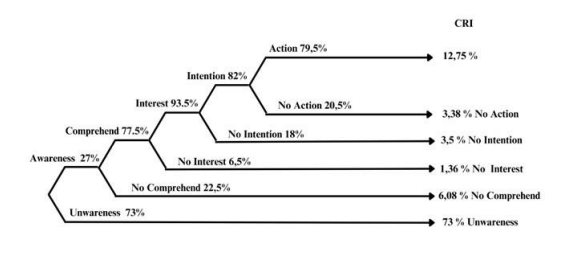
This study aims to find out and analyze how effective visual content is in promotion strategies in the Industrial Revolution Era 4.0 on Instagram @Beanspot_id as well as knowing the respondents' responses about the level of awareness, comprehension, intention, interest, action on visual content in promotional strategies on Instagram @beanspot_id. This study used a quantitative method with a case study approach and a positivism paradigm. Data was obtained through the method of distributing online questionnaires, namely the Google Form which was carried out to 100 respondents with the criteria, namely followers of the Instagram account @beanspot_id. The results of this study reveal that through calculations using the Customer Response Index (CRI) method, which measures the effectiveness of visual content in promotional strategies in the industrial revolution era 4.0 on Instagram @beanspot_id, is less effective. The recommendation for Beanspot, especially the marketing team, to be able to explore more creative ideas and optimize more in terms of visualization so that they can attract new followers then increase the brand awareness, as well as the sales, especially on social media. For the development of further research, researchers provide suggestions using the CRI method on the Instagram Beanspot, which was declared to be ineffective, this could occur because of several factors, one of which is because there is a lot of competition via Instagram which is quite tight for similar coffee to go brands. Thus, the researcher’s suggestion for Beanspot, especially the marketing team, is to be able to explore more creative ideas and optimize more in terms of visualization such as making quizzes with prizes that can attract new followers to increase brand awareness as well as being able to develop sales, especially on social media.
References
1) Aiwan, T. Y. (2013). Efektivitas Pesan Iklan Televisi Tresemme Menggunakan Customer Response Index (CRI) pada Perempuan di Surabaya (The Effectiveness of Tresemme Television Advertising Messages Using the Customer Response Index (CRI) for Women in Surabaya). Jurnal E-Komunikasi, 1(2), 298-307. https://publication.petra.ac.id/index.php/ilmu-komunikasi/article/view/914/814.
2) Arnetta. (2022). Pentingnya Desain Konten Media Sosial, Amalia Nanda: Desain Visual Adalah Wajah Terdepan Sebuah Bisnis (The Importance of Social Media Content Design, Amalia Nanda: Visual Design is the Front Face of a Business).
https://dailysocial.id/post/desain-konten-media-sosial-umkm.
3) Bevins, C. (2014, May). Get Schooled: A Visual Social Semiotic Analysis of Target’s Branding using Instagram. Master Theses. Paper 327. https://digitalcommons.liberty.edu/cgi/viewcontent.cgi?article=1329&context=masters.
4) Best, R. (2012). Market Based Management Strategies for Growing Customer Value and Profitability. 6th ed. New Jersey: Prentice Hall.
5) Caples, J. (1997). Tested Advertising Method. Fifth Edition. Prentice Hall.
6) Caroline Saskia. (2023). 10 Medsos Paling Banyak di Download di Indonesia, Tiktok Teratas (10 Most Downloaded Social Media in Indonesia, top Tiktok). https://tekno.kompas.com/read/2023/01/17/18030007/10-medsos-paling-banyak-di-download-di-indonesia-tiktok-teratas.
7) Chaffey, D. (2013). Definitions of E-marketing vs Internet vs Digital Marketing. Smart Insight Blog, February 16.
8) Chaffey, D., and Ellis-Chadwick, F. (2019). Digital marketing. UK: Pearson.
9) Colley, R. H. (1961). DAGMAR (Defining Advertising Goals for Measured Advertising Result). New York: Association of Nation Advertiser.
10) Durianto, D., et.al. (2003). Invasi Pasar dengan Iklan yang Efektif Strategi, Program dan Teknik Pengukuran (Market Invasion with Effective Advertising Strategies, Programs and Measurement Techniques). Jakarta: Gramedia.
11) Effendy, O. U. (2002). Hubungan Masyarakat: Suatu Studi Komunikologis (Public Relations: A Communicological Study). Bandung: Remaja Rosdakarya.
12) Fuchs, C. (2018). Industry 4.0: The Digital German Ideology. TripleC, 16(1): 280–28.
https://www.triple-c.at/index.php/tripleC/article/view/1010.
13) Grossman, R. P., and Brian, D. (Spring 1998). The Persistence of Classically Conditioned Brand Attitudes. Journal of Advertising, 27(1): 23-31. http://dx.doi.org/10.1080/00913367.1998.10673540.
14) Gunawan, I. (2014). Metode Penelitian Kualitatif (Qualitative Research Method). Surabaya: Bumi Aksara.
15) Haidar, N. F., and Martadi. (2021). Analisis Konten Visual Post Instagram Riliv dalam Membentuk Customer Engagement (Riliv Instagram Post Visual Content Analysis in Forming Customer Engagement). Jurnal Barik, 2(2): 121-134.
https://ejournal.unesa.ac.id/index.php/JDKV/article/view/41181.
16) Halvorson, K. (2010). Content Strategy for The Web. New Riders: Berkeley
17) Handoko. (2006). Pengantar Manajemen (Management Intraduction). Jakarta: Gramedia.
18) Hird, C. (2013). Social Media Marketing: A Best Practices Analysis of Selected Destination Magazines.
19) Huey, L. S., and Yazdanifard, R. (2014). How Instagram can be Used as a Tool in Social Network Marketing. Center for Southern New Hampshire University (SNHU), 7(4): 122-124.
20) Kurniawan, R. (2016). Analisis Regresi (Regression Analysis). Jakarta: Prenada Media.
21) Lavidge, R. J., and Gary A. S. (1961). A Model for Predictive Measurements of Advertising Effectiveness. Journal of Marketing, 25(October): 59-62. https://www.scirp.org/(S(i43dyn45teexjx455qlt3d2q))/reference/ReferencesPapers.aspx?ReferenceID=1227650.
22) Manic, M. (2015). Marketing engagement through visual content. Bulletin of the Transilvania University of Brasov. Economic Sciences, 8(2): 89-94. https://www.researchgate.net/publication/290084483.
23) Páramo, Á. J. L., García, Á. H., & Peláez, J. C. (2021). Modelling E-mail Marketing Effectiveness–an Approach based on the Theory of Hierarchy-of-Effects. Cuadernos de Gestión, 21(1). DOI: http://10.5295/cdg.191094ah.
24) Porsayev, G. The Perspectives of the Digital Marketing. International Journal on Economics, Finance and Sustainable Development, 2(12), 1-5. https://doi.org/10.31149/ijefsd.v2i12.1008.
25) Ranjbarian, B., Abdollahi, S. M., and Khorsandnejad, A. (2011). The Impact of Brand Equity on Advertising Effectiveness (Samsung and Snowa brand names as a case study). Interdiscpilnary Journal of Contemporary Research in Business, 3(5): 229-238. https://journal-archieves8.webs.com/229-238.pdf.
26) Saravanakumar, M. and Lakshmi, T. (2012). Social media marketing. Life Science Journal, 9(4): 4444-4451.
https://www.lifesciencesite.com/lsj/life0904/670_13061life0904_4444_4451.pdf.
27) Schwab, K. (2016). The Global Competitiveness Report 2016- 2017. Geneva: World Economic Forum. https://www.weforum.org.
28) Shimp, A. T. (2003). Periklanan Promosi dan Aspek Tambahan Komunikasi Pemasaran Terpadu (Promotional Advertising and Additional Aspects of Integrated Marketing Communications). Jakarta: Erlangga.
29) Simarmata, J. (2010). Rekayasa Perangkat Lunak (Software Engineering). Yogyakarta: Andi Publisher.
30) Sudjana, N., and Ibrahim (1989). Penelitian Kualitatif dan Kuantitatif (Qualitative and Quantitative Research). Bandung: Sinar Baru.
31) Sujarweni, V. W. (2014). Metodologi Penelitian (Research methodology). Yogyakarta: Pustaka Baru Press.
Downloads
Published
Issue
Section
License
Copyright (c) 2026 Tuti Widiastuti , Sukmariani Vionnisa (Author)

This work is licensed under a Creative Commons Attribution 4.0 International License.