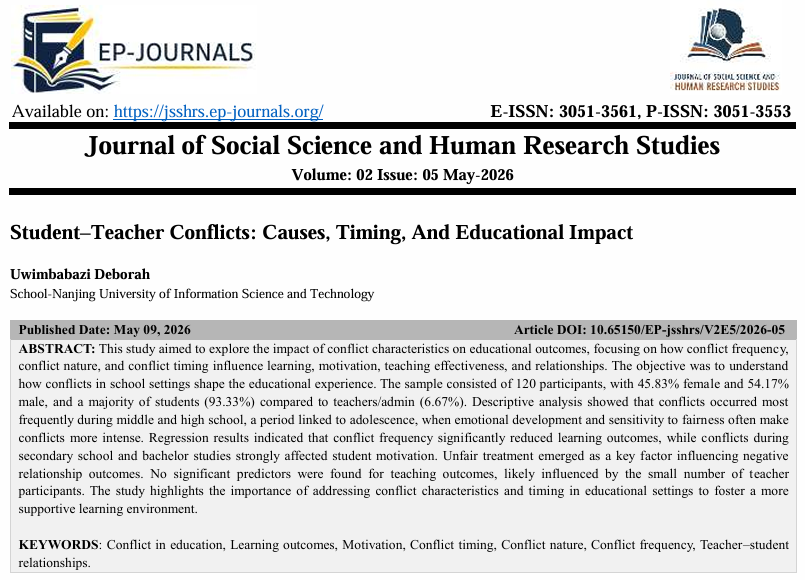
Student–Teacher Conflicts: Causes, Timing, And Educational Impact
DOI:
https://doi.org/10.65150/EP-jsshrs/V2E5/2026-05Keywords:
Conflict in education, Learning outcomes, Motivation, Conflict timing, Conflict nature, Conflict frequency, Teacher–student relationships.Abstract
This study aimed to explore the impact of conflict characteristics on educational outcomes, focusing on how conflict frequency, conflict nature, and conflict timing influence learning, motivation, teaching effectiveness, and relationships. The objective was to understand how conflicts in school settings shape the educational experience. The sample consisted of 120 participants, with 45.83% female and 54.17% male, and a majority of students (93.33%) compared to teachers/admin (6.67%). Descriptive analysis showed that conflicts occurred most frequently during middle and high school, a period linked to adolescence, when emotional development and sensitivity to fairness often make conflicts more intense. Regression results indicated that conflict frequency significantly reduced learning outcomes, while conflicts during secondary school and bachelor studies strongly affected student motivation. Unfair treatment emerged as a key factor influencing negative relationship outcomes. No significant predictors were found for teaching outcomes, likely influenced by the small number of teacher participants. The study highlights the importance of addressing conflict characteristics and timing in educational settings to foster a more supportive learning environment.
References
1) Bickmore, K. (2002). Good training? Conflict resolution and gender in Canadian schools. McGill Journal of Education, 37(3), pp.223-245.
2) Bickmore, K. (2024). Emotional intelligence and conflict management in the classroom. Frontiers in Education, 9, pp.1–15.
3) Chen, X., Wang, Y., Li, X. and Zhang, Z. (2024). Effect of teacher–student relationship on academic engagement. Frontiers in Psychology, 15, pp.1–12.
4) Deutsch, M. (1973). The resolution of conflict: Constructive and destructive processes. Yale University Press.
5) Fang, Y. (2021). The teacher–student conflict and its educational implications. Open Journal of Social Sciences, 9, pp.348–366.
6) Gregory, A. and Weinstein, R.S. (2008). The discipline gap and African Americans: Defiance or cooperation in the high school classroom. Journal of School Psychology, 46(4), pp.455-475.
7) Gregory, A., Cornell, D. and Fan, X. (2010). The relationship of school structure and support to suspension rates for Black and White high school students. American Educational Research Journal, 48(4), pp.904-934.
8) Laursen, B., Coy, K.C. and Collins, W.A. (1998). Reconsidering changes in parent-child conflict across adolescence: A meta-analysis. Child Development, 69(3), pp.817-832.
9) Peng, J., Huang, F. and Li, R. (2025). Teacher–student relationships as a pathway to sustainable learning. Journal of Educational Psychology, 117(2), pp.327–340.
10) Rahim, M.A. (2002). Toward a theory of managing organizational conflict. International Journal of Conflict Management, 13(3), pp.206-235.
11) Sava, F.A. (2002). Causes and effects of teacher conflict-inducing attitudes towards pupils: A path analysis model. Teaching and Teacher Education, 18(8), pp.1007-1021.
12) Sellman, E. (2011). Peer mediation services for conflict resolution in schools: What transformations in activity characterize successful implementation? British Educational Research Journal, 37(1), pp.45-60.
13) Tyler, T.R. and Blader, S.L. (2003). The group engagement model: Procedural justice, social identity, and cooperative behavior. Personality and Social Psychology Review, 7(4), pp.349-361.
14) Van Petegem, K., Aelterman, A., Van Keer, H. and Rosseel, Y. (2005). The influence of student characteristics and interpersonal teacher behaviour in the classroom on student’s wellbeing. Social Indicators Research, 73(1), pp.85-108.
15) Wang, Y., Zhang, L., Li, H. and Xu, J. (2023). Moderating effect of teacher–student support and conflict on learning motivation. Educational Psychology Review, 35(3), pp.467–483.
Downloads
Published
Issue
Section
License
Copyright (c) 2026 Uwimbabazi Deborah (Author)

This work is licensed under a Creative Commons Attribution 4.0 International License.